ZCode Goes Open Source: A Critical Turning Point After Security Incident

ZCode goes open source after a security scandal, backed by dual third-party audits and a bug bounty program.
AI coding tool ZCode has announced a full open-source release in direct response to community-reported security concerns — specifically that its Repo Wiki feature may have silently uploaded local repository snapshots to the cloud. The team apologized, removed the feature in v3.14.0, and commissioned independent audits from CAICT and NSFOCUS, both of which confirmed the production OSS bucket was cleared and no file exfiltration paths remain. The open-source release covers the desktop client, web workspace, backend, Agent CLI, and runtime, enabling full community audits of data flows. A bug bounty program has also been established to shift security oversight from internal self-review to community-maintained accountability.
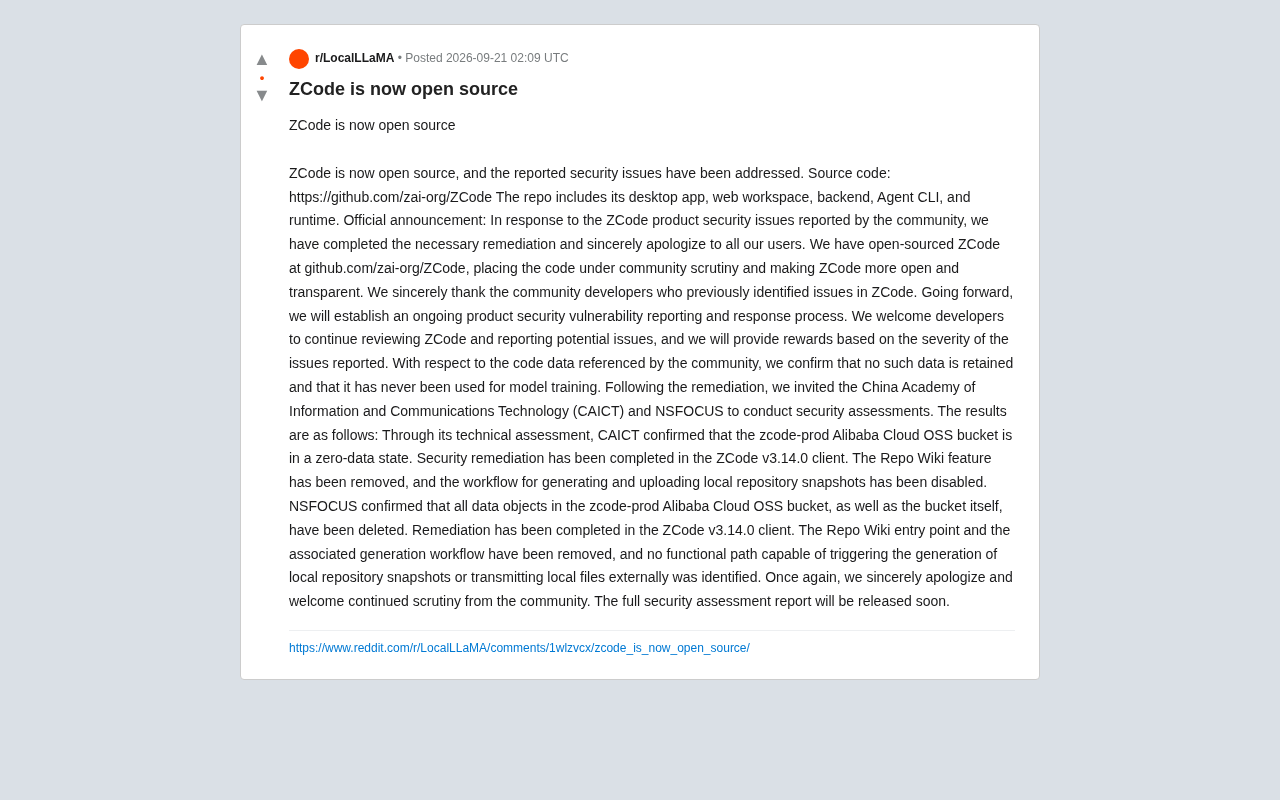
AI coding tool ZCode has announced a full open-source release, following a security controversy raised by the community. The team confirmed that production environment data has been deleted, local repository snapshot uploads have been disabled, and third-party security assessments have been completed by CAICT and NSFOCUS. A vulnerability bounty program has also been established. The source code is now hosted at github.com/zai-org/ZCode, covering core components including the desktop client, web workspace, backend services, Agent CLI, and runtime.
From Security Controversy to Full Open Source
ZCode's decision to go open source wasn't a routine product strategy shift — it was a direct response to security issues previously surfaced by the community. In their official statement, the team acknowledged the security vulnerabilities and apologized to users. By placing all code under community oversight, they chose openness and transparency as the path to rebuilding trust.
Also notable is the team's explicit stance on data handling: in response to community concerns about code data, the team confirmed that no user data was ever retained or used for model training. This is a particularly sensitive issue given that AI coding tools commonly involve local code uploads — developers' biggest fear is that their private code is quietly collected and fed into training pipelines.
The scope of the open-source release is comprehensive. Rather than just releasing a client-side shell, it includes the backend and runtime as well. This means community developers can theoretically conduct a full audit of data flows and independently verify the team's claims, rather than relying solely on their word.
Third-Party Security Assessment Results
To strengthen their case, the ZCode team invited two institutions to conduct security assessments after completing the remediation: the China Academy of Information and Communications Technology (CAICT) and NSFOCUS. Both assessments pointed in the same direction:
CAICT's Assessment
CAICT confirmed through technical evaluation that the zcode-prod Alibaba Cloud OSS bucket used in the production environment contains zero data. The ZCode v3.14.0 client has completed its security remediation — the Repo Wiki feature has been removed, and the workflow that generated and uploaded local repository snapshots has been disabled.
CAICT (China Academy of Information and Communications Technology) is a national-level technical research institution directly under the Ministry of Industry and Information Technology. It plays a long-standing role in setting standards, conducting certification and testing, and carrying out policy research in the information and communications sector. Security assessment reports issued by CAICT carry a degree of official authority in China and are commonly used by companies to demonstrate compliance to regulators and users. Choosing CAICT over a purely commercial security firm was partly a deliberate move to leverage the institution's credibility and add weight to the findings.
NSFOCUS's Assessment
NSFOCUS reached an even more definitive conclusion: all data objects in the zcode-prod bucket, along with the bucket itself, have been deleted. The remediation was completed in v3.14.0 — the Repo Wiki entry and its associated generation workflow were removed, and no functional paths capable of triggering local repository snapshot generation or exfiltrating local files to external destinations were found.
The cross-validation from two independent institutions is essentially a direct answer to the core dispute: whether local code was being uploaded. The crux of the original concern was that features like Repo Wiki could silently upload local repository snapshots to the cloud without user knowledge. The remediation addresses this at the functional level, cutting off that pathway entirely.
Establishing a Long-Term Vulnerability Response Program
Beyond the one-time remediation, ZCode has committed to building an ongoing process for reporting and responding to product security vulnerabilities. The team says it welcomes developers to continue reviewing the code and submitting potential issues, with rewards offered based on severity.
This kind of bug bounty program is common in mature open-source projects, but for a product that has just gone through a trust crisis, it sends a clear signal: security is no longer a self-audit behind closed doors, but something maintained collectively by the community. The team also mentioned that the full security assessment report will be published at a later date.
A Bug Bounty Program is a mechanism where a company publicly solicits vulnerability reports from independent security researchers and pays rewards based on severity. Typical grading standards reference CVSS (Common Vulnerability Scoring System), with reward amounts varying by orders of magnitude — from low-severity information disclosure issues to critical remote code execution vulnerabilities. Google, Microsoft, and major projects on HackerOne all run mature bounty programs. For open-source projects, bounty programs incentivize capable researchers to report privately discovered vulnerabilities through responsible disclosure rather than exploiting them publicly or selling them on the black market, turning external security scrutiny into a continuous, constructive input for the product.
What This Incident Reveals
ZCode's response offers a useful reference case: when faced with a security controversy, rather than downplaying the issue, the team responded head-on with a combination of open sourcing, third-party audits, data deletion, and a bounty program.
For developers using AI coding tools, this incident is also a reminder — the privacy boundaries around local code deserve ongoing attention. Any tool that claims to run locally but still interacts with the cloud should be transparent about its data flows. By disabling local snapshot uploads at the functional level and having third parties confirm the storage bucket has been cleared, ZCode has moved "we don't collect your data" from a promise to a verifiable technical fact.
That said, open-sourcing the code and obtaining third-party assessments do increase transparency, but the real test will come over time. Whether the community can sustain long-term scrutiny to continuously verify security, and whether the promised vulnerability response program actually delivers, will be the true measures of whether ZCode successfully rebuilds trust. The full assessment report has yet to be made public — the details disclosed in the coming weeks are worth watching closely.
Related articles

DeepCell: One-Click AI Generation of Documents, Spreadsheets, and Slides
DeepCell tops Product Hunt with one-click generation of documents, spreadsheets, and slides, using the .deepcell format for linked updates, designed for System 2 tasks like modeling and sales reviews.

Doneas: 15-Minute Daily Accountability Calls That Keep Indie Developers From Procrastinating
Doneas is a daily accountability tool for indie developers: plan tasks on Monday, join a 15-minute call with five builders each day, and log deliveries on a public progress page. This article analyzes its core mechanics, effectiveness, and potential issues around retention and matching.

Fastlane 2.0: Fully Automated AI Ad Campaigns, From Creative to Optimization
Fastlane 2.0 is an AI ad automation tool: enter your website and it learns your brand, generates video and image ads, and runs and optimizes them on Meta, TikTok, Instagram, and YouTube.