Zed Editor HTML Extension Upgraded to v0.3.2: A Routine Version Bump

Zed's HTML extension gets a routine v0.3.2 bump via automation bot, with no major functional changes.
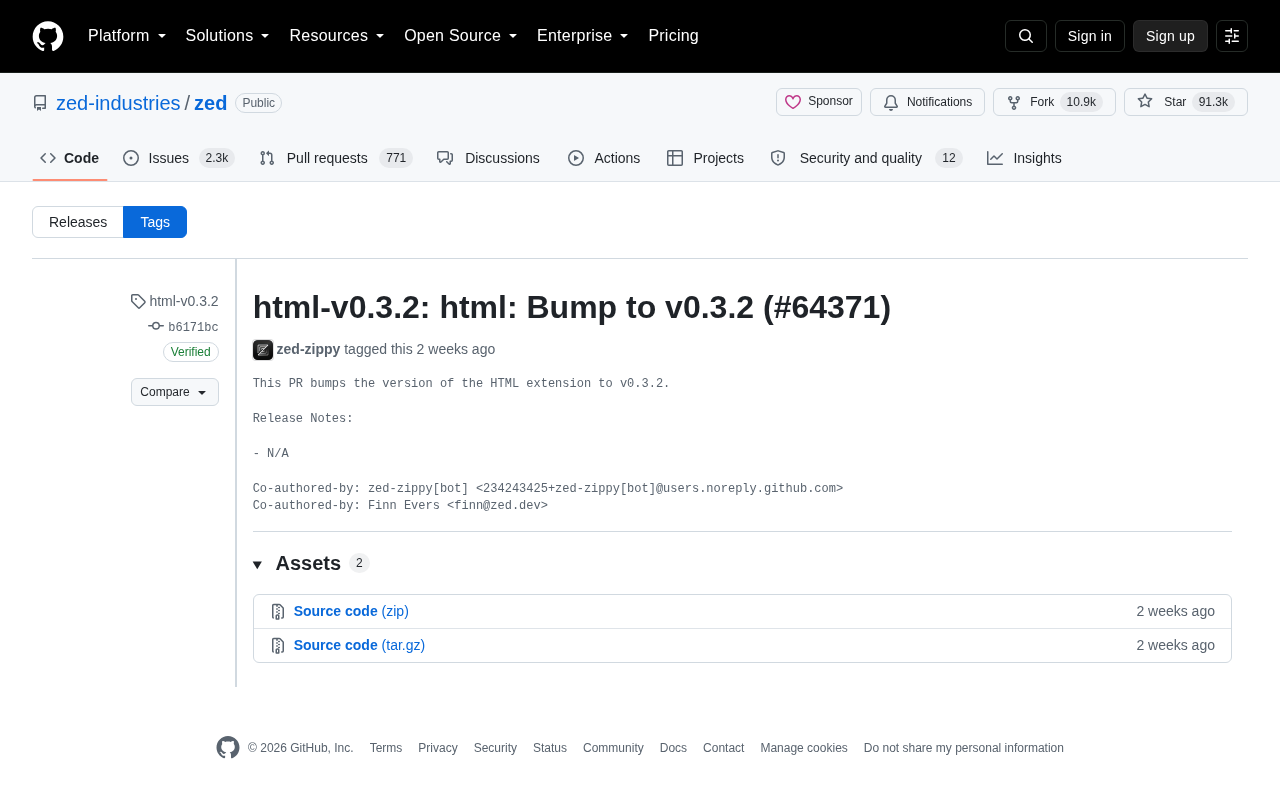
The Zed editor's official repository released HTML extension v0.3.2 (PR #64371), a routine version bump initiated by the automation bot zed-zippy and completed with maintainer Finn Evers. Release notes are marked N/A, indicating no breaking changes or major new features — the update primarily serves dependency syncing and compatibility maintenance. The commit passed GitHub's GPG signature verification, reinforcing supply chain security. Zed, the Rust-built high-performance editor from the original Atom team with over 91k GitHub stars, exemplifies mature automated release practices. Users will notice no visible changes after upgrading.
The official Zed repository recently released HTML extension version v0.3.2 (PR #64371). This is a routine version bump triggered by an automated bot and completed in collaboration with a maintainer.
Update Overview
According to the GitHub release page, the core action in this commit is bumping the Zed HTML extension version to v0.3.2. The official release notes are marked simply as "N/A," meaning no significant functional changes or breaking modifications were recorded.
Looking at the commit history, this update was submitted collaboratively by the zed-zippy[bot] automation tool and maintainer Finn Evers, and passed GitHub's verified signature check (GPG key ID: B5690EEEBB952194), confirming the commit source is trustworthy.
Background: Zed and the HTML Extension
Zed is a high-performance code editor that has gained significant attention in recent years. Built by the original team behind the Atom editor, it emphasizes a Rust-based architecture and exceptional responsiveness. The project has accumulated over 91,000 stars and approximately 10,900 forks on GitHub, reflecting a highly active community.
The HTML extension is one of Zed's many language extensions, providing HTML syntax highlighting, code completion, and language server support. Extensions of this type typically rely on an underlying language server, and version iterations often accompany dependency upgrades, compatibility fixes, or minor optimizations.
Zed's extension system differs from plugin mechanisms in editors like VS Code. Zed uses a WebAssembly (WASM)-based extension sandbox, where extensions run as WASM modules naturally isolated from the main process, balancing both security and performance. Under this architecture, the HTML extension provides syntax highlighting via the Tree-sitter parser and can optionally mount external language servers such as vscode-html-languageserver for intelligent completion and diagnostics. This means a version number change sometimes only reflects minor updates to the WASM compilation target or Tree-sitter grammar files, and does not necessarily correspond to user-visible functional changes.
The Significance of Automated Version Management
What's worth noting here is the workflow behind this update. Having a bot account (zed-zippy[bot]) automatically initiate a version bump PR is a common automated dependency management practice in modern open-source projects. This mechanism reduces repetitive work for maintainers, ensures the extension ecosystem stays in sync with the main program, and safeguards supply chain security through signature verification.
For a project like Zed — with a large number of extensions and frequent iterations — an automated version bump process can significantly improve release efficiency while making contribution records more transparent and traceable.
GPG signature verification is a critical component of modern software supply chain security. When a commit carries a verified GPG signature, GitHub displays a green "Verified" badge, proving the commit genuinely came from the account holding the corresponding private key and was not tampered with or forged. This verification is especially important for automated bot accounts — it effectively prevents attackers from injecting malicious code into the dependency chain by impersonating bot commits, a common "supply chain poisoning" attack. The Zed project configures a dedicated GPG key for zed-zippy (ID: B5690EEEBB952194), putting into practice the best practices advocated by security foundations like OpenSSF.
Impact on Users
Since the release notes are marked N/A, regular users will typically notice no obvious interface or functional changes after upgrading to v0.3.2. Minor version updates like this are more about maintaining the extension's health — such as syncing underlying dependencies, fixing potential issues, or laying the groundwork for future features.
Users who use Zed for frontend development are advised to keep extension auto-updates enabled to receive the latest compatibility and stability improvements.
Summary
This is a typical routine maintenance update for an open-source project. Its technical value lies in showcasing Zed's mature automated release and signature verification workflow, rather than any specific feature upgrade. For developers tracking the evolution of the Zed ecosystem, the ongoing cadence of version iterations is itself a reflection of the project's vitality.
Related articles

Chain of Thought Isn't Just for AI: How Humans Can Use CoT to Improve Thinking Quality
Chain of Thought isn't just a prompt trick for large models. Starting from a Hacker News discussion, this article analyzes why CoT works for human thinking too, breaks down actionable ways to transfer it, and highlights the key differences between human CoT and machine CoT.
Cloudflare Teams Up with OpenAI: Closi…
Cloudflare Teams Up with OpenAI: Closing the Loop from Vulnerability Discovery to Defense with AI
Cloudflare uses OpenAI Daybreak to investigate security vulnerabilities and generate reviewable remediation plans, while developers use Codex to boost coding efficiency and quality.

Orca Multi-Agent Orchestration in Practice: A Guide to Parallel Collaboration with Claude and Codex
Orca is Stable AI's free open-source agent workbench supporting 34 agents like Claude Code and Codex in parallel. Learn its Git worktree isolation, multi-model orchestration, and mobile management.