Zed Editor Releases v1.30.1-pre Preview: The Iteration Rhythm Behind a Minor Update

Zed releases v1.30.1-pre patch preview—a routine fix iteration with the official release approaching.
Zed editor published v1.30.1-pre on GitHub (commit 406c7e7), a patch-level update in the 1.30 series with a GitHub-verified signature. The preview targets early adopters and plugin authors for compatibility testing. The patch-level version indicates a focus on fixes over features. The article covers Zed's fast-paced release rhythm, semantic versioning, and open-source collaboration, noting the official 1.30.1 is imminent and advising stability-focused users to wait.
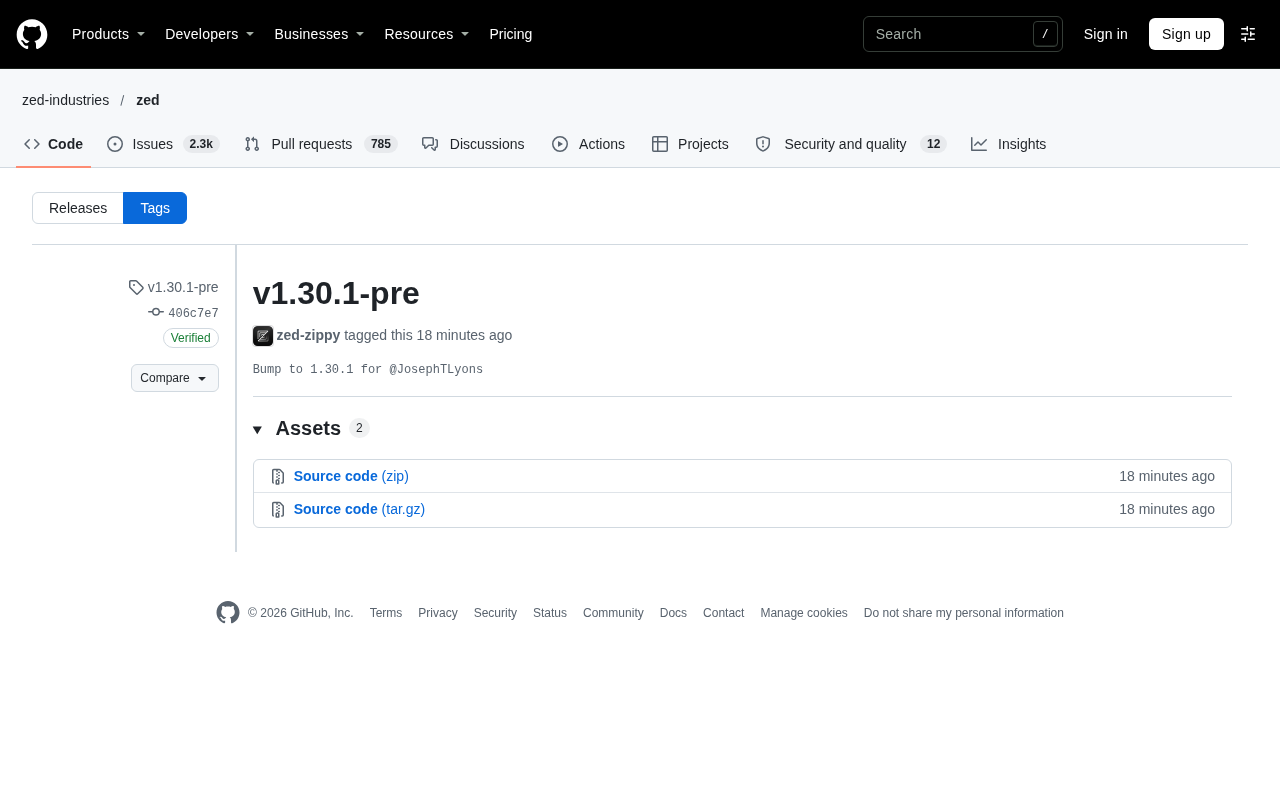
Zed editor has published a v1.30.1-pre preview release on GitHub, commit hash 406c7e7, tagged by contributor zed-zippy. The commit message indicates this bumps the version to 1.30.1 for @JosephTLyons. Judging by the version number, this is a patch-level preview within the 1.30 series, which typically means bug fixes or minor adjustments over the previous release rather than significant feature changes.
A Typical Patch-Level Preview Release
Several key details can be read from the release page. The commit carries a GitHub-verified signature (GPG key ID: B5690EEEBB952194), confirming the code's trusted origin. The -pre suffix in the version number indicates this is a preview channel ahead of the official release, aimed at users willing to try early builds or who need to verify compatibility in advance.
It's no surprise that Zed adopts this small-step, fast-paced release approach. As a high-performance code editor written in Rust, it needs to balance rapid iteration with stability—and the preview channel serves exactly as that buffer.
The Collaboration Pattern Revealed by the Commit Message
The commit message "Bump to 1.30.1 for @JosephTLyons" reflects a common version-bumping operation in open-source projects. Such commits contain no feature code themselves; their purpose is to advance the version number to the next patch position, typically executed by a maintainer after confirming fixes are in place. It reflects the Zed team's collaboration habits: dividing work by person and advancing by version number.
Semantic Versioning (SemVer): Zed's version numbers follow the semantic versioning specification, formatted as major.minor.patch. A major version change indicates incompatible API modifications, a minor version increase indicates backward-compatible feature additions, and a patch number increase indicates backward-compatible bug fixes. The -pre suffix is a pre-release identifier, indicating the version has not yet met official release standards and is often used for internal testing or early validation. Semantic versioning allows developers and users to quickly assess the impact scope of version changes, and it is also the foundation for dependency management tools (such as Cargo) to resolve version constraints.
GitHub Verified Signature: GitHub displays a "Verified" badge for commits signed with a GPG key, indicating that the commit was indeed created by the person holding the corresponding private key and that the content has not been tampered with. Commit signing is an important part of open-source supply chain security, preventing attackers from forging maintainer identities to inject malicious code. For a rapidly iterating project like Zed, signature verification helps users and downstream systems confirm that version origins are trustworthy.
Version Bump Commit: In open-source projects, version numbers are typically defined centrally in configuration files (such as Cargo.toml). Maintainers update the version number through dedicated "bump" commits and apply Git tags, triggering CI builds and release processes. Such commits contain no feature code themselves, but they are the starting point of the release pipeline. The "for @JosephTLyons" in Zed's commit message indicates that the operation was performed on behalf of a maintainer, reflecting the team's internal division of labor and collaboration conventions.
What the Preview Means for Users
For ordinary users, the most direct implication of 1.30.1-pre is that the official 1.30.1 release is on its way. If your current version has issues affecting your workflow, this patch release is worth watching; if you prioritize stability, waiting until the -pre suffix is removed before upgrading is the safer choice.
For plugin authors and power users, the preview is a window to verify compatibility in advance. Zed's extension ecosystem is still growing, and running your configuration and plugins on the preview early can help avoid hitting pitfalls all at once after the official release.
Zed's Iteration Philosophy as Seen Through Version Numbers
Zed's version numbers follow semantic versioning conventions: major version changes represent larger modifications, minor versions correspond to feature increments, and patch numbers focus on fixes. 1.30.1 falls at the patch level, indicating that the current focus is on polishing rather than expansion.
This rhythm is reasonable for an editor still in a rapid growth phase. Feature iteration attracts new users, while patch maintenance retains existing ones—only by running both tracks in parallel can the product go further. The preview mechanism adds an extra layer of validation before fixes are pushed to everyone, reducing the risk of exposing all users to problems.
Signals Worth Noting
From this release alone, the information is limited, but two signals are worth attention: first, the continuity of version bumps shows that maintenance of the 1.30 branch is proceeding normally; second, the activity of the preview channel means the team is still maintaining a high release frequency. For developers who use Zed as their primary editor, regularly checking such preview releases is a low-cost way to keep up with the project's rhythm.
Going forward, it's worth watching when the official 1.30.1 release lands and whether this patch release comes with specific fix notes.
One-line Summary
Zed releases v1.30.1-pre patch preview, a routine fix iteration with the official release approaching.
Paragraph Summary
Zed editor has published a v1.30.1-pre preview release on GitHub, commit hash 406c7e7, a patch-level update in the 1.30 series. The commit carries a GitHub-verified signature, and the commit message indicates a version bump to 1.30.1. The preview is mainly aimed at early adopters and plugin authors for verifying compatibility in advance. The patch-level version number indicates that the current phase focuses on fixes and polishing rather than feature expansion. The article analyzes Zed's small-step, fast-paced release rhythm, semantic versioning conventions, and open-source collaboration patterns, noting that the official 1.30.1 release is on its way and recommending that stability-focused users wait for the official version.
Related articles

Prompt Engineering for Beginners: From Writing Prompts to Engineering Thinking
Starting from the essence and four functions of prompts, this article systematically explains the six-step process, four success criteria, learning value, and practical limitations of prompt engineering to help you build a complete understanding.

Anthropic Launches Nasdaq IPO: AI Giant's Listing and Risk Disclosures
Anthropic officially launches its Nasdaq IPO under ticker ANT, with market valuation expected to potentially exceed SpaceX's record. The prospectus devotes nearly 100 pages to AI risks, while first-half revenue grew over 14x but net losses widened sharply, reigniting the AI bubble debate.

Rust cURL Clone Uses 4,832 unsafe Blocks—Is the Memory Safety Myth Broken?
A Rust cURL clone uses 4,832 unsafe keywords, challenging Rust's memory safety narrative. We analyze what unsafe really means, compare Fil-C, and examine rewrite motives.