Zed Editor v1.23.1-pre Released: BYOK Support for GPT-4.1 Sol and Enhanced Table Preview

Zed v1.23.1-pre brings BYOK for GPT-4.1 Sol, JSONL table preview, and major crash fixes.
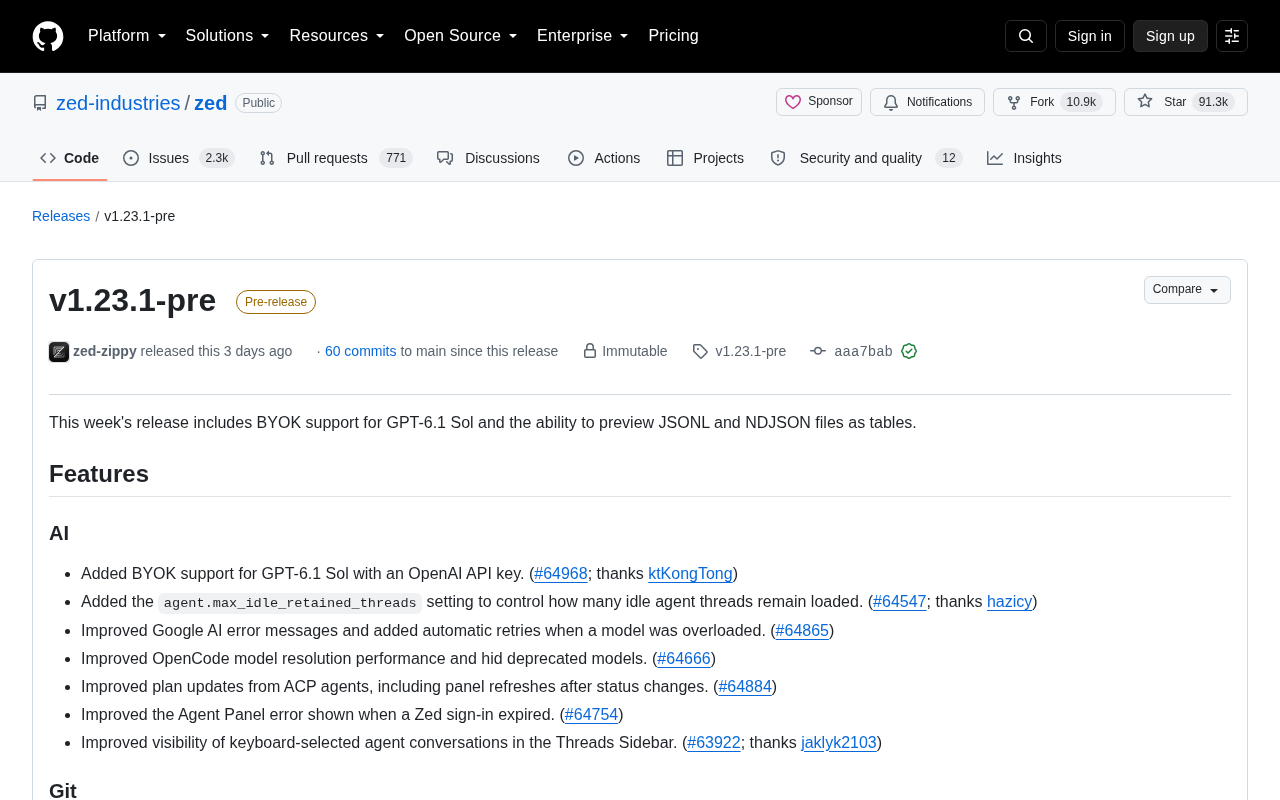
Zed v1.23.1-pre is the latest pre-release of this Rust-powered high-performance code editor. The two headline features are BYOK (Bring Your Own Key) support for the GPT-4.1 Sol model — letting users and enterprise teams use their own OpenAI API keys for cost and compliance control — and table-based preview for JSONL and NDJSON files, greatly improving the experience for data engineers and ML practitioners inspecting line-delimited JSON. The release also includes multiple Agent panel refinements, fixes for crashes on Windows, in Vim mode, and on Linux, and resolves Zed Cloud connection failures in enterprise environments with TLS inspection proxies. Notably, the title bar menu on Linux and Windows now requires a click instead of a hover — a breaking interaction change.
The high-performance Rust-powered code editor Zed has released v1.23.1-pre. This version's two headline features are: BYOK (Bring Your Own Key) support for the GPT-4.1 Sol model, and a new table-based preview for JSONL and NDJSON files. Beyond that, this update covers a wide range of improvements to AI Agent, Git, language support, and remote development, along with dozens of crash fixes and polish.
AI Capabilities Keep Growing: BYOK and Agent UX Improvements
For developers increasingly relying on AI-assisted coding, the AI-related updates in this release deserve the most attention. The newly added BYOK support lets users connect to the GPT-4.1 Sol model directly using their own OpenAI API Key (#64968), freeing them from platform-bundled quota plans while giving teams more flexibility to control model usage costs and data flow.
On the Agent panel front, Zed made several detail improvements: a new agent.max_idle_retained_threads setting allows users to control the number of idle Agent threads kept loaded (#64547) — a practical option for those sensitive to memory usage. The team also improved the ACP (Agent Client Protocol) proxy's plan update mechanism so the panel automatically refreshes after state changes (#64884), and improved error messaging in the Agent panel when the Zed login session expires (#64754).
Error messages from Google AI have been improved, with automatic retry added when models are overloaded (#64865); OpenCode's model resolution performance has been boosted and deprecated models are now hidden (#64666). These changes may be subtle, but they all point in the same direction — making multi-model, multi-Agent collaboration more stable and reliable.
What is BYOK? BYOK (Bring Your Own Key) is a common SaaS licensing model that allows users to connect using their own third-party API keys rather than being tied to a platform's shared quota. In the AI coding assistant space, this matters significantly: enterprises can connect directly to providers like OpenAI under their own enterprise contracts, benefiting from volume discounts and independent Data Processing Agreements (DPAs) for compliance; developers can also precisely track their own token consumption and call costs, rather than having them bundled into a platform subscription. GPT-4.1 Sol is a model series from OpenAI optimized for coding tasks, known for low inference latency and strong code completion accuracy — making it one of the leading options in AI-assisted coding today.
Data Preview Upgrade: Table View for JSONL and NDJSON
Another practical update comes from the language support layer. Zed has added JSONL and NDJSON formats to its table data preview feature (#64471). Developers can open a table preview view alongside the source file using cmd-k v (macOS) or ctrl-k v (Linux/Windows).
For engineers who frequently work with log streams, datasets, or machine learning training data, line-delimited JSON formats like JSONL/NDJSON are extremely common — but they're notoriously hard to read as plain text. Being able to view them as a table directly in the editor can significantly improve data inspection efficiency. Alongside this, a display bug has also been fixed where row dividers in the table preview extended beyond the last column (#63367).
Another language support improvement: when opening unsupported file types, Zed now offers extension installation suggestions for more languages (#63211), reducing friction for newcomers setting up their environment. Support for text reflowing in Typst files has also been added (#64858).
What are JSONL and NDJSON? JSONL (JSON Lines) and NDJSON (Newline Delimited JSON) are essentially the same format: each line stores a single valid JSON object, with lines separated by newline characters. This design enables streaming reads and writes without loading the entire document into memory for parsing, making it widely used for log collection, event streams, large-scale dataset exports, and machine learning training data storage. Compared to a standard JSON array, JSONL excels at append writes and line-by-line processing; the tradeoff is that each line's structure is independent, making it tedious to compare fields across lines when reading manually. Zed's table preview parses each JSON line as a record and presents the fields as spreadsheet-style columns, dramatically reducing the cognitive load of inspecting data by eye.
Small but Meaningful Improvements to Git and Remote Development
The Git panel's tree view now includes a folder-specific right-click context menu (#59853), making version control operations more convenient. A UX-affecting bug has also been fixed: previously, commit details and diffs were blocked by in-progress fetch, pull, or push operations and couldn't be opened until they finished — this has been resolved (#64720).
On the remote development side, remote sessions now support the terminal.shell configuration (#61451), making remote terminal behavior feel more like a local environment. Combined with improvements to file system watcher responsiveness (#63410), the experience of working on slow or unresponsive file systems is now smoother.
Extensive Crash Fixes and Polish
As a pre-release build, v1.23.1-pre invested significant effort in stability, fixing several crash issues:
- Crash when reading stored credentials without a username on Windows (#64735)
- Crash when pasting multiple selections at the end of a file in Vim mode (#64876)
- Crash when typing the first key of a multi-key binding at the end of a read-only file (#64730)
- Rare crash on Linux when hovering over wrapped Markdown text (#64672)
AI Agent interaction logic also received several fixes, including resolving an issue where stale Agent responses could clear new prompts or display old errors (#64917), fixing missing or outdated output in Agent tool results (#64708), and fixing an error where OpenAI model calls to MCP servers treated optional fields as required (#64920). These fixes are critical to ensuring the reliability of AI-assisted coding.
Enterprise users will want to note a fix for Zed Cloud connection failures due to UnknownIssuer errors in enterprise network environments using TLS inspection proxies (with root CAs installed in the system trust store) (#63686) — a classic enterprise deployment pain point.
TLS Inspection Proxies in Enterprise Environments: TLS inspection proxies (also known as SSL interception proxies), widely deployed in corporate networks, sit in a man-in-the-middle position between clients and servers to decrypt HTTPS traffic for security auditing. These proxies work by injecting self-signed root certificates onto enterprise devices for transparent interception — but if an application uses its own independent certificate trust store rather than the system trust store (such as the Mozilla-maintained CA bundle), it will fail to recognize the self-signed root CA and throw an
UnknownIssuererror, causing connection failures. This issue is especially common in non-browser runtimes like Electron, Tauri, and native Rust network stacks. Zed's fix for this scenario means that in these enterprise network environments, Zed Cloud features like code sync and account authentication will work properly — a key prerequisite for enterprise-scale adoption and deployment.
One Breaking Change to Watch
This update includes a behavior change: on Linux and Windows, the title bar application menu now requires a click to open and no longer supports hover-to-expand. If you prefer the old behavior, it can be restored by enabling the title_bar.open_menus_on_hover setting (#48496). This kind of seemingly minor interaction change can affect the muscle memory of high-frequency users — worth noting before upgrading.
Summary
Zed v1.23.1-pre continues the project's sustained commitment to being an AI-native editor — BYOK support for GPT-4.1 Sol lowers the barrier to entry, while stability fixes to the Agent panel and multi-model collaboration make day-to-day use more reliable. Meanwhile, features like JSONL/NDJSON table preview and the Git folder context menu reflect Zed's careful attention to real-world development workflows. As a pre-release build, it's best suited for developers who are happy to try things early and can tolerate the occasional rough edge.
Related articles

Chain of Thought Isn't Just for AI: How Humans Can Use CoT to Improve Thinking Quality
Chain of Thought isn't just a prompt trick for large models. Starting from a Hacker News discussion, this article analyzes why CoT works for human thinking too, breaks down actionable ways to transfer it, and highlights the key differences between human CoT and machine CoT.
Cloudflare Teams Up with OpenAI: Closi…
Cloudflare Teams Up with OpenAI: Closing the Loop from Vulnerability Discovery to Defense with AI
Cloudflare uses OpenAI Daybreak to investigate security vulnerabilities and generate reviewable remediation plans, while developers use Codex to boost coding efficiency and quality.

Orca Multi-Agent Orchestration in Practice: A Guide to Parallel Collaboration with Claude and Codex
Orca is Stable AI's free open-source agent workbench supporting 34 agents like Claude Code and Codex in parallel. Learn its Git worktree isolation, multi-model orchestration, and mobile management.