ZenMode OS: An Open-Source Launcher Reshaping Phone Habits with a "Zen Score"

ZenMode OS is an open-source Android launcher that uses a Zen Score and social accountability to fight phone addiction.
ZenMode OS is an open-source Android launcher that intervenes at the system level rather than relying on after-the-fact usage statistics. Its core Zen Score mechanism quantifies self-discipline into a trackable number, paired with a "gold instead of dopamine" reward system that turns using your phone less into a rewarding behavior. Social accountability features let users track habits with friends, while its open-source nature adds transparency for an app that handles sensitive usage data. The product is currently in early stages on Product Hunt, and long-term retention remains to be proven.
In an era dominated by infinite scrolling and push notifications, phone manufacturers and app developers are locked in a battle for user attention. A new open-source Android launcher called ZenMode OS takes the opposite approach — it aims to make "intentional choices" easier than impulsive ones. The product recently launched on Product Hunt with a distinctive premise: replacing dopamine with gold.
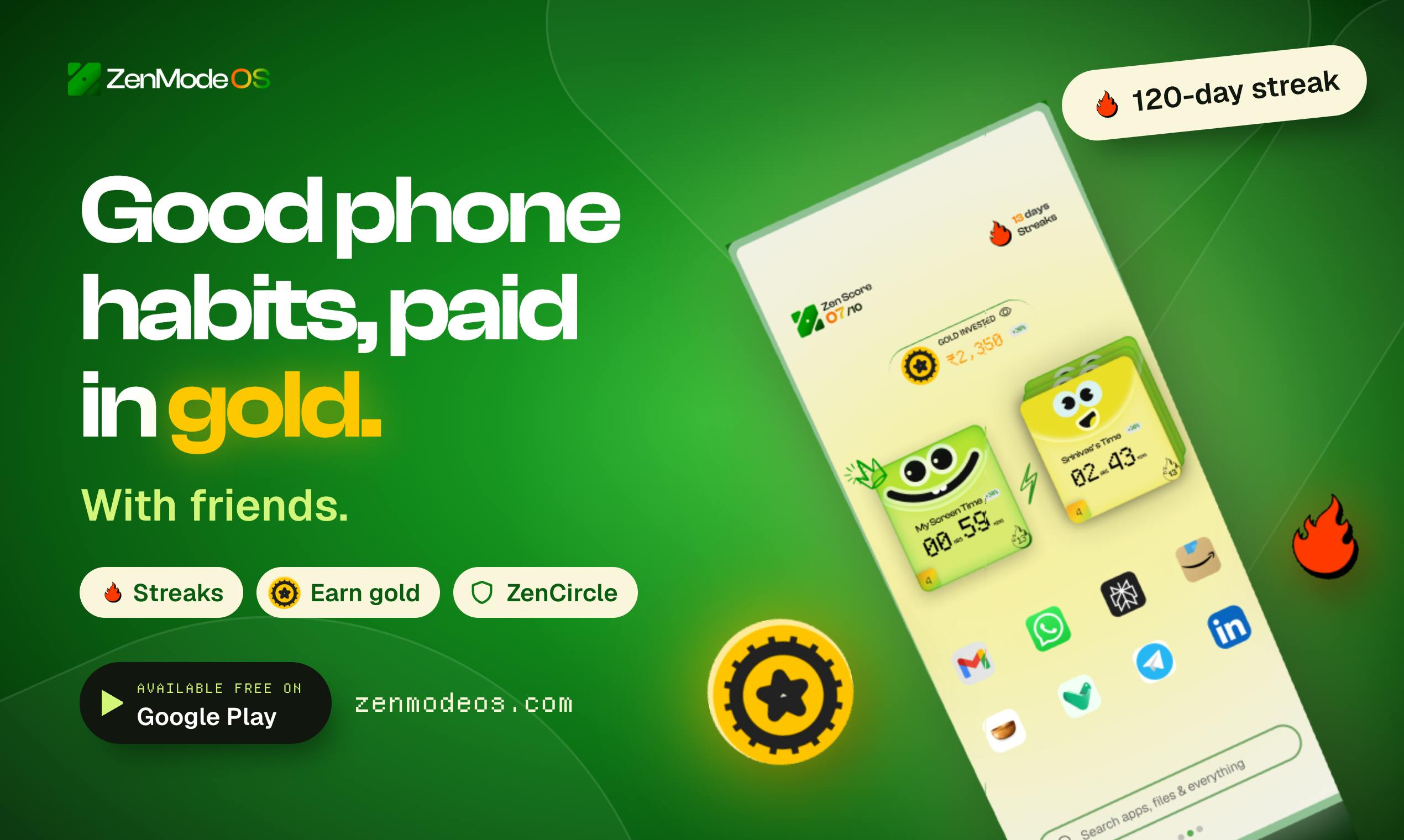
Core Philosophy: Making the Rational Choice Easier
ZenMode OS has a clear product vision: "makes the intentional choice easier than the impulsive one." This statement cuts to the heart of today's digital wellness problem — people aren't unaware that they scroll too much; they simply lack a strong enough mechanism to resist the pull of instant gratification.
Unlike the many "screen time statistics" tools on the market, ZenMode OS isn't content with showing you data after the fact. Instead, it intervenes at the launcher level, shaping every interaction from the moment you pick up your phone. The launcher is the gateway to Android — taking over the home screen means it can exert influence the instant you unlock your device, giving it more leverage than a standalone app ever could.
An Android Launcher is the core system app responsible for displaying the home screen, app icons, and widgets — essentially the "front door" of your phone. Every time a user unlocks their device or returns to the home screen, the launcher is the first thing they interact with. This privileged entry point gives launchers an intervention opportunity that other apps can't match: they can introduce friction, prompts, or alternative choices before the user opens a single app. While third-party launchers like Nova Launcher and Niagara Launcher are well established, launchers focused specifically on "digital wellness" intervention remain rare. By operating at this level, ZenMode OS has the potential to influence nearly all phone usage behavior, not just activity within a single app.
Zen Score: A Quantifiable Self-Discipline Metric
The product's central mechanism is the Zen Score. It distills a user's phone habits into a single quantifiable number, creating what the team calls "real accountability."
The brilliance of this design lies in turning the abstract concept of "self-discipline" into concrete numerical feedback. When good habits can be clearly measured, users find it much easier to perceive their own progress or regression. Compared to a vague stat like "you used your phone for 5 hours today," a unified Zen Score more closely resembles a "level" in game design — providing a continuous sense of purpose and forward momentum.
From Dopamine to Gold: A Reward Reversal
ZenMode OS's most distinctive tagline is "rewards that land in gold instead of dopamine."
The "gold" here likely refers to some form of virtual or tangible incentive currency. Traditional apps manufacture dopamine hits through likes, notification badges, and endless content — making users more addicted the longer they engage. ZenMode OS flips this logic: it transforms the act of using your phone less and building better habits into a behavior that earns real rewards. This inversion of the attention economy's core logic is what sets it apart from ordinary digital wellness tools.
Dopamine is the central neurotransmitter of the brain's reward system, released when we anticipate or receive a reward, producing feelings of pleasure and motivation. Social media platforms, short-form video apps, and messaging services exploit this mechanism — unpredictable likes, comments, and new messages create a "variable reinforcement" effect identical to the design of slot machines, compelling users to check their phones repeatedly. Critics have labeled this a "dopamine-driven feedback loop." When ZenMode OS says it replaces dopamine with gold, it's essentially trying to substitute immediate but hollow stimulation with a delayed but cumulative reward — points or virtual currency earned through habit formation. This aligns closely with behavioral economics interventions that aim to make long-term benefits feel concrete and immediate.
Social Accountability: Building Better Habits with Friends
The phrase "all with your friends" in the product's tagline reveals another key dimension — social. ZenMode OS emphasizes that habit formation doesn't have to be a solo endeavor; it can be done together with friends.
Introducing social accountability is a repeatedly validated technique in the field of behavior change. When your Zen Score is visible to friends, or when you need to hit shared goals together, peer monitoring and encouragement significantly increases the likelihood of sticking with it. This design transforms personal self-discipline into a group effort, reducing the psychological burden of fighting phone addiction alone.
Social Accountability is a classic mechanism in behavior change research, rooted in social learning theory and the concept of commitment devices. When individuals publicly declare goals to others, or form mutual monitoring relationships, the psychological cost of abandoning those goals rises significantly. Extensive research in areas like fitness and smoking cessation shows that interventions with peer accountability achieve success rates 30–40% higher than solo efforts. In the digital wellness space, apps like BeReal and Forest have experimented with various degrees of social design. By bringing this mechanism to the launcher level, ZenMode OS gives the counter-intuitive act of "not scrolling" the backing of real social relationships — rather than relying solely on individual willpower.
Open Source: A Built-In Trust Advantage
Notably, ZenMode OS is an open-source product, tagged on Product Hunt under Android, Productivity, Open Source, and GitHub.
For a launcher that needs deep access to your home screen and usage data, being open source translates directly to greater transparency and trustworthiness. Users can inspect the code themselves to confirm the app isn't misusing their data or doing anything underhanded. In an era of growing privacy concerns, this open posture is itself a competitive advantage — and one particularly well-suited to winning over the digital wellness audience, who tend to be more privacy-conscious by nature.
Early Traction and a Realistic Assessment
Based on Product Hunt data, ZenMode OS currently has 6 upvotes, 11 comments, and ranked 17th on its launch day. The fact that comment count exceeds upvote count suggests it sparked meaningful discussion, though overall awareness remains at an early stage.
Objectively speaking, the core challenge facing digital wellness launchers like this is long-term retention — users can easily slip back into old habits once the novelty wears off. ZenMode OS deploys three mechanisms to counter this decay: Zen Score quantification, gold-based rewards, and social accountability. The strategy is coherent, but real-world effectiveness will take time to prove out. For users who have long struggled with phone distraction and are open to trying open-source tools, it's worth a shot.
Related articles

JobRunner MCP Server: AI Agents Can Now Fix Failed Java Jobs
JobRunner launches an open-source MCP server enabling AI agents to view cluster status, diagnose failures, and recover Java jobs—incident response from any cloud coding environment or existing agent.

MLAI Digital Launches 9 Security Agents: MCP Server Safeguards the Full Lifecycle of Agentic AI
MLAI Digital launches Security MCP Server with nine built-in specialized security agents covering vulnerability discovery, attack simulation, prompt injection detection, API and infrastructure assessment, and accelerated remediation—embedding security validation across the full Agentic AI lifecycle from development to production.

Running Isaac Lab on H100 GPUs: Exploring Better Approaches
Exploring optimization methods for running Isaac Lab on NVIDIA H100 GPUs, including MIG configuration, mixed precision, TensorRT acceleration, and community experience to improve robotics simulation and reinforcement learning efficiency.