Zenzap Raises $44M to Challenge Workplace WhatsApp with AI Chat App

Zenzap raises $44M to challenge WhatsApp's enterprise dominance with an AI chat app.
London-based startup Zenzap has completed a $44 million funding round for its AI chat app designed for enterprise teams, aiming to fill the gap between consumer messaging tools like WhatsApp and enterprise collaboration needs. WhatsApp is widely used at work but lacks compliance auditing, access control, and system integration. Zenzap offers a WhatsApp-like experience with AI and enterprise management features, and has been adopted by Starbucks, Taco Bell, and other chain enterprises. The article analyzes the unique needs of chain businesses, the investment logic behind the AI chat app boom, and the migration and compliance challenges Zenzap faces.
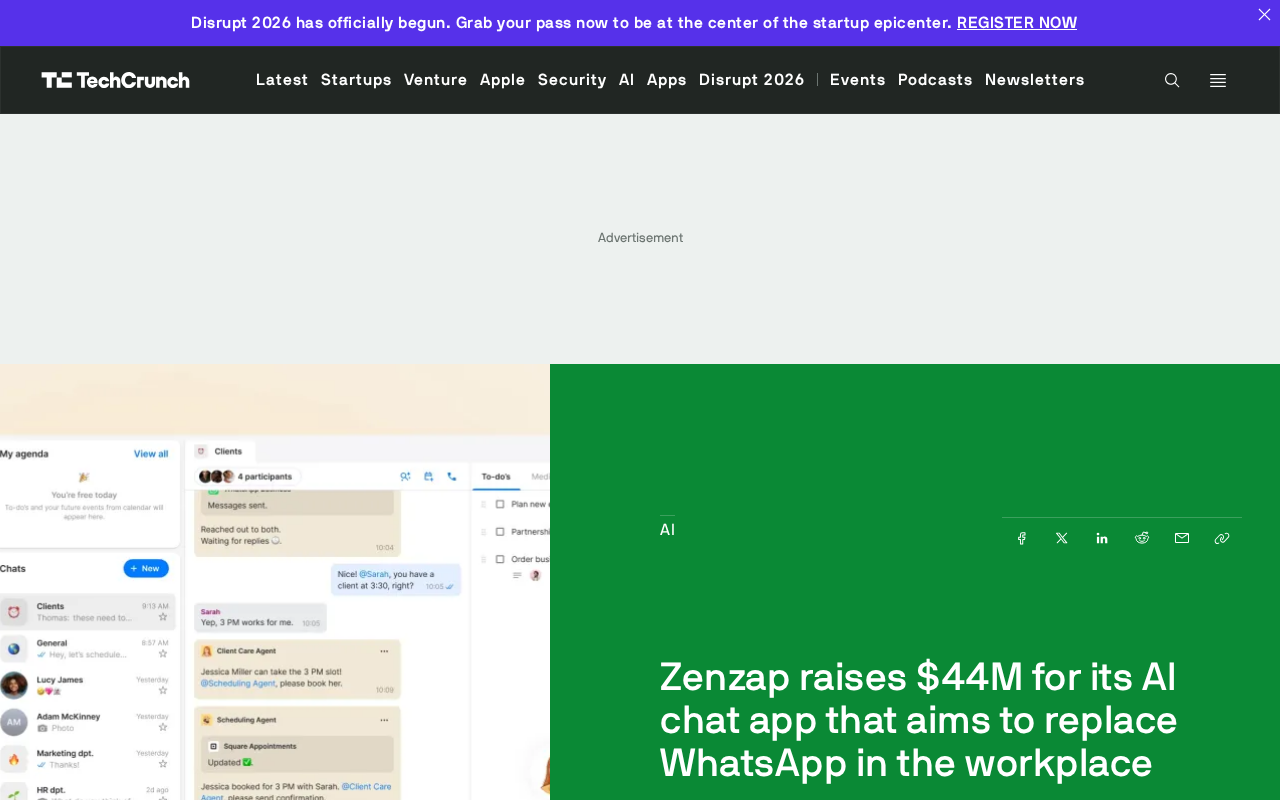
Workplace communication tools are undergoing a new wave of AI-driven reshuffling. London-based Zenzap recently announced the completion of a $44 million funding round, with its flagship product being an AI chat app designed for enterprise teams, taking direct aim at WhatsApp, which is widely used in workplace scenarios.
The Gap Between Consumer Messaging and Enterprise Collaboration
WhatsApp's dominance in personal messaging is undisputed, but its use in the workplace has always occupied an awkward position. A large number of teams actually rely on WhatsApp groups for daily work communication, yet they lack the compliance auditing, access control, data archiving, and business system integration capabilities that enterprise management requires.
This is exactly the gap Zenzap is targeting. It retains a WhatsApp-like instant messaging experience while layering on AI capabilities and enterprise-grade management features. According to public information, Zenzap has been adopted by well-known organizations including Starbucks and Taco Bell, which indicates that its product has already completed preliminary validation in large-scale, multi-location, high-turnover workforce scenarios.
Compliance Audit is one of the core capabilities that distinguishes enterprise-grade communication tools from consumer products. In regulated industries such as finance, healthcare, and restaurant chains, enterprises need to fully record employees' business communications to provide evidence in the event of disputes, regulatory inspections, or legal proceedings. Compliance auditing typically includes: message retention and archiving, keyword monitoring and alerting, eDiscovery support, and data processing workflows that comply with industry regulations (such as SEC 17a-4 and HIPAA in the US, and GDPR in the EU). Consumer-grade tools like WhatsApp do not provide these capabilities. If enterprises use them for business communication, they will be unable to provide compliant communication records when facing audits or litigation, resulting in enormous legal and financial risks.
Access Control is equally critical in enterprise communication scenarios. It involves role-based access control (RBAC), data visibility management, device management, and remote wipe capabilities. For example, chain enterprises need to ensure that store employees can only see operational information for their own store, while regional managers can view aggregated data across stores. Consumer-grade chat apps lack this kind of fine-grained permission system, preventing enterprises from enjoying the convenience of instant messaging while safeguarding information security.
Why Big Brands Choose a Chat Tool
The communication needs of chain enterprises like Starbucks and Taco Bell have clear particularities: scattered locations, a large frontline workforce, high turnover rates, and the need for rapid synchronization of operational information between headquarters and stores. Traditional enterprise IM tools are often not friendly enough for frontline employees, while consumer-grade chat apps cannot meet compliance requirements.
Zenzap's value proposition lies in solving both ends of the problem simultaneously — using a sufficiently low barrier to entry to cover frontline employees, and a sufficiently powerful admin backend to satisfy IT and compliance departments. AI capabilities further reduce the cost of information retrieval and task distribution, such as automatically summarizing group discussions and intelligently pushing operational notifications.
Frontline Workers refers to employees who directly interact with customers or participate in production, logistics, retail, and other front-line operations. They typically do not sit at a desk using a computer, but rely on mobile devices to complete their work. In chain enterprises like Starbucks and Taco Bell, frontline employees make up an extremely high proportion of the workforce, and turnover rates remain high year-round (annual turnover in the restaurant industry often exceeds 100%). Traditional enterprise IM tools (such as Slack and Teams) are designed more for knowledge workers, requiring corporate email login and desktop use, making them less friendly to frontline employees. While consumer-grade chat apps are easy to use, they lack management capabilities. Zenzap's entry point is precisely this contradiction: providing frontline employees with a zero-learning-curve mobile chat experience while giving headquarters IT and compliance departments centralized management, auditing, and integration capabilities. This "dual-end adaptation" strategy is key to its rapid adoption in chain enterprise scenarios.
ROI (Return on Investment) is often the final deciding factor in enterprise software procurement decisions. For Zenzap, its ROI argument needs to cover several aspects: reducing operational errors caused by poor communication, lowering employee training costs, improving information distribution efficiency, and avoiding potential fines through compliance capabilities. Chain enterprise customers typically conduct pilot deployments, quantify these metrics, and then decide whether to roll out on a full scale.
The Enterprise Race for AI Chat Apps Is Heating Up
Zenzap's funding round is not an isolated event. The enterprise communication and collaboration market is attracting increasing capital attention, with the core logic being: large language models are upgrading the chat interface from mere "message delivery" to a "task execution entry point." Users can directly complete queries, approvals, scheduling, and other operations within a conversation, without needing to switch between multiple applications.
However, this track also faces significant challenges. The migration cost for enterprise customers is extremely high — once a team gets used to a certain tool, their willingness to switch is very low. In addition, data security and privacy compliance requirements vary greatly across different markets. If Zenzap wants to grow from a regional player into a global platform, it will need to continuously invest in compliance infrastructure.
Large Language Models (LLMs) integrated into enterprise communication tools are changing the nature of the chat interface. The core function of traditional IM tools is message delivery, but with LLM integration, the chat window becomes a natural language interaction interface that can call backend APIs, query databases, and execute workflows. For example, an employee can directly type in a group chat, "Help me check last Wednesday's schedule for Store No. 3," and the AI assistant will parse the intent, call the scheduling system's API, and return the result — all without switching to another application. This "conversation-as-operation" model dramatically lowers the barrier to using enterprise software, especially for frontline employees who are unfamiliar with complex systems.
However, deploying LLMs in enterprise environments also brings new challenges: model hallucinations may lead to the spread of incorrect information, sensitive data may be incorporated into model training, and AI regulations vary across regions. When choosing AI chat tools, enterprise customers will focus on whether the model supports private deployment, whether data is used for training, and whether audit logs for AI decisions are provided. These requirements further raise the bar for the track, and they are areas where Zenzap needs to continue investing.
The Real Difficulty of Challenging WhatsApp
WhatsApp's position in enterprise scenarios was not won through product features, but through user inertia. Employees are already using it, and managers find it difficult to force them to switch to another app. What Zenzap needs to do is not just provide better features, but also offer a sufficiently compelling reason to migrate — such as lower communication costs, clearer compliance guarantees, or tangible efficiency gains brought by AI.
The $44 million funding round provides Zenzap with expansion ammunition, but the war in workplace communication is far from over. Slack, Teams, and various vertical industry communication tools are all accelerating their AI adoption. Whether Zenzap can maintain its first-mover advantage depends on whether it can continue to deliver convincing results on the three dimensions that enterprise customers care about most: security, integration, and ROI.
One-line Summary
Zenzap raises $44M to challenge WhatsApp's dominance in enterprise communication with an AI chat app.
Paragraph Summary
London-based startup Zenzap recently completed a $44 million funding round for its AI chat app designed for enterprise teams, aiming to fill the gap between consumer messaging tools like WhatsApp and enterprise-grade collaboration needs. WhatsApp is widely used in the workplace but lacks compliance auditing, access control, and system integration capabilities. Zenzap retains a WhatsApp-like instant messaging experience while adding AI capabilities and enterprise-grade management features, and has been adopted by chain enterprises including Starbucks and Taco Bell. The article analyzes the unique communication needs of chain enterprises, the investment logic behind the heating up of the AI chat app track, and the migration cost and compliance challenges Zenzap faces, noting that its ability to maintain its first-mover advantage depends on continued performance across security, integration, and ROI.
Related articles

Understanding DeepSeek in 3 Minutes: The Rise from a Quant Hedge Fund to an Open-Source AI Leader
DeepSeek's history in 3 minutes: from High-Flyer Quant's compute build-up to V2's MLA inference cost cuts, V3's $5.576M training bill, R1's open-source global shock, and V4 with a $7B Series A.

Local Creative Writing Model Showdown: Fine-tuned Qwen3.8 27B Wins, DeepSeek v4.1 Underwhelms
Bilibili creator tests seven local creative writing models: Hemingway and HumanLike Chat based on Qwen3.8 27B perform best, DeepSeek v4.1 is plain, Dongfang Shuo ranks last with confused characters. Includes three test prompts, scores, and usage advice.

Liang Wenfeng's Three Big Bets: Why Did DeepSeek Open-Source Its 82% Gross Margin?
Why did DeepSeek open-source DeepInfer, its 82% gross margin inference framework, and then launch a hundred-billion funding round? An analysis of Liang Wenfeng's three big bets and the open-source strategy.