Zero-Code AI SaaS Development: A Complete Guide to Outsourcing on Fiverr

A complete guide to outsourcing an AI social media automation SaaS on Fiverr — no coding required.
This article documents an experiment in fully outsourcing AI app development to a Fiverr freelancer — with zero code written by the client — resulting in a working tool that auto-generates, schedules, and publishes social media content. It covers every key step: filtering sellers by rating and level, communicating requirements before ordering, clarifying source code ownership and revision terms, staying on-platform to leverage escrow protection, and thoroughly testing before confirming delivery. The article also addresses the model's limitations: escrow protects money, not quality, and source code maintainability and long-term iteration costs remain real concerns for anyone considering this as a serious product foundation.
Building an AI App Without Writing a Single Line of Code
This is a remarkably instructive experiment: outsourcing the entire development of a SaaS application to a freelancer on Fiverr, ultimately producing an AI tool that automatically generates content, schedules posts, and publishes to social media — all without the client writing a single line of code.
The logic behind this approach is grounded in reality. AI tools can help anyone quickly assemble a demo, but turning that into a truly functional, scalable product still requires real technical expertise. Local developers tend to charge more, have packed schedules, and are hard to find. Outsourcing platforms become a middle-ground solution — sidestepping the cost of building an in-house team while delivering a more reliable end product than pure AI generation alone.

From Sign-Up to Hiring: How to Navigate Fiverr
The barrier to entry is remarkably low. Visit fiverr.com or download the app, sign up with your Google account in about ten seconds. The platform defaults you to the buyer role — no seller setup required.
One detail worth noting: upload a real profile photo. As the original source points out, freelancers respond faster to buyers who appear to be genuine users. It's a reasonable trust signal in platform-based transactions — a real identity signals lower communication friction and a higher likelihood of closing.
Search using the keyword "AI web app development." But searching alone isn't enough — your filtering strategy is what matters:
- Ratings of 4.8 stars and above
- Hundreds of reviews, not just three or five
- Prioritize Level 2 or Top Rated sellers
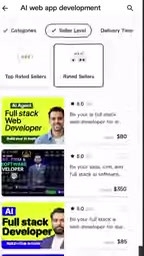
The logic behind this filtering approach is a basic understanding of sample size: a handful of five-star reviews can be fabricated, but a high rating accumulated across hundreds of transactions is a more reliable signal of actual quality. The source also emphasizes the importance of reading the negative reviews, reviewing the portfolio, and then shortlisting your top three candidates. Bad reviews often reveal a seller's real weaknesses more clearly than glowing praise ever could.
Fiverr's seller level system is the platform's core mechanism for establishing trust. New sellers start as "New Seller" by default, and can advance to "Level 1" after completing a set number of orders at a high rating, then to "Level 2" with further activity. "Top Rated Seller" status requires manual review by Fiverr's editorial team, with thresholds covering completed order count, response rate, on-time delivery rate, and more. The significance of this tiered system: the higher the level, the more real-world transactions a seller has been tested by, and the stronger the platform's endorsement of their account. For clients, Level 2 and above sellers also come with a more complete transaction history in the event of a dispute, making the overall risk more manageable.
Communication and Ordering: Don't Skip This Step
"Never place an order without communicating first" is the principle that gets repeated throughout this entire process. The right approach is to send a clear project brief first, then ask a few key questions:
- Will I receive the full source code?
- How many revisions are included?
- When does the delivery clock start?
These questions target the most common points of dispute in outsourcing: source code ownership, revision limits, and timelines. Once you have clear answers, ask the seller to send a custom offer, then accept it and pay.
Financial Safety: The Escrow Mechanism Is Everything

This is the single most important part of the entire process: never pay outside of the Fiverr platform. The moment you move the transaction off-platform, you forfeit all buyer protections.
Fiverr uses an escrow mechanism — your payment is held by the platform and only released to the freelancer after you confirm acceptance of the work. This design significantly reduces transaction risk and represents the core value of outsourcing platforms over private arrangements. For clients who lack the technical expertise to personally evaluate code quality, this layer of protection is especially critical.
The escrow mechanism originates from traditional finance, referring to a neutral third party temporarily holding transaction funds until both sides fulfill their obligations. In the context of digital outsourcing platforms, this mechanism addresses two classic fraud scenarios: "buyer pays, seller disappears" and "seller delivers, buyer refuses to pay." On Fiverr specifically, funds are immediately deducted and frozen when the buyer places an order — they don't go directly to the seller. The seller can only withdraw once the buyer clicks "Accept Delivery" or the order auto-completes at expiry. If a dispute arises, Fiverr's support team can intervene as arbitrators, and buyers can request a refund under certain conditions. For technically non-expert clients, this design is especially critical: even if you can't audit code quality yourself, you at least retain meaningful financial leverage at the functional acceptance stage.
Acceptance and Deliverable: A Working Automated Application
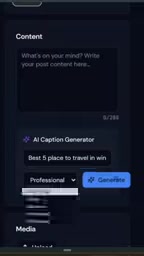
After delivery, make sure to test every feature thoroughly before accepting. The acceptance process shown in the original source is straightforward: enter a topic, the AI writes the post, set a schedule, done — social media content is published automatically.
If you find issues, submit a revision request. Once you're satisfied, confirm delivery and leave a five-star review. The loop is complete: from an idea to a working AI application, with no code written and no agency hired.
The Value and Limitations of This Approach
This case study offers a clear non-technical path to entrepreneurship, but it deserves a realistic assessment. What it truly solves is the problem of "finding a reliable executor." Filtering, communicating, and acceptance testing still require real judgment from the client's side — the escrow mechanism protects your money, but product quality, ongoing maintenance, and future iteration still depend on how clearly you defined your requirements upfront and how well-matched the seller's skills are.
For those who want to validate a product idea but lack development skills, platforms like Fiverr do meaningfully lower the cost of experimentation. But treating it as the technical foundation of a long-term product requires thinking through deeper questions: source code maintainability, the cost of future development, and more. The original content is itself a promotional walkthrough, with the full step-by-step tutorial housed on the author's channel.
Source code ownership is the most frequently overlooked issue in outsourced development — and the one most likely to cause long-term headaches. Some freelancers build applications using templates, third-party libraries, or proprietary frameworks, meaning the "source code" delivered may depend on their private components, leaving the client unable to independently deploy or modify the app. The right approach is to establish during the communication phase: the deliverable must include complete, independently runnable code, documentation of all dependency licenses, and confirmation that no closed-source proprietary modules from the seller are included. The hidden costs of maintenance and future iteration are equally important — an application quickly assembled by an outside developer, if poorly structured or undocumented, will cost significantly more time and money for anyone who tries to work on it later.
Related articles

Chain of Thought Isn't Just for AI: How Humans Can Use CoT to Improve Thinking Quality
Chain of Thought isn't just a prompt trick for large models. Starting from a Hacker News discussion, this article analyzes why CoT works for human thinking too, breaks down actionable ways to transfer it, and highlights the key differences between human CoT and machine CoT.
Cloudflare Teams Up with OpenAI: Closi…
Cloudflare Teams Up with OpenAI: Closing the Loop from Vulnerability Discovery to Defense with AI
Cloudflare uses OpenAI Daybreak to investigate security vulnerabilities and generate reviewable remediation plans, while developers use Codex to boost coding efficiency and quality.

Orca Multi-Agent Orchestration in Practice: A Guide to Parallel Collaboration with Claude and Codex
Orca is Stable AI's free open-source agent workbench supporting 34 agents like Claude Code and Codex in parallel. Learn its Git worktree isolation, multi-model orchestration, and mobile management.