Zero-Code AI Website Builder Review: Generate Complete Apps Just by Talking

An AI website builder generates full-stack runnable apps from natural language descriptions alone.
This article reviews a conversational zero-code AI website builder that automatically generates full-stack applications from natural language descriptions. The tool supports built-in plugin extensions, multi-device compatibility, source code downloads, and secondary development, making it ideal for office workers, entrepreneurs, and non-technical users looking to quickly validate ideas. However, for complex business logic and enterprise-grade systems, professional development teams are still necessary.
Conversational App Development: Build Software with Natural Language
Zero-code development has moved from concept to reality. The AI website builder I tested today lets you describe your needs in plain natural language and automatically generates a fully functional application with both front-end and back-end — all without writing a single line of code.
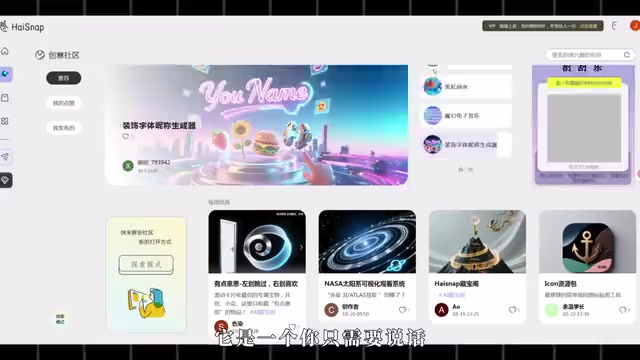
Whether you're a non-technical office worker, an entrepreneur looking to quickly validate an idea, or a developer who needs to rapidly prototype, this zero-code AI tool is worth trying.
The Technical Background of Conversational App Development
Conversational App Development is a new development paradigm that has emerged alongside breakthroughs in large language model (LLM) capabilities. Its core technology relies on combining Natural Language Understanding (NLU) with code generation — the model must not only understand user intent but also map it to concrete technical implementation plans. Earlier low-code/zero-code platforms (such as OutSystems and Bubble) primarily relied on visual drag-and-drop interfaces, while the new generation of AI website builders uses Prompt Engineering to directly transform requirements into runnable code. Essentially, this compresses the three traditional development stages — "requirements analysis → architecture design → code writing" — into a single conversational interaction. This is precisely why these tools enable people with zero programming knowledge to get a real, usable application from just a text description.
How to Use It: Just Type Your Idea into the Input Box
The workflow is incredibly straightforward: open the website, describe the app features you want in plain language in the input box, hit send, and the AI automatically builds the application for you.
Real Example: Generating an AI Medical Device Customer Service App
Using the demo from the video as an example, the input requirement was:
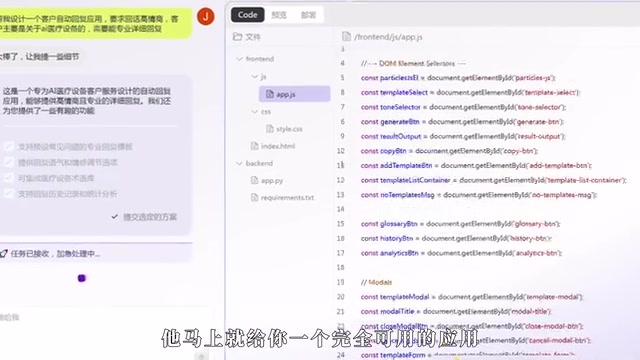
"Help me design an automated customer response application. It should reply with high emotional intelligence. The customers are primarily asking about AI medical devices, and the responses need to be professional and detailed."

This description contains four key elements: application type (auto-reply), communication style (high emotional intelligence), industry domain (AI medical devices), and response standard (professional and detailed). The AI accurately understands these semantic cues and generates an application that matches the requirements.
Core Feature Highlights: It's More Than Just a Page
Full-Stack Generation (Front-End + Back-End)
Many zero-code tools on the market can only generate front-end interfaces, but this AI website builder handles both the front-end interface and back-end logic simultaneously. In other words, the generated application actually runs — it's not just a pretty but non-functional static page.
The technical significance of this capability shouldn't be underestimated. The front-end handles user interface and interaction logic, typically built with HTML/CSS/JavaScript; the back-end manages data storage, business logic, and API endpoints, involving server-side languages (like Node.js, Python) and databases. Traditional zero-code tools, constrained by template-based architectures, often can only generate static front-end pages. AI tools capable of full-stack generation typically leverage full-stack frameworks (like Next.js) or BaaS (Backend as a Service) platforms to automatically assemble back-end capabilities — databases, authentication, API routing — in a modular fashion. This gives the generated apps real data read/write and business processing capabilities — and that's the essential difference between "actually runs" and "just looks good."
Built-in Plugins with One-Click Activation
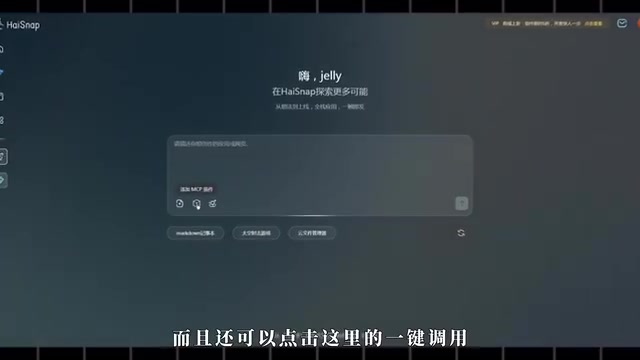
The platform offers a built-in plugin system that lets users add more functional modules to their applications with a single click, easily extending the app's capabilities without any additional technical work.
Multi-Device Compatibility: Works on Desktop and Mobile
Generated applications automatically adapt to both desktop and mobile devices, with no need for additional responsive design adjustments. For cross-platform use cases, this saves a considerable amount of effort.
Downloadable Source Code with Support for Secondary Development
Click the button in the upper right corner to download the complete source code. This means you can not only use the generated application directly but also perform secondary development and deep customization on top of it — offering a high degree of flexibility. For users with some technical background, this essentially means the AI handles the most time-consuming "building from scratch" phase, while fine-tuning and adjustments remain in your own hands.
Use Cases: Who Should Try This
This type of conversational zero-code development tool is especially suited for the following groups:
- Office workers: Quickly build internal tools or mini-programs, eliminating the cycle of submitting requests and waiting for development schedules
- Entrepreneurs: Validate product ideas at low cost, generating an MVP (Minimum Viable Product) in minutes
- Non-technical users: No need to learn programming — turn your software requirements into reality using natural language
- Developers: Rapidly generate prototype code so you can focus your time on core business logic
For entrepreneurs in particular, the value of an MVP (Minimum Viable Product) is especially compelling. This concept originates from Eric Ries' The Lean Startup methodology, and the core idea is: build a product version with just the essential features at the lowest possible cost, quickly put it on the market to gather user feedback, then iterate and optimize. Traditional MVP development often requires weeks or even months of engineering effort, while AI website builders compress this cycle to minutes, dramatically reducing the cost of trial and error in startup validation. This trend is also a microcosm of the broader "democratization of software development" wave — from GitHub Copilot's code completion, to Cursor's AI editor, to conversational website builders, the continuous lowering of technical barriers is reshaping the fundamental question of "who can build software."
A Realistic Perspective: The Capability Boundaries of AI Website Builders
Of course, these tools have their limitations. For simple CRUD applications, information display pages, and basic interactive tools, the quality of AI-generated output is more than adequate. But when it comes to complex business logic, high-concurrency scenarios, or deeply customized enterprise-grade systems, professional development teams are still indispensable.
The underlying issue is the gap between "generation quality" and "engineering quality." Enterprise-grade systems typically need to meet stringent requirements including high concurrency (thousands to tens of thousands of requests per second), data consistency (ACID transactions), security compliance (such as GDPR data protection regulations or China's Classified Protection of Information Security Level 3 certification), and observability (logging, monitoring, and alerting systems). AI-generated code may be functionally correct, but often falls short on engineering details like performance optimization, exception handling, and security hardening. Moreover, complex business systems usually involve multi-team collaboration, legacy system integration, and long-term maintenance — all of which exceed the current capabilities of conversational tools. This is why the industry generally positions such tools as "prototype accelerators" rather than "engineering replacements."
That said, as rapid prototyping tools and lightweight application generators, these zero-code AI products are genuinely driving the democratization of software development — enabling more everyday people to quickly turn the ideas in their heads into usable products.
Key Takeaways
- The AI website supports generating complete applications from natural language descriptions, with integrated front-end and back-end
- The platform provides a built-in plugin system with one-click feature extensions and multi-device compatibility
- Generated application source code is downloadable, supporting secondary development and customization
- Ideal for office workers, entrepreneurs, non-technical users, and others who need to quickly build applications
- The tool is well-suited for lightweight apps and prototyping, while complex enterprise applications still require professional teams
Related articles
 Product Reviews
The Programmer's Desk Setup Guide: Building a Workspace That Feels Like Home
Discover how programmers build productive, comfortable workspaces. From multi-monitor setups to ergonomic design, explore the desk philosophy that drives focus and flow.
 Product Reviews
Qoder vs Cursor Real-World Comparison: Which $20/Month AI IDE Is Better?
Hands-on comparison of Qoder vs Cursor AI IDEs: Agent autonomy, human interaction count, and architecture decisions. Qoder needed only 2 interactions vs Cursor's 8.
 Product Reviews
Cursor Cloud Agent Demo: Eliminating Bottlenecks Across the Entire Software Development Lifecycle
Deep analysis of Cursor's Cloud Agent demo showing how cloud VMs, automated test artifacts, and a full-chain control plane systematically eliminate human bottlenecks across the software development lifecycle.