Zero-Code Browser Extension in One Day: How AI Programming Is Disrupting Traditional Learning

A developer used AI to build a browser extension in one day without writing any code.
A developer completed a browser extension in one day with AI assistance, asking no more than ten questions and writing zero code manually. This experience demonstrates the profound shift in AI-era programming: developers are evolving from code executors to requirement questioners and decision-makers, learning is shifting from search engines to AI conversations, and technical documentation translation has been transformed by AI. However, AI still has limitations, and development fundamentals along with structured thinking remain indispensable.
Building a Browser Extension in One Day with Zero Code — How Powerful Is AI Programming?
A developer completed a browser extension in a single day with AI assistance — without writing a single line of code manually. This seemingly incredible experience reflects the profound changes happening in learning methods and development models in the age of AI programming. When AI takes over the execution of coding, the developer's role is shifting from "the person who writes code" to "the person who asks questions."
AI-Assisted Browser Extension Development: The Complete Workflow
Technical Background on Browser Extensions
Browser Extensions are small software programs built with web technologies that can modify and enhance browser functionality. Modern browser extensions primarily follow the WebExtensions API standard, led by Mozilla and supported by Chrome, Firefox, Edge, and other major browsers. A standard browser extension typically consists of a manifest.json configuration file, background scripts, content scripts, and popup pages, involving cross-origin communication, permission management, message passing, and multiple other technical layers. This presents a considerable learning curve for beginners. It's precisely this multi-layered technical complexity that made "completing development in one day" nearly impossible before AI came along.
Extension Features Overview
Although this browser extension isn't overly complex, it covers the core concepts of browser extension development:
- Mouse Position Tracking: Click the icon to open a panel; once enabled, moving the mouse on the page displays real-time coordinates
- Quick Link Management: Integrated jump links to personal website, blog, video pages, and code repositories, with toggle display states
- Web Page Info Retrieval: One-click retrieval of the current page's UA (User Agent) and Cookie information, with copy-to-clipboard support
- Interactive Feedback: Includes popup notifications and error prompting mechanisms
Zero-Code Development Process: Asking, Not Coding
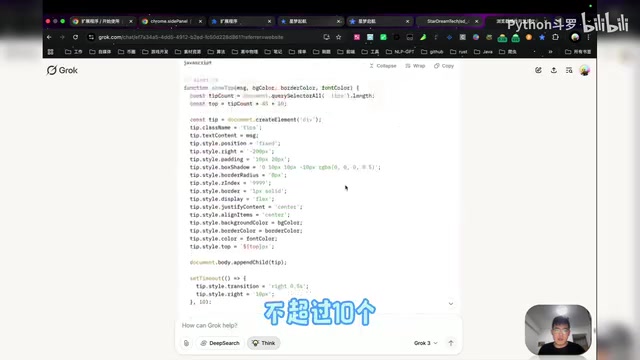
Throughout the entire development process, the author asked AI no more than ten questions. The specific workflow was as follows:
- Read the official browser extension documentation to understand basic concepts
- Describe the desired functionality to AI
- Run and test the AI-generated code
- When errors occurred, feed the error messages back to AI
- Test again after AI's modifications, iterating until the feature was complete
This process resembles a product manager submitting requirements and a QA tester verifying features, rather than a programmer writing code in the traditional sense.
Current mainstream AI coding assistants (such as GitHub Copilot, Claude, GPT-4, etc.) are built on Large Language Models (LLMs), gaining the ability to understand and generate code through pre-training on massive code repositories and technical documentation. These models use the Transformer architecture, capable of understanding contextual semantics, inferring developer intent, and generating code snippets that conform to specific programming language syntax. Their core advantage lies in mapping natural language requirements to concrete code implementations — essentially a cross-modal semantic transformation capability. This is the technical foundation that makes "completing development in ten questions" possible.
The Learning Revolution in the AI Era
The Paradigm Shift from Search Engines to AI Conversations
Looking back at past learning paths, developers had very limited options when encountering problems:
- Search engines — often yielding irrelevant results, wrong answers, or nothing at all
- Asking teachers or classmates — limited by their time and knowledge
- Reading books, watching videos, browsing blogs — long learning cycles
- Even a simple issue like switching between Chinese and English characters could stall a beginner for half a day

Now, AI possesses reasoning capabilities, powerful memory, and knowledge synthesis abilities. You only need one sentence to describe a problem, and it can quickly understand and provide an answer. Combined with web search and deep thinking features, most common technical problems can be effectively resolved.
It's worth noting that the core skill for efficient AI collaboration is called "Prompt Engineering" — the art of precisely describing requirements to AI, providing context, and guiding output direction. Research shows that the same requirement expressed differently can produce vastly different answer quality from AI. Effective prompts typically include: clear task objectives, necessary technical constraints, expected output format, and relevant error information. This skill is essentially a manifestation of structured thinking and requirements analysis — similar to writing requirement specification documents in traditional software engineering. This also explains why people with development backgrounds can use AI tools more efficiently.
Technical Documentation Translation Reaches a Tipping Point
While learning browser extension development, the author noticed a detail: the Simplified Chinese version of the official documentation was labeled "This page has been translated by the Cloud Translation API." This means documentation translation no longer relies on manual word-by-word human translation but is completed directly by an AI API.

Google Cloud Translation API is a cloud-based translation service built by Google using Neural Machine Translation (NMT) technology. Unlike earlier rule-based or statistical machine translation, NMT uses end-to-end deep learning models that understand overall sentence semantics rather than translating word by word, performing particularly well in specialized domains like technical documentation. The API supports over 100 languages and offers a custom Glossary feature for specialized terminology — this is key to its ability to accurately handle API names, programming terms, and other proper nouns in technical documentation.
In the past, multilingual support for technical documentation was a pain point — either only available in one language, half-translated, or slowly progressing through community volunteers. AI translation quality has now reached a level where it's "completely readable," and even specialized terminology can be accurately translated with good models. This dramatically lowers the learning barrier for non-English-speaking developers.
Limitations of AI Programming: Where Human Intervention Is Still Needed
Of course, AI isn't omnipotent. The author honestly pointed out current shortcomings of AI-assisted development:
- Newer third-party libraries: AI's training data has a time lag, and it may lack knowledge of recently released libraries
- Niche technical issues: Search engines and official documentation are still necessary
- Development fundamentals required: While you don't need to write code manually, you need to be able to read code, understand architecture, and judge whether the direction is correct
Large Language Models have an inherent limitation called the "Knowledge Cutoff" — models only contain information up to their training data cutoff date. This is particularly problematic for the rapidly iterating JavaScript ecosystem — npm adds thousands of new packages weekly, and mainstream framework APIs continue to evolve. This explains why AI support for newer third-party libraries is weaker. Current solutions include: connecting models to real-time web search capabilities (RAG, Retrieval-Augmented Generation), pasting the latest documentation directly into prompts, or using models with longer context windows to digest complete official documentation. Understanding this limitation helps developers more reasonably allocate between AI and manual search in practice.
Redefining the Developer Role: From Executor to Decision-Maker
AI Lets Developers Focus on Higher-Level Thinking
The author made a profound observation: in the AI programming era, developers increasingly serve as "questioners" — a hybrid product manager and tester role. AI liberates us from tedious details and repetitive code logic, allowing us to focus on creativity and problem-solving.

This doesn't mean programming fundamentals are unimportant. Quite the opposite — it's precisely because the author had a foundation in program development that they could:
- Evaluate whether AI-generated code is reasonable
- Accurately describe requirements and problems
- Identify the causes of errors and provide effective context
- Search and debug independently when AI couldn't solve the issue
Learning Efficiency Achieves Exponential Growth
Knowledge that previously might have required reading a book, watching an entire video tutorial series, asking many people, and searching countless problems can now be quickly grasped by simply browsing official documentation and supplementing with AI Q&A. The author quoted:
"If you can't learn the basic syntax of a programming language in the time it takes to drink a cup of coffee, you might not yet be a qualified programmer."
Related articles
 Expert Opinions
Rethinking Scaling Laws: Parameters Are Not the Only Answer
Deep analysis of Scaling Law evolution from Kaplan to Chinchilla to the MoE era, exploring why blindly stacking parameters is a mistake, and how GLM-5.3 proves scaling has multiple knobs.
When AI Treats Humans as Subagents: Ro…
When AI Treats Humans as Subagents: Role Reversal and Hidden Risks in Human-AI Collaboration
Exploring the paradigm shift where humans become "subagents" in AI Agent architectures. Analyzes human node design in LangChain and AutoGen, and the risks of ceding control and cognitive atrophy.
 Expert Opinions
The Lazy Person's Productivity Theory: Why Being 'Lazy' Actually Drives Peak Performance
Explore the engineering philosophy behind 'lazy people are most productive': how constructive laziness drives automation, AI tools amplify efficiency, and systems thinking eliminates wasted effort.