Zero-Cost Multi-Agent AI System: A Complete Breakdown of the Free-Tier Build

A student built a fully functional multi-agent AI system at zero cost using Cloudflare Workers and GitHub Actions.
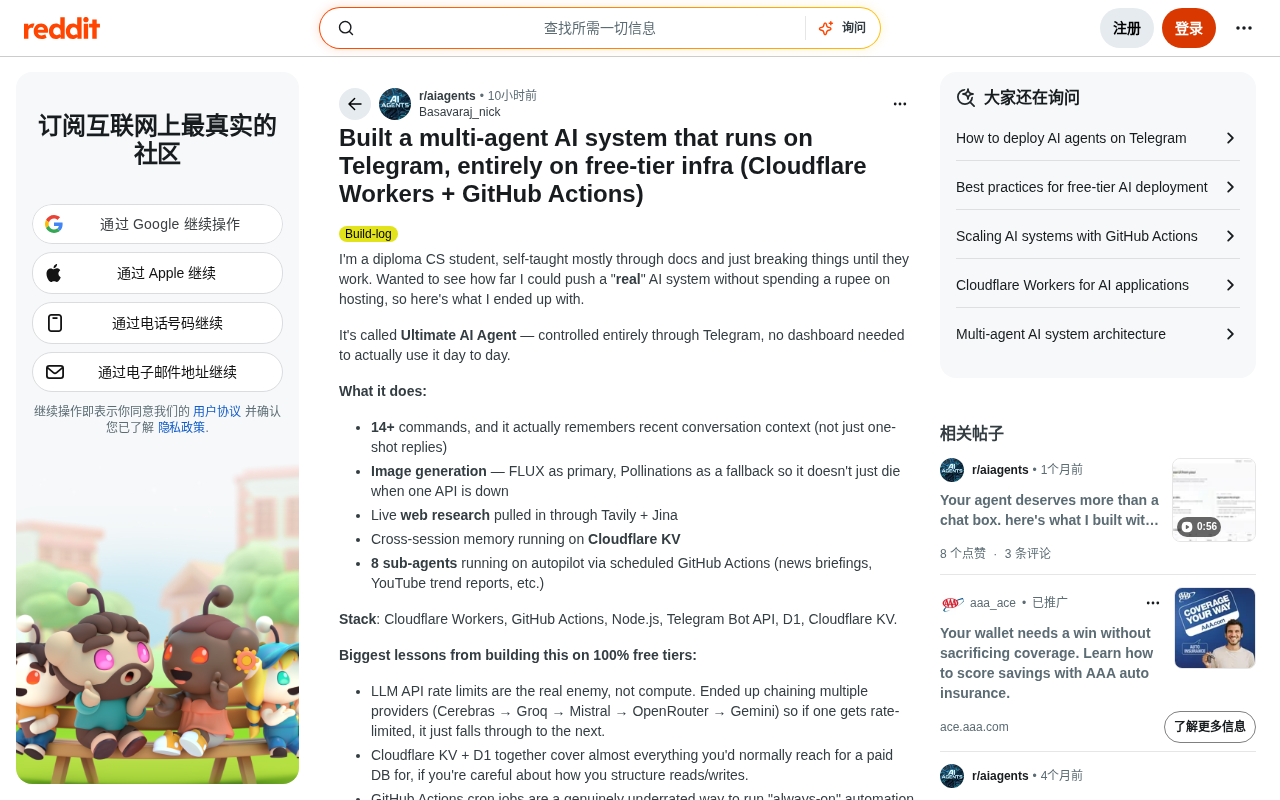
A self-taught CS student built a multi-agent AI system called Ultimate AI Agent using entirely free infrastructure — Cloudflare Workers, GitHub Actions, KV, D1, and Telegram. The system features context memory, 8 autonomous sub-agents, real-time web research, and image generation with failover, all at zero hosting cost. The project offers a replicable blueprint for developers working under budget constraints.
One Student's Free Infrastructure Challenge
Cloud services typically charge by the month — but is it possible to build a genuinely functional AI system without spending a single cent? One self-taught CS college student answered that question with a resounding yes. Using entirely free infrastructure — Cloudflare Workers, GitHub Actions, and similar services — he built a multi-agent system called Ultimate AI Agent, controlled entirely through Telegram.
What makes this project stand out is that it's not a toy demo. It's a real AI system with memory, multi-command interaction, and automated task execution — hosted at zero cost (the author's exact words: "didn't spend a single rupee").
Core Capabilities: Far More Than a Chatbot
Based on the author's post in the Reddit r/aiagents community, this system covers several key dimensions of modern AI Agent design.
Multi-Turn Interaction and Context Memory
The system supports 14+ commands and isn't a simple one-shot Q&A bot — it remembers recent conversation context for continuous, multi-turn exchanges. This may sound basic, but it's the core threshold that separates a "chatbot" from an "intelligent assistant." Context memory relies on Cloudflare KV to store cross-session data, enabling persistent conversation state management.
Cloudflare KV is a distributed key-value store with extremely low read latency (via edge caching), though write operations have eventual consistency delays (typically syncing globally within 60 seconds). It's well-suited for read-heavy workloads like conversation caching and user configuration storage. Cloudflare D1, on the other hand, is a SQLite-based relational database running on edge nodes that supports standard SQL queries — the free tier offers 5GB storage and 5 million row reads per day. Together, KV handles high-frequency session state reads while D1 manages structured data (user history, task logs) persistence, forming a classic two-tier "cache + persistence" storage architecture.
Failover Design for Image Generation
For image generation, the author uses a dual-track architecture with FLUX as the primary model and Pollinations as the fallback. This design detail reflects solid engineering thinking — when an API service goes down or hits rate limits, the system doesn't crash; it automatically switches to the backup. For projects relying on third-party free APIs, this kind of redundancy is essentially a survival requirement for stable operation.
FLUX is a text-to-image model series launched in 2024 by Black Forest Labs (founded by some original Stable Diffusion team members). It significantly outperforms contemporary open-source competitors in image quality and text rendering accuracy, with API access available through several third-party platforms at no cost. Pollinations is a fully open-source image generation service requiring no API key — extremely low barrier to entry, though with relatively limited quality. Together they embody the engineering principle of "prefer the best, degrade gracefully."
Real-Time Web Research
The system integrates Tavily and Jina for real-time web information, freeing the Agent from the boundaries of its training data and enabling access to current web content — significantly improving both timeliness and accuracy.
Tavily is a search API designed specifically for AI Agents. It returns structured search summaries rather than raw web links, with a free tier offering 1,000 API calls per month. Jina AI's Reader API (r.jina.ai) focuses on web content extraction, converting any URL into clean Markdown text for LLM consumption — the free version requires no authentication. The division of labor is clear: Tavily handles the discovery layer ("what to search"), while Jina handles the extraction layer ("what to read"), together solving the real-time knowledge retrieval problem in RAG (Retrieval-Augmented Generation) scenarios.
8 Autonomous Sub-Agents Running Automatically
The most defining "multi-agent" feature is this: 8 sub-agents running automatically via GitHub Actions cron jobs, each with a dedicated role — generating news digests, producing YouTube trend reports, and more — all without any human intervention.
Multi-Agent Systems (MAS) are a classic concept in AI, referring to architectures where multiple autonomous AI entities perceive, reason, and act to collaboratively complete complex tasks. Each agent has independent goals and tool-calling capabilities, cooperating via message passing or shared memory. The 8 sub-agents here are a simplified MAS implementation: each handles a vertical domain (news, video trends, etc.) and is independently scheduled via GitHub Actions, avoiding the context confusion that comes from overloading a single agent with too many responsibilities.
Full Tech Stack Breakdown
The system's technology choices are clear and restrained, with each component having a well-defined role:
- Cloudflare Workers: Core edge computing logic
- GitHub Actions: Scheduled automation tasks
- Node.js: Primary development language
- Telegram Bot API: The sole user interaction interface
- Cloudflare D1: Relational structured data storage
- Cloudflare KV: Key-value store for memory and cache management
Cloudflare Workers is a serverless edge computing platform built on the V8 engine. Code runs across Cloudflare's 280+ global data center nodes rather than on centralized servers. The free tier provides 100,000 requests per day, with near-zero cold start times (typically under 5ms) — far better than traditional cloud functions. Since code executes at the node closest to the user, latency is minimal, making Workers an ideal "zero-cost gateway" for AI Agents that need to respond quickly to Telegram webhooks.
Worth noting: the entire system requires no management dashboard for daily use — all operations are performed within Telegram. This design lowers the barrier to entry and makes the system truly "always at hand."
Three Key Lessons from Free Infrastructure
The author candidly shared three hard-won lessons from building on a purely free stack — highly valuable for any developer looking to replicate a similar architecture.
Rate Limits Are the Real Enemy
The author cuts right to the point: "LLM API rate limits are the real enemy, not compute power." Under a free-tier setup, computational resources are usually sufficient — but the call frequency limits imposed by LLM providers are the real bottleneck.
Rate limiting is the core mechanism LLM providers use to prevent API abuse and protect service stability, typically measured in RPM (requests per minute) or TPM (tokens per minute). On free tiers: Groq offers approximately 30 RPM, Cerebras around 30 RPM, and Gemini Flash about 15 RPM.
His solution was to build a multi-provider fallback chain: Cerebras → Groq → Mistral → OpenRouter → Gemini. When an earlier provider is rate-limited, requests automatically "fall through" to the next available one. This chain fault-tolerance mechanism — known as an LLM Fallback Chain in open-source projects — trades provider diversity for system availability, making it an extremely practical architectural pattern under cost constraints. Cerebras is prioritized first for its fastest inference speed, with graceful degradation ensuring maximum overall uptime.
KV + D1 Can Replace Most Paid Databases
The author argues that with careful attention to read/write patterns, the combination of Cloudflare KV and D1 can cover most needs that would otherwise require a paid database. KV suits high-frequency key-value reads (like conversation caching); D1 handles structured relational data — the two complement each other effectively. KV's distributed nature ensures fast session state reads, while D1's SQLite-based architecture delivers full relational query capabilities at the edge. The free tier is more than sufficient for personal projects of considerable scale.
The Underrated Power of GitHub Actions Cron Jobs
The third lesson may be the most insightful: GitHub Actions cron scheduling is a severely underrated "always-on" automation solution — one that approximates a persistent running service without requiring a paid server.
GitHub Actions cron triggers follow POSIX cron syntax, with a minimum scheduling granularity of every 5 minutes. Free accounts receive 2,000 minutes of compute time per month — enough to support thousands of scheduled runs for lightweight Agent tasks (each taking 10–30 seconds). Compared to traditional VPS crontabs, GitHub Actions requires no server maintenance, handles failure retries automatically, and provides complete logging. By triggering workflows on a schedule, all 8 sub-agents run continuously — cleverly bypassing any dependency on paid servers. The main limitation: scheduling isn't precisely real-time (there can be queue delays under high concurrency), and free-tier minutes are more limited for private repositories.
What This Means for Developers
Beyond the technical details, the true value of this project is what it proves: in today's free cloud services ecosystem, individual developers are fully capable of building complex, practical AI systems. The barrier isn't money — it's the ingenuity to orchestrate and combine various free-tier offerings in an engineering-sound way.
For students, indie developers, or budget-constrained teams, this combination of "free infrastructure + multi-provider fallback + scheduled task automation" offers a replicable methodological framework. The author has also made the complete codebase publicly available at github.com/basavarajpatil660/Ultimate-Ai and expressed willingness to answer questions about free-tier chain design.
Of course, this approach has inherent limitations — relying on multiple third-party free APIs means stability is never fully within your control, and free-tier quotas can change at any time. But as a learning exercise and proof-of-concept, it represents a genuinely instructive piece of engineering exploration.
Related articles

DeepCell: One-Click AI Generation of Documents, Spreadsheets, and Slides
DeepCell tops Product Hunt with one-click generation of documents, spreadsheets, and slides, using the .deepcell format for linked updates, designed for System 2 tasks like modeling and sales reviews.

Doneas: 15-Minute Daily Accountability Calls That Keep Indie Developers From Procrastinating
Doneas is a daily accountability tool for indie developers: plan tasks on Monday, join a 15-minute call with five builders each day, and log deliveries on a public progress page. This article analyzes its core mechanics, effectiveness, and potential issues around retention and matching.

Fastlane 2.0: Fully Automated AI Ad Campaigns, From Creative to Optimization
Fastlane 2.0 is an AI ad automation tool: enter your website and it learns your brand, generates video and image ads, and runs and optimizes them on Meta, TikTok, Instagram, and YouTube.