Zero-to-AI for First/Second-Year Master's Students: A 4-Month Complete Learning Roadmap
A 4-month structured AI roadmap for grad students, from zero to a portfolio-ready project.
This guide offers a practical 4-month AI learning roadmap designed for first and second-year master's students with no prior background. It covers Python fundamentals, essential math, and core ML concepts in month one, followed by PyTorch and deep learning practice in month two. Month three branches into three goal-specific paths — job hunting, paper publishing, or interdisciplinary research — and month four focuses on producing a concrete, demonstrable outcome.
For first and second-year master's students just starting out, AI is practically a required course tied to both academics and career prospects. Yet many people dive straight into textbooks on advanced math, machine learning, and deep learning, grinding through page by page from the very beginning. Three months later, they've bookmarked 200 course videos, but don't have a single working project on their computer — and can't clearly explain what they actually know during lab meetings.
This article is based on a graduate-level AI learning roadmap shared by a content creator on Bilibili. The core message is crystal clear: The biggest risk for grad students learning AI isn't starting from zero — it's having no clear goal. The following 90–120 day beginner roadmap will help you avoid this most common pitfall.
First, Ask Yourself: Why Are You Learning AI?
Before you start, answer one question: What's your reason for learning AI? Learners generally fall into three categories, and different goals lead to completely different paths:
- To get a job: You need a complete project that matches specific job requirements
- To publish papers: You need to build an iterative experimental framework aligned with your advisor's research direction
- To do interdisciplinary AI research (medicine, materials science, finance, etc.): You need to find scenarios where AI can genuinely improve efficiency or uncover patterns
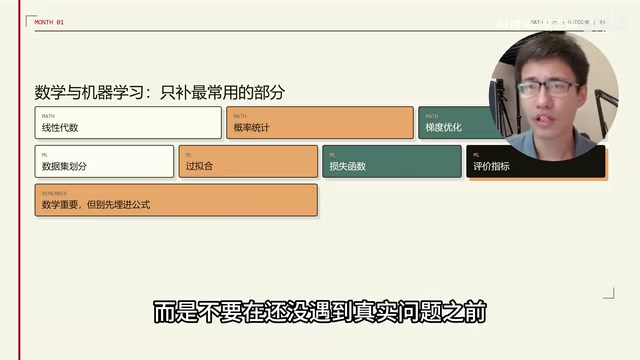
Regardless of which category you fall into, you can follow the same foundational roadmap for the first two months, then branch out starting in the third month. Here's a critical reminder: Math isn't unimportant — but don't bury yourself in formulas before you've encountered real problems. Many students spend enormous amounts of time deriving every step of Bayesian formulas or matrix decomposition proofs, but in actual projects, the scenarios that truly require hand-derived math are far fewer than you'd imagine. What's far more common: you need to understand what a formula does, why it's designed that way, and what happens when parameters change — this kind of "engineering intuition" matters more than proof-writing ability.
Month 1: Build a "Good Enough" Foundation
The goal of this first phase isn't to learn every fundamental — it's to gain the ability to read code, run projects, and understand experiments.
Python and Engineering Skills
You don't need to master Python, but you should at least be able to:
- Read and modify code
- Process data and set up environments
- Use Git and know how to troubleshoot errors step by step
Git deserves special emphasis here. Git is the most widely used version control tool in both software development and research. It helps you track every code change, switch freely between different experimental approaches, and collaborate with others. For grad students, learning to manage experiment code and config files with Git not only prevents the nightmare of "I can't find my previous version after all these changes," but is also a baseline skill expected by virtually every technical job. Open-source projects on platforms like GitHub and Gitee are also essential resources for learning and reproducing papers.
Only Cover the Most Commonly Used Math
For math, start with linear algebra, probability and statistics, and the most commonly used parts of gradient optimization — don't try to cover everything. Specifically, the most frequently used linear algebra concepts include matrix multiplication, transpose, inverse matrices, and eigenvalue decomposition — these directly correspond to how data transforms between layers in neural networks. In probability and statistics, conditional probability, Bayes' theorem, and common distributions (Gaussian, Bernoulli, etc.) form the foundation for understanding classification tasks, generative models, and loss function design. For gradient optimization, the core concept is understanding "gradient descent": the model computes the partial derivatives (gradients) of the loss function with respect to parameters, then updates parameters in the opposite direction of the gradient, gradually finding the parameter combination that minimizes the loss. These three areas give you just enough to understand the neural network training process — you can go deeper on specific topics as needed later.
Core Machine Learning Concepts
First understand the core concepts of dataset splitting, overfitting, loss functions, and evaluation metrics. These will appear repeatedly in every project you do going forward and form the foundation for interpreting experimental results.
These concepts are worth explaining in detail. Dataset splitting means dividing your data into training, validation, and test sets: the training set is for model learning, the validation set is for tuning hyperparameters and monitoring model status during training, and the test set provides the final assessment of how the model performs on "never-before-seen data." Without proper splitting, the model might just "memorize" the training data and fail to generalize to new data — which leads to the concept of overfitting: the model performs great on training data but poorly on new data, like a student who can only solve problems they've seen before but can't handle variations. The loss function is a mathematical function that measures the gap between predicted and actual values — common examples include cross-entropy loss for classification tasks and mean squared error for regression tasks. It serves as the "compass" for model optimization. Evaluation metrics measure model quality from a business or research perspective — accuracy, precision, recall, F1 score, AUC, etc. Different tasks require different metrics. For instance, in medical diagnosis where the cost of missed detections is very high, recall matters more than accuracy.
Month 2: Deep Learning and PyTorch in Practice
Entering the deep learning phase, the focus is on running through PyTorch's core pipeline: tensor operations, automatic differentiation, network construction, training loops, loss functions, optimizers, and model evaluation.
PyTorch is an open-source deep learning framework developed by Meta (formerly Facebook) AI Research. It's currently the most popular choice in academia and is increasingly adopted in industry. Understanding its core pipeline is essential: Tensors are the fundamental data structure in PyTorch — think of them as multi-dimensional arrays with GPU acceleration support. All data — images, text, audio — gets converted to tensors before being fed into a model. Automatic differentiation (Autograd) is one of PyTorch's most powerful features: it automatically tracks all operations on tensors and computes gradients during backpropagation, so you don't have to manually derive partial derivatives for each layer. The training loop is the basic pattern of deep learning engineering: forward pass to compute predictions → compute loss → backpropagation to get gradients → optimizer updates parameters → repeat until the model converges. Optimizers (such as SGD, Adam, etc.) determine the specific strategy for parameter updates — different optimizers have different characteristics in terms of convergence speed and stability. Adam is the most commonly used default choice due to its adaptive learning rate.
Then independently complete a small project — it could be image classification, text classification, or a simple prediction task.
Here's a very practical learning benchmark: the test of whether you've truly gotten started isn't "did I finish watching the videos" — it's whether you can re-run the whole thing on your own after closing the tutorial.
Going further, when you encounter these common issues, you should know where to look first:
- Model won't converge: This usually means the loss isn't decreasing or is even oscillating upward. Common causes include learning rate set too high or too low, data not properly normalized, label-data mismatch, or unreasonable network architecture. When debugging, try using a very small data subset to test whether the model can "overfit" on it — if it can't even learn a few samples, there's most likely a bug in your code or configuration.
- Dimension mismatch: This is one of the most frequent errors PyTorch beginners encounter, usually occurring where tensor shapes don't align — for example, when a fully connected layer's input dimension doesn't match the previous layer's output dimension, or when the batch dimension is missing. Build the habit of printing
tensor.shapeat key points to quickly locate issues. - Out of memory: Deep learning model training requires substantial GPU memory. When the model is too large or batch size is set too high, you'll get a "CUDA out of memory" error. Solutions include reducing batch size, using mixed precision training (FP16), gradient accumulation, or model parallelism.
- Abnormal metrics: For example, accuracy stuck at a fixed value (possibly due to class imbalance causing the model to only predict the majority class), or training metrics looking great but test metrics being poor (classic overfitting) — these require analysis based on data distribution and experimental design.
Being able to copy code doesn't mean you've gotten started. Being able to locate problems when things go wrong — that's when you've truly begun.
Month 3: Choose a Path Based on Your Goal
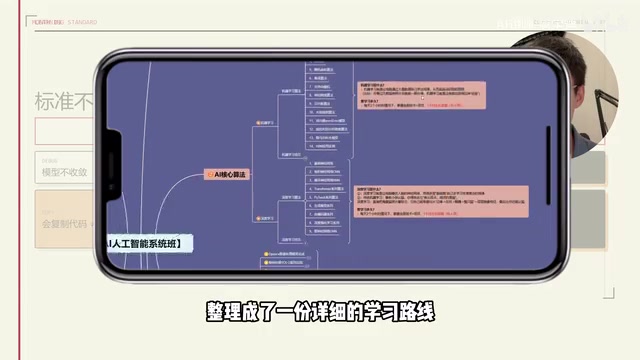
Starting from the third month, stop trying to "learn everything" and focus on one path based on your goal. Special emphasis here: Don't learn algorithms, frontend, and Agent development all at once, only to end up knowing just a little about each.
Path 1: For Job Hunting
First identify the specific position, then study accordingly:
- LLM Application Development: Focus on model API calls, local deployment, RAG (Retrieval-Augmented Generation), Agent development, tool calling, context management, evaluation, and project deployment
This path has become a job market hotspot in recent years following the explosion of large language models like ChatGPT. Several key concepts are worth explaining. RAG (Retrieval-Augmented Generation) is one of the most mainstream architectures in LLM applications today. While large language models are knowledge-rich, they suffer from outdated knowledge and "hallucination" (fabricating facts). RAG's core approach: when a user asks a question, first retrieve relevant content snippets from an external knowledge base (company documents, databases, etc.), then feed those snippets as context along with the user's question into the LLM, letting the model generate answers based on real source material. This leverages the LLM's language capabilities while ensuring answers are grounded in evidence. Agent refers to the technical direction of enabling LLMs to not just "answer questions" but also "take actions." An Agent can autonomously plan task steps based on user instructions, call external tools like search engines, code executors, and database queries, dynamically adjust strategies based on intermediate results, and ultimately complete complex tasks. Context management refers to how to efficiently organize conversation history, system prompts, and external knowledge within limited input windows (token length limits) — this directly affects the quality of model output.
- Algorithm Engineer positions: Continue studying machine learning, deep learning, Transformer architecture, paper reproduction, and model optimization
Transformer is a neural network architecture proposed by the Google team in the 2017 paper Attention Is All You Need. It fundamentally transformed the field of natural language processing and rapidly expanded into computer vision, speech, protein structure prediction, and virtually every other AI domain. Transformer's core innovation is the self-attention mechanism, which allows the model to directly attend to information from all other elements in a sequence when processing each element, thereby capturing long-range dependencies and overcoming the bottleneck that RNN/LSTM architectures faced with long sequences. Today, virtually all major large language models (the GPT series, LLaMA, Claude, etc.) and vision models (ViT, Swin Transformer, etc.) are built on the Transformer architecture. For algorithm engineer job seekers, deep understanding of Transformer principles, variants, and optimization techniques is essentially a hard requirement.
What matters most on the job-hunting path isn't how much you've studied — it's whether you can present a complete project that matches the target position.
Path 2: For Publishing Papers
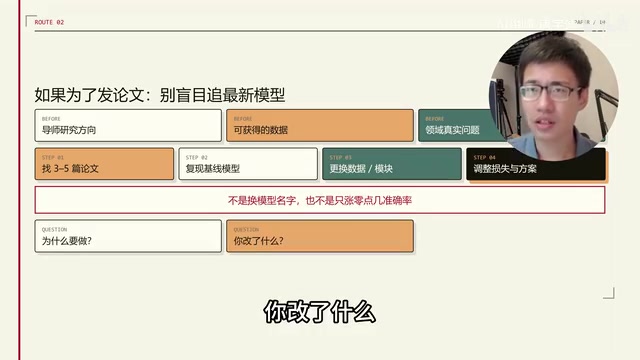
Don't blindly chase the latest models. The correct order is:
- Identify your advisor's research direction, the data you have access to, and the problems the field actually needs to solve
- Find 3–5 related papers and first reproduce a baseline model
- Then try swapping data, modifying modules, adjusting loss functions, or optimizing the experimental design
The baseline model is a critically important concept in research. A baseline is the reference result obtained using existing or classic methods under your experimental setup — it provides a "measuring stick" for your improvements. Without a baseline, you can't prove what's actually better about your method. The process of reproducing a baseline is also the best way to deeply understand prior work — many details omitted in papers (data preprocessing methods, hyperparameter choices, random seed settings, etc.) can only be truly appreciated during reproduction.
A paper isn't just swapping model names, nor is it done when accuracy improves by a fraction of a percent. You need to clearly address three questions: Why did you do this? What did you change? Can the experiments prove your method works?
Path 3: Interdisciplinary AI Research
Different fields have vastly different data types, and the learning path varies accordingly:
- Tabular data: Study Pandas, Scikit-learn, feature engineering, and classical machine learning
Tabular data (also called structured data) is the most common data format in fields like medical records, financial transactions, and experimental measurements, stored in rows and columns. Pandas is the core Python library for handling tabular data, providing the DataFrame data structure with support for data cleaning, merging, group statistics, missing value handling, and more. Scikit-learn is the most classic machine learning library in Python, with a complete toolkit from data preprocessing to model training to evaluation, covering dozens of classical algorithms including linear regression, decision trees, random forests, SVM, K-Means clustering, and more. Feature engineering is often more important than model selection in tabular data scenarios — it refers to constructing new features from raw data that are more helpful for the prediction task, based on domain understanding and data analysis. For example, extracting "day of week" or "is it a holiday" from date fields, or applying log transformations and cross-combinations to numerical features. In Kaggle and other data science competitions, winning solutions often invest far more effort in feature engineering than model tuning. It's worth noting that for tabular data tasks, deep learning isn't always the best choice — gradient boosting tree models like XGBoost and LightGBM still outperform neural networks in many scenarios.
- Image data: Focus on computer vision (CNN, object detection, image segmentation, etc.)
CNN (Convolutional Neural Network) is the cornerstone architecture of computer vision. Its core idea is to use convolutional kernels that slide across images to extract local features (such as edges, textures, and shapes), then progressively combine them into higher-level semantic features. Classic CNN architectures include AlexNet, VGG, ResNet (Residual Network), and more. Object detection not only identifies "what's in the image" but also marks "where it is" — common models include the YOLO series and Faster R-CNN. Image segmentation goes even further by classifying every pixel in an image, divided into semantic segmentation (distinguishing categories) and instance segmentation (distinguishing individual objects), with wide applications in medical image analysis, autonomous driving, and more.
- Text data: Move toward NLP and large language models
- Time series / Graph data: Corresponding to time series forecasting models and graph neural networks respectively
Time series data refers to data sequences ordered by time, such as stock prices, weather observations, sensor readings, and user behavior logs. The core challenge of time series forecasting is capturing trends, periodicity, and sudden changes in the data. Traditional methods include statistical models like ARIMA and exponential smoothing, while deep learning approaches include LSTM, Temporal Convolutional Networks (TCN), and recent Transformer-based time series models (such as Informer, PatchTST, etc.). Graph data describes relationship networks between entities — user relationships in social networks, atomic bonds in molecules, entity associations in knowledge graphs, etc. Traditional neural networks can't directly handle this non-Euclidean structured data. Graph Neural Networks (GNN) use a "message passing" mechanism — each node aggregates information from its neighboring nodes to update its own representation — enabling deep learning on graph structures. GCN, GAT, and GraphSAGE are the most classic GNN models, with wide applications in drug discovery, recommendation systems, fraud detection, and more.
The key to interdisciplinary AI research has never been slapping the letters "AI" onto your research topic — it's finding a scenario where AI can genuinely improve efficiency, uncover patterns, or solve problems.
Month 4: Produce a Concrete Result That Proves Your Capabilities
In the final month, don't start new courses. Instead, consolidate everything you've accumulated into a tangible deliverable:
- For job hunting: Build a project you can put on your resume, demo live, and defend under interview follow-up questions
- For publishing papers: Complete baseline reproduction, comparative experiments, ablation studies, and results analysis to form an iterative experimental framework
The ablation study is a core experimental design for validating method effectiveness in papers. Its basic logic is similar to the "controlled variable method": if your method includes multiple improvement modules (say, a new attention mechanism + a new data augmentation strategy + an improved loss function), an ablation study removes these modules one by one and observes how performance changes, thereby proving each module's individual contribution. If removing a certain module doesn't cause a noticeable performance drop, that module may not actually be doing anything useful. Reviewers almost always look at ablation studies when evaluating papers — they're the most powerful evidence for "explaining why your method works." Comparative experiments involve fairly comparing your method against existing methods (including the baseline models you reproduced) on the same datasets and evaluation metrics, showing where your method outperforms or matches existing work.
- For interdisciplinary research: Complete a minimum viable research topic — define the problem, organize data, select a model, design metrics, and produce initial results
Running source code is just the starting point. You also need to be able to swap data, modify modules, design evaluations, interpret results, and finally organize everything into a code repository, experiment logs, architecture diagrams, or a demo.

Here's a clear division of labor worth remembering:
Papers answer "why do it this way," source code answers "how exactly is it implemented," and experimental results answer "does what you did actually work."
AI Tools Are Powerful, But They Can't Make Judgments for You
Today's AI tools are indeed increasingly powerful, but that doesn't mean you can get away with not understanding code at all. Tools can help you write faster, but they can't judge for you:
- Whether there's data leakage: Data leakage is one of the most insidious and fatal errors in machine learning experiments. It refers to inadvertently using information during model training that shouldn't have been accessible — the most common case being test set information "leaking" into the training process. For example, if you compute mean and standard deviation on the entire dataset (including the test set) for normalization before splitting into training and test sets, the model has indirectly "seen" the test set's distribution, resulting in inflated evaluation scores. Another example: in time series forecasting, if you don't split data chronologically, the model might use "future data" to predict "the past" — results look great but are completely useless in real scenarios. Data leakage won't throw an error, the code runs fine, but the experimental conclusions are entirely unreliable — this is exactly the type of problem AI tools cannot identify for you.
- Whether metrics are set reasonably
- Whether experimental conclusions are reliable
- Why a project won't run
So for grad students learning AI, what you really need to prioritize isn't watching ten more courses — it's running through a complete closed loop as quickly as possible: sufficient fundamentals, clear goals, focused direction, and deliverable results.
Whether you want to use AI to land a job, publish papers, or do interdisciplinary research — complete one closed loop first, then continue going deeper. This is perhaps the most pragmatic path for learning AI during your graduate studies.
Related articles
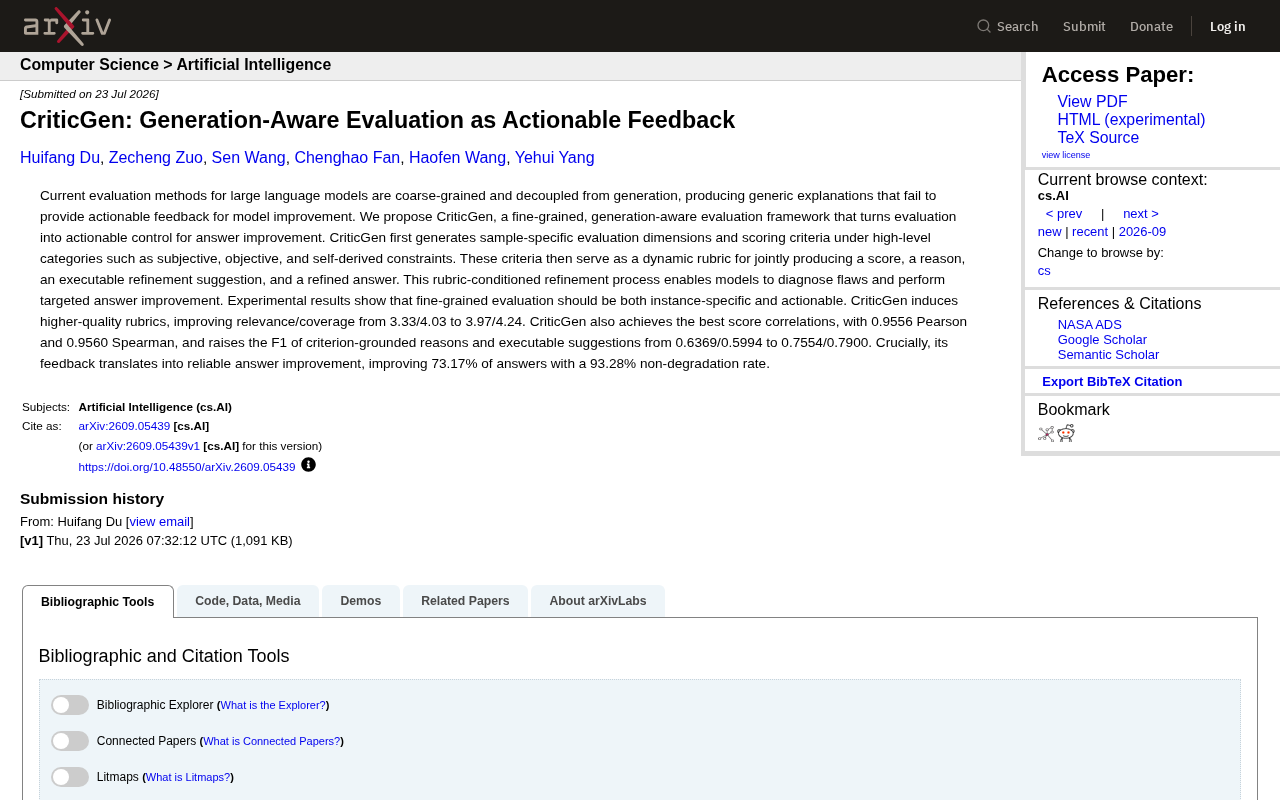
CriticGen: A New Framework That Transforms AI Evaluation into Actionable Improvement Feedback
CriticGen proposes a generation-aware evaluation framework that transforms AI assessment from passive scoring to an active optimization loop, achieving 73.17% answer improvement and 93.28% non-degradation rate.
Vercel AI SDK workflow-harness Update Analysis
Deep analysis of Vercel AI SDK workflow-harness 1.0.107 update: architecture design, engineering practices, and developer value for building reliable AI apps.
Rootless Containers Explained: Principles, Benefits, and Leading Implementation Approaches
A deep dive into rootless container principles and security benefits, comparing Podman, Docker Rootless mode, and Kubernetes integration with practical migration advice.