Zero to Deep Learning in Three Months: An Efficient AI Self-Study Roadmap

A 3-month, application-first AI roadmap: two weeks of basics, then deep learning starting with computer vision and LLMs.
This three-month AI self-study roadmap, shared by a Bilibili creator, centers on "timebox" learning — compressing Python, math, and machine learning into two weeks without getting bogged down in derivations, then devoting the remaining time to deep learning. It recommends starting with computer vision for its intuitive nature, then transitioning to NLP with a direct focus on LLMs and AI Agents rather than traditional fundamentals. Data mining is listed as optional. The roadmap suits engineering-focused beginners but those aiming for research will still need to revisit the theoretical foundations they skipped.
For beginners looking to break into artificial intelligence quickly, the biggest pain point is rarely a shortage of resources — it's not knowing how to allocate limited time. A three-month AI self-study roadmap from a Bilibili content creator offers a clear framework: rather than endlessly polishing fundamentals, focus on application-driven learning and push quickly into the core areas of deep learning. This article breaks down and interprets that roadmap.
Foundation Phase: Python and Math in One Week or Less
The roadmap's central philosophy is "good enough is good enough." The author recommends spending no more than one week on Python and math, for a straightforward reason: these fundamentals are just a stepping stone for what comes next — you don't need to master them.
Grasping basic syntax and core concepts is enough to move on. In today's development environment, AI Agents can already help you write code and read papers, so there's no need to grind away at Python and math in the early stages. This view may be controversial, but for learners whose goal is employment and practical application, it dramatically lowers the barrier to entry.
Machine Learning: Grasp the Ideas, Skip the Formula Derivations
The machine learning section is similarly recommended to take about one week. The author offers a counterintuitive but pragmatic observation: the more deeply you study machine learning, the heavier the burden becomes — and the less motivated you'll feel to push forward.
The approach is to "skim" the ten classic algorithms — just understand what each one does, how it models the problem, what data goes in, and what comes out. Formula derivations and underlying mechanics can be skipped for now. With this approach, Python, math, and machine learning together can be covered in roughly two weeks.
Deep Learning: Start with Computer Vision
Once the foundations are in place, the remaining two-plus months are devoted entirely to deep learning. The author recommends choosing from three directions: computer vision, natural language processing, and data mining.

Computer vision is the recommended starting point because it's relatively concrete — it's something you can see and touch — making it more intuitive to learn. This phase involves first mastering deep learning fundamentals (neural networks, various network architectures, convolutional neural networks, etc.) before moving into specific tasks like detection, segmentation, and recognition. Expect this to take around one month.
Convolutional Neural Networks (CNNs) are the core foundational architecture for computer vision, inspired by how biological visual cortexes respond to local receptive fields. Unlike fully connected networks, CNNs use convolutional kernels that slide across images to extract local features, drastically reducing the number of parameters while achieving translation invariance — meaning the network can recognize a target regardless of where it appears in the image. Once you've mastered CNNs, specific tasks like detection (e.g., the YOLO family), segmentation (e.g., U-Net), and recognition all build on this foundation, so the investment in this core module pays dividends repeatedly as you tackle downstream tasks.
Expanding Directions: The Underlying Logic Stays the Same
Many beginners worry that after learning one direction, switching to another means starting from scratch. The author's answer is no.

While studying computer vision, you'll already become familiar with a large amount of neural network fundamentals and architectures. Expanding into other directions essentially just means "different input data, different output results" — the algorithmic logic in between stays the same. This means that if your first direction is solid, expanding into others will be surprisingly smooth.
Natural Language Processing: Focus on LLMs and AI Agents
When pivoting to natural language processing, the author advises not getting hung up on traditional fundamentals, because in the current landscape — dominated entirely by large language models and AI Agents — many of those traditional skills are simply no longer needed.

The learning focus should be on large language models and AI Agents, guided by practical application. From an employment perspective, application-oriented roles are more plentiful, job opportunities are broader, and the barrier to entry is relatively lower. This is a path far more aligned with real market demand.
Large Language Models (LLMs) typically refer to language models with billions to hundreds of billions of parameters, pretrained using Transformer architectures — prominent examples include the GPT series, LLaMA, and Claude. AI Agents are systems built on top of LLMs that incorporate tool-calling, memory management, and task-planning capabilities, enabling them to autonomously decompose goals, call external APIs, and execute complex tasks step by step. For application-oriented learners, the core skills include Prompt Engineering, Retrieval-Augmented Generation (RAG), and building Agent pipelines using frameworks like LangChain and LlamaIndex. These skills are in high demand in engineering roles today and don't require a deep mathematical background.
Data Mining: Optional, as Needed
Data mining is positioned as an elective. If you still have time and interest after completing the first two directions, you can supplement with data mining — topics like time series analysis or graph neural networks — or participate in competitions for hands-on practice.
The Value and Limitations of This Roadmap
The greatest value of this roadmap lies in its "timebox" thinking — setting a firm time limit for each phase to prevent beginners from getting stuck in endless foundational study. It's application- and employment-driven, which aligns well with the technical realities of the current LLM era.
That said, it's worth viewing this critically: skipping formula derivations and underlying theory does accelerate onboarding, but if your goal is research or deep model fine-tuning, a solid mathematical and theoretical foundation remains indispensable. This roadmap is better suited for learners targeting engineering applications and fast employment rather than academic research. Whether three months truly counts as "getting started" depends heavily on the intensity of daily effort and the depth of hands-on practice.
"Timeboxing" is a project management and learning strategy whose core idea is to set a fixed time limit for a task in advance and force progress once that time is up — rather than waiting until you feel "satisfied enough" to move on. This method effectively combats perfectionism-driven procrastination, and is especially well-suited to technical learning — because the boundaries of foundational knowledge are nearly infinite. Without a time constraint, beginners can easily fall into a perpetual cycle of "building fundamentals" and never reach the core domain. The trade-off is that understanding of some concepts stays at the usage level; when complex problems arise, you may need to go back and fill gaps. This makes the strategy's suitability highly dependent on personal goals — engineering application vs. academic research.
Related articles

AI Agent Fundamentals: The Three Core Components — Brain, Memory, and Tools
A beginner's guide to AI Agents: covering the three core components (brain, memory, tools), four stages of LLM deployment, and why Agents matter for real business use cases.
Boycotting Software That Doesn't Support Linux: One Developer's Philosophy of Choice
A Linux-only developer shares his philosophy of boycotting non-Linux software — without sacrificing productivity — and explains how coding agents like Claude Code are closing the gap with commercial tools.
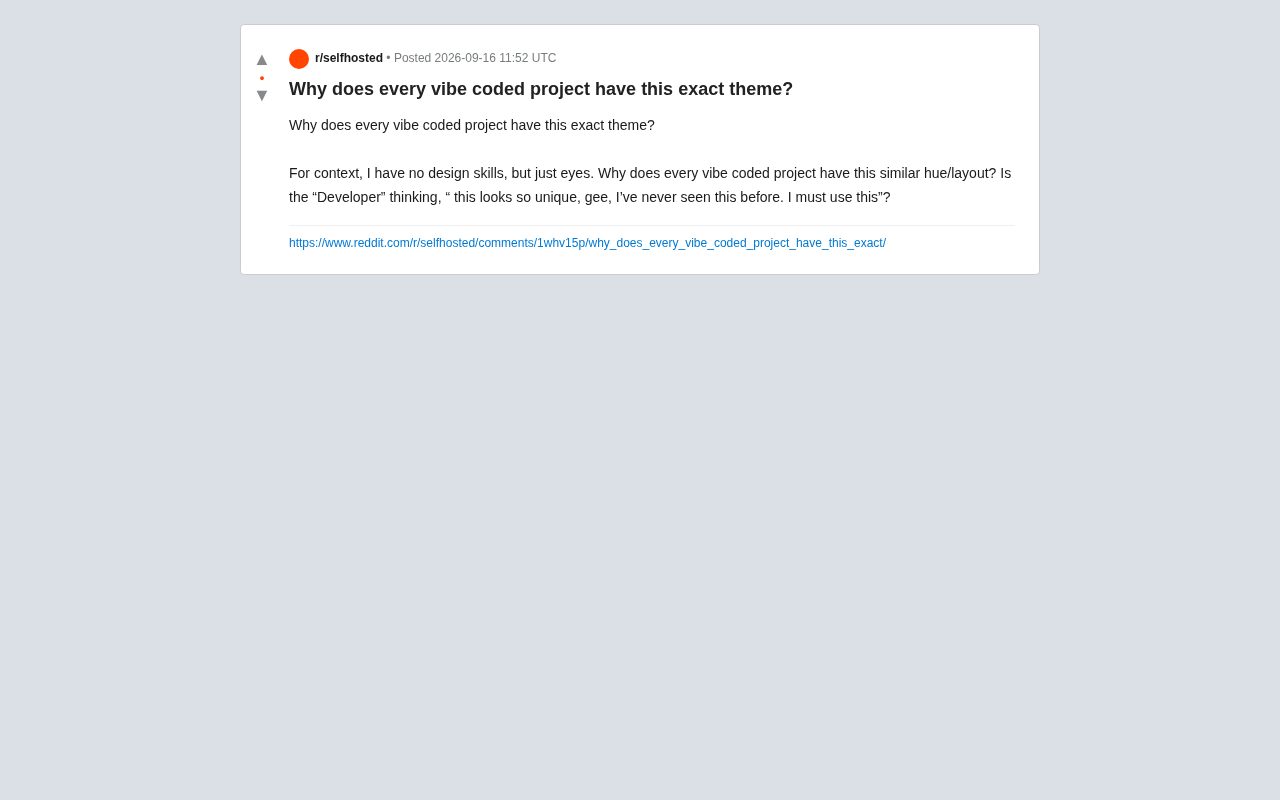
Why Do All AI-Generated Projects Look the Same? The Aesthetic Homogenization Problem in Vibe Coding
Why do vibe coding projects all use purple gradients and dark glassmorphism? We break down the technical roots of AI aesthetic homogenization and how to escape it.