Zero to Hero in 3 Hours: AI Automation Testing with Playwright and DeepSeek
Playwright, via the DevTools Protocol and MCP, is the core tool for AI automation testing's new threshold.
Based on a Bilibili AI automation testing intro video, the article outlines Playwright's core advantages, boundaries, and AI integration path. Playwright is Microsoft-built and DevTools Protocol-based, controls browsers directly through the engine without drivers, and natively supports async for high-concurrency tasks. Compared with Selenium, it is fast, uses smart locators to reduce failures, and enables LLMs to call automation capabilities via Playwright MCP; however, browser support is mainly limited to Chromium, excluding older engines like IE. The article also gives a three-step beginner path: understand async and protocol principles, practice locating and assertions, and let AI take over some tasks via MCP, noting that the video has few practical details on DeepSeek Harness and official docs should fill the gaps.
AI automation testing is becoming the new threshold for testing roles. A recent video on Bilibili titled "2026's Hottest AI Automation Testing Roles (DeepSeek Harness/Playwright/Python): Zero to Agent Testing Mastery in 3 Hours" has drawn attention. The creator starts with Playwright's core features, compares it to traditional tools like Selenium, and demonstrates how to combine it with large language models to complete automation testing tasks. Based on that video, this article outlines Playwright's core advantages, its boundaries of applicability, and the path to integrating AI, helping readers with no background quickly build a conceptual framework.
Why Playwright? Microsoft and the DevTools Protocol
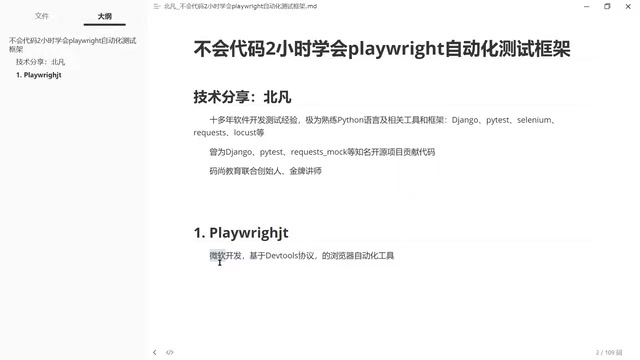
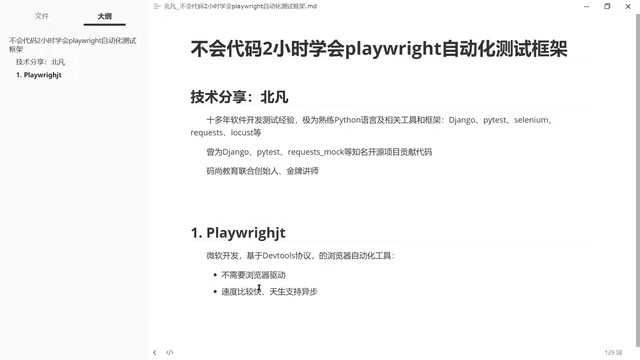
The creator first emphasizes two foundational labels for Playwright: it is developed by Microsoft, and it is based on the DevTools Protocol. The former means the project has a stable maintenance and update cadence and is unlikely to be abandoned; the latter determines its fundamental technical difference from Selenium.
By building on the DevTools Protocol, Playwright controls the browser directly through the browser engine and does not need to rely on browser drivers the way Selenium does. This lowers the environment setup barrier—as long as a browser is installed on the machine, it can run. At the same time, the DevTools Protocol itself is a Socket-based bidirectional asynchronous communication protocol, so Playwright natively supports asynchronous operations, giving it a clear advantage in large numbers of highly concurrent automation tasks.
DevTools Protocol (Chrome DevTools Protocol, CDP) is a debugging interface exposed by Chromium-based browsers. It allows external programs to communicate with the browser over WebSocket and directly control low-level behaviors such as page loading, DOM queries, network interception, and JavaScript execution. Playwright talks to the browser engine through CDP, so it does not require a separate browser driver (such as Selenium's chromedriver); it only needs a compatible browser installed locally. CDP itself is a bidirectional asynchronous messaging protocol, which is the technical root of Playwright's native support for async/await and its ability to efficiently handle large numbers of concurrent sessions. Note that because CDP is a capability specific to Chromium-based browsers, Playwright's support for Firefox and WebKit is implemented through their own customized patched protocols, with slightly different feature coverage from Chromium.
Playwright vs. Selenium: Advantages and Limitations
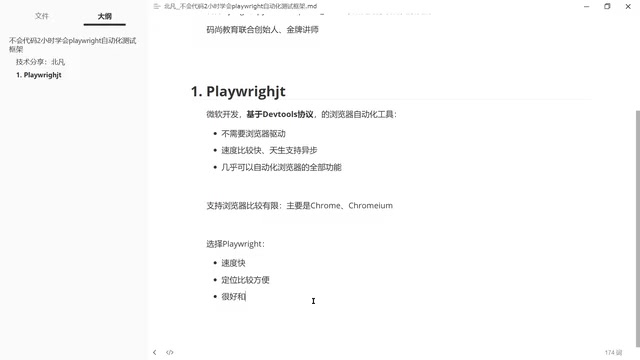
The creator summarizes Playwright's advantages in three points: speed, convenient smart locators, and ease of integration with AI. The smart locator logic reduces the probability of element location failures, while the Playwright MCP protocol allows large language models to directly invoke Playwright capabilities—something traditional tools can hardly match.
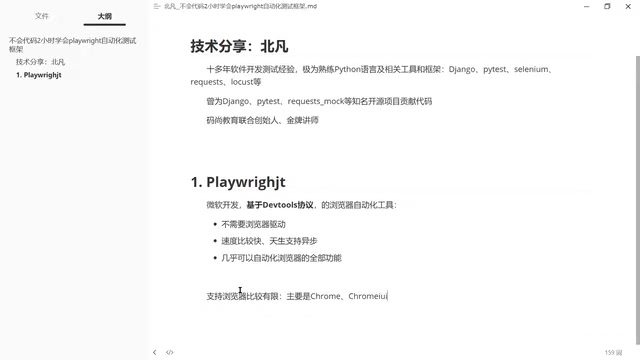
But Playwright does not completely dominate Selenium across the board. Because it relies entirely on the DevTools Protocol, its browser support is limited, mainly covering Chromium-based browsers (and Chromium-based Edge, etc.); older engines such as IE cannot be used. The creator also mentions that Selenium still has value in certain specific business scenarios, but Playwright is up to the task in mainstream scenarios.
Playwright MCP (Model Context Protocol) is a standardized interface that lets large language models "use" Playwright. MCP was proposed by Anthropic and is essentially a protocol describing tool capabilities and invocation methods: it packages Playwright's browser operations (opening pages, clicking, filling forms, taking screenshots, reading the DOM, etc.) into a tool list that AI can understand. The model calls them as needed during reasoning and sends execution results back to the model for further decisions. Compared with having AI directly generate Selenium scripts and then run them, the MCP model lets AI "watch while operating" in a real browser environment, with element location backed by Playwright's smart locators, significantly reducing the probability of script failures caused by page structure changes. This is also the technical foundation of "agent-style testing": AI is no longer just a code generator, but an execution entity that can perceive page state and autonomously complete multi-step operations.
Smart locators are one of the core differences between Playwright and Selenium. Selenium commonly uses ID, XPath, CSS selectors, and other locators, which tend to break when the page structure changes slightly; Playwright, by contrast, has built-in user-semantics-oriented locators such as getByRole, getByText, getByLabel, and getByPlaceholder, which prioritize matching elements by accessibility role and visible text. Playwright also provides an auto-waiting mechanism: before performing actions such as clicks and typing, it automatically waits for the element to be visible, interactive, and stable, without the need to hand-write explicit waits (WebDriverWait) as in Selenium. Together, these two points make test scripts closer to human operating habits and easier for AI to understand and generate—AI only needs to describe "click the login button" without caring about the button's specific path in the DOM tree.
How Large Language Models Plug into Automation Testing
The "DeepSeekAd Harness" in the video title points to the path of combining AI with testing tools. The creator mentions that through the Playwright MCP protocol, Playwright can be handed over to AI for use, and AI can complete automated operations well. This means testers can describe tasks in natural language and have AI generate or execute test scripts, greatly lowering the coding barrier. For zero-background learners, first mastering Playwright's basic locating and operations, then understanding how MCP is invoked, is a reasonable sequence for a 3-hour introductory path.
Suggested Learning Path for Beginners
Based on the video content, a zero-background introduction can be divided into three steps: first, understand Playwright's asynchronous features and the principles of the DevTools Protocol to build technical intuition; second, get hands-on with launching the browser, locating elements, basic assertions, and other operations; third, try letting AI take over some automation tasks through the MCP protocol and experience agent-style testing. The creator emphasizes "getting started quickly" rather than digging into details, which suits short-term, employment-oriented sprinting.
It should be noted that the video contains relatively few concrete demonstration details about DeepSeek Harness and is more about conceptual guidance. When studying in practice, readers are advised to supplement hands-on practice with official documentation and real projects.
One-line Summary
Playwright, with the DevTools Protocol and MCP protocol, has become the core tool for AI automation testing's new threshold.
Paragraph Summary
Based on an introductory AI automation testing video on Bilibili, the article outlines Playwright's core advantages, boundaries of applicability, and AI integration path. Playwright is developed by Microsoft and built on the DevTools Protocol, controlling the browser directly through the browser engine without browser drivers, and natively supports asynchronous operations, making it suitable for high-concurrency automation tasks. Compared with Selenium, it is fast, reduces failure rates through smart locators, and allows large language models to directly call automation capabilities through the Playwright MCP protocol; however, because it relies on the DevTools Protocol, browser support is mainly limited to Chromium-based browsers, and older engines such as IE cannot be used. The article also provides a three-step learning path for beginners: understand async and protocol principles, get hands-on with locating and assertions, and let AI take over some tasks through MCP. It also notes that the video offers few practical details on DeepSeek Harness and that official documentation should be used to fill the gaps.
Related articles

Vibe Coding End-to-End in Practice: Building Products with AI from Zero
A look at Bilibili's 80-episode Vibe Coding course: from concept to end-to-end practice, covering AI-directed coding, multi-platform development, engineering delivery, and AI-automated operations—ideal for beginners who want to build products independently.

TensorLean: A New Tool for Formal Verification of GPU Kernels
Columbia University and CertiK propose TensorLean, which uses Lean to formally verify production GPU kernels at the PTX level. It checked 149 kernel instances, proving 83 correct and finding 38 defects, involving FlashAttention, DeepGEMM, and others.

WorkBuddy Zero-Basics Office Automation Hands-On Tutorial
WorkBuddy hands-on tutorial: learn how this domestic Codex alternative adapts to common office software, with 28 knowledge points and SQL materials to automate your office work.