Zero-to-Hero Python Course Review: How a 400-Episode Series Uses AI to Supercharge Learning

A 400-episode free Bilibili Python course integrates AI tools, game projects, and human Q&A to help beginners stick with learning.
This Bilibili Python course plans 400 episodes covering environment setup through web frameworks and data analysis, with ongoing updates. Its standout design choices include integrating AI tools like Copilot, ChatGPT, and DeepSeek from day one; using turtle graphics and game projects like Tank Battle and Plants vs. Zombies to create immediate wins and combat dropout; and providing live human Q&A rather than AI bots, since beginners struggle to phrase technical questions effectively. Supplementary exercises, real-time feedback, and an interview-focused problem bank round out the offering. Future plans include FastAPI, LLM applications, and quantitative trading. The planning is solid and practical, but actual teaching quality awaits content delivery.
For beginners, the biggest barrier to learning Python isn't the syntax itself — it's dry concepts, abstract explanations, and courses that never connect to real-world practice. A free Python series on Bilibili, planned at 400 episodes, aims to tackle these longstanding problems through AI assistance, hands-on examples, and live human Q&A. This article breaks down the course's core design philosophy and examines just how useful it really is for complete beginners.
Overall Course Structure: A Complete Path from Basics to Real Projects
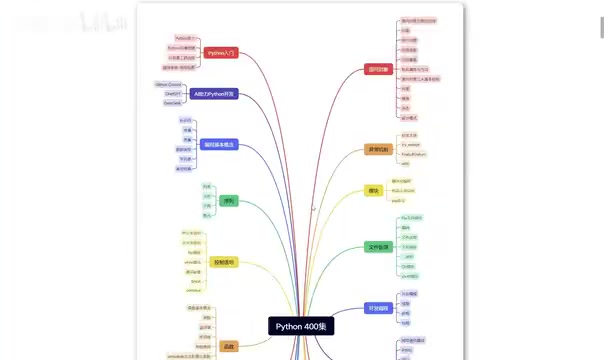
The course plans to release 400 video episodes in total, covering everything from environment setup to hands-on project development. The creators have laid out a detailed mind map of the curriculum, with clearly defined tiers: the beginner stage covers environment setup and fun starter projects; the foundational stage tackles core programming concepts including sequences, control statements, and functions.
Building on that is an advanced knowledge module covering object-oriented programming, exception handling, modules, file I/O, concurrent programming, and network communication. Notably, the course also includes topics like regular expressions, functional programming, and memory management — areas that introductory tutorials often skip, yet come up constantly in real development work.
The curriculum also covers popular web frameworks like Flask and Django, as well as two major application tracks: data analysis and office automation. It's worth noting that the 400 episodes represent the current planned scope; the course follows a continuous-update model and will keep expanding over time.
AI-Assisted Development: Weaving Large Language Models into the Learning Process
One of the clearest ways this course differs from traditional Python tutorials is its explicit inclusion of AI tools in the curriculum. The creators plan to walk learners through tools like Copilot, ChatGPT, and DeepSeekAd to boost both development speed and learning efficiency.
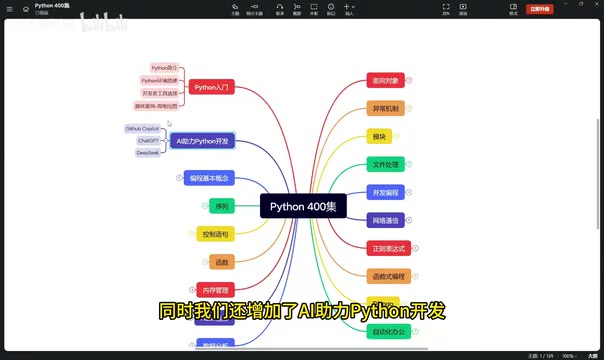
This design aligns well with today's actual development environment. For beginners, learning how to use AI coding assistants to autocomplete code, explain error messages, and generate examples is itself a valuable skill. Introducing AI tools from day one, rather than teaching syntax in isolation, is far closer to what real-world workflows look like — and it can significantly reduce the frustration of getting stuck.
Gamified Learning: Using Graphics and Games to Lower the Entry Barrier
To combat the monotony of programming study, the course incorporates fun, interactive content at multiple stages. In the beginner phase, it introduces the turtle graphics module, where learners can draw roses, stars, and even animated "I love you" effects — giving abstract code immediate, visible results.
Once learners have built up some technical foundation, the course moves into mini-game projects, including classics like Tank Battle, Plants vs. Zombies, Happy消消乐 (a match-three puzzle game), and Flappy Bird. Recreating these games from scratch reinforces knowledge while keeping motivation high. This "learn by playing" approach is one of the most effective antidotes to the all-too-common "started and quit" dropout pattern.
The turtle module is a built-in Python graphics library rooted in the teaching philosophy of the Logo programming language from the 1960s — the idea of letting beginners draw shapes by directing a "turtle" across the screen. Because it requires no extra installation and provides instant visual feedback, it has long been a staple of K–12 programming education in Western countries. Drawing with turtle actually exercises core concepts like coordinate systems, loop control, and function encapsulation — they're just wrapped inside the intuitive goal of "draw a flower," which dramatically lowers the psychological barrier. For someone with zero coding experience, seeing their code "come alive" in the first few lessons is a crucial psychological anchor for staying motivated.
Exercises and Practice: Tests and Instant Feedback on Key Concepts
The course emphasizes practice alongside theory rather than pure lecture. For trickier concepts like tuples, dictionaries, and sets — areas where beginners commonly struggle — the course includes dedicated tests and exercises. Standard chapters also come with their own practice sets.
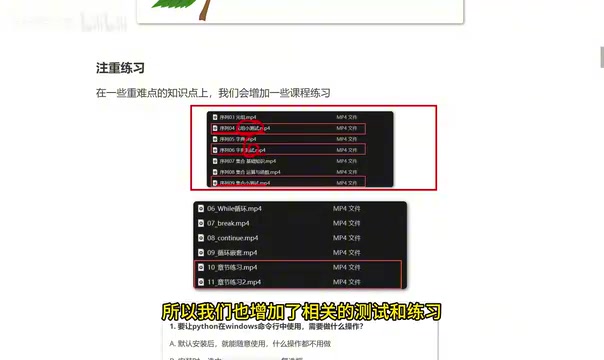
For particularly challenging material, the creators have added a real-time feedback mechanism to verify how well learners have absorbed each lesson. This instant-check design helps learners catch weak spots early, preventing knowledge gaps from snowballing over time.
Live Human Q&A and a Practice Problem System: Two Practical Support Features
The course includes a real-time Q&A system — and the creators are explicit that it's staffed by real people, not AI bots. Their reasoning is compelling: beginners often struggle to articulate their problems in a way that produces useful responses from tools like ChatGPT or DeepSeek. A human, they argue, is simply better at understanding how another human expresses confusion.
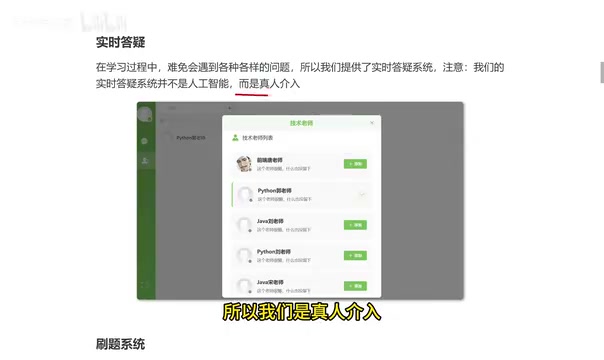
This reflects a genuine reality: AI-powered Q&A is powerful, but there's still a real barrier for newcomers who haven't yet picked up the vocabulary. The course also provides a coding problem bank geared toward job interviews. Regardless of experience level, heavy LeetCode-style practice before job hunting is essentially unavoidable — so having a dedicated problem system is a practical addition for learners aiming to enter the workforce.
The core difficulty beginners face when using AI tools for Q&A is a chicken-and-egg problem between prompt-writing ability and depth of programming understanding. Getting an accurate answer from ChatGPT or DeepSeek typically requires clearly describing the error context, the surrounding code, and the expected behavior — precisely the kind of articulation that beginners haven't yet learned. This is sometimes described as the reverse of the "curse of knowledge" in technical education: the less you know, the harder it is to ask a good question. The advantage of a human teaching assistant is the ability to infer the real problem from a vague description and guide the learner toward the root cause using everyday language — a capability that AI support systems still struggle to replicate in unstructured, beginner-level Q&A scenarios.
What's Coming Next: Advanced Topics and Large Language Model Applications
The update roadmap branches in two directions. On the knowledge side, future plans include FastAPI, additional frameworks, AI large language models, and quantitative trading. On the project side, planned additions include a full e-commerce backend management system and an online education platform.
From beginner syntax to web frameworks to large language models and quantitative trading, this course is trying to build a continuous learning path from zero to relatively advanced applications. For learners who want to study Python systematically on a tight budget, a free, well-structured course that actively embraces AI tools like this one is worth considering.
Summary
The core approach of this 400-episode Bilibili Python course is to lower the entry barrier with fun examples, reinforce learning through practice and real projects, fill in service gaps with human Q&A and a problem bank, and weave AI coding tools into the entire learning journey. As a course introduction, the planning is thorough and the direction is practical — but the actual teaching quality will ultimately be judged once the full content rolls out.
Related articles

How Big Can Stars Really Get? The Physical Limits of the Largest Stars
Red supergiants are the largest stars by volume, with radii up to 2,000 times the Sun, engulfing the inner solar system. But there is no precise upper limit on stellar size—models predict up to 15,000 solar radii. The most massive blue stars are far smaller than red supergiants—biggest and heaviest are two different things.

Apple HomeView Smart Display Full Feature Breakdown: Wall-Mount or Desktop, $299
Apple launches HomeView, a $299 smart display with wall-mount and desktop options, 12MP camera for facial recognition, smart home control, music playback, and recipe step-by-step cooking. Full breakdown of watch faces, apps, privacy, and cooking integration.

Where Did the Promised New Studio Go? Craft Computing Answers After Five Years
Craft Computing's host responds to viewer questions: the new studio promised five years ago was shelved as construction costs soared from $30,000 to $75,000, and was replaced by a 168-square-foot garage conversion.