Zeta Global Launches AIM Inference Model: How Fireworks Powers Vertical AI

Zeta Global uses Fireworks to launch AIM, a domain-specific marketing AI model, reflecting a new enterprise AI deployment paradigm.
A congratulatory tweet from Fireworks revealed an important enterprise AI trend: MarTech company Zeta Global leveraged Fireworks' inference platform to launch its proprietary Athena Inference Model (AIM), built on consumer behavior data. The article examines what "specialized intelligence" means, explores the three technical paths to achieving it, and analyzes the emerging division of labor — where platforms like Fireworks handle inference infrastructure while domain players like Zeta Global contribute data and business context. This model lowers the barrier to enterprise AI ownership and highlights inference efficiency as a key bottleneck for scaling AI in production.
The Vertical AI Wave Behind a Single Tweet
A brief tweet from Fireworks offers a revealing window into how enterprise AI is being deployed today. The post congratulated Zeta Global on the successful launch of its Athena Inference Model (AIM), framing it as another example of "enterprises using Fireworks to bring specialized intelligence to their customers."
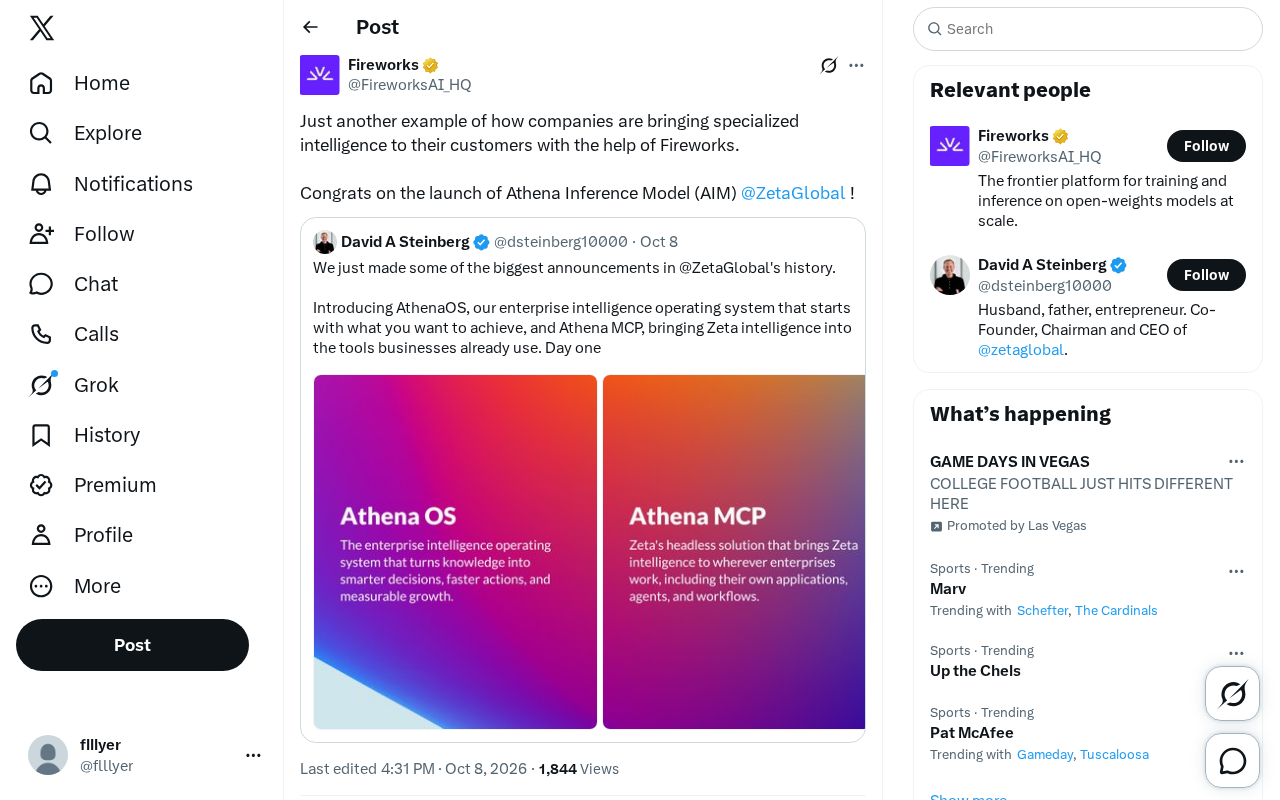
The message was short, but it points to an accelerating trend: more and more companies are moving beyond simply calling general-purpose large models via API. Instead, they're building their own specialized inference models grounded in proprietary industry data and domain-specific use cases. Zeta Global, a player in the marketing technology (MarTech) space, exemplifies this "vertical intelligence" philosophy with the launch of AIM.
What Is "Specialized Intelligence"?
General-purpose large models excel at a broad range of tasks, but they often fall short in the deep, domain-specific scenarios that enterprises actually care about. Specialized intelligence refers to AI models that have been customized, fine-tuned, or otherwise optimized for a particular vertical or business need.
For a company like Zeta Global — whose core business revolves around data-driven marketing — an inference model's value lies in its ability to draw on vast consumer behavior datasets to make more accurate predictions and decisions. Think customer intent recognition, optimal timing for marketing outreach, or personalized content recommendations. Compared to off-the-shelf models, a purpose-built Athena Inference Model can, in theory, align far more tightly with Zeta's proprietary data assets and business logic.
There are generally three technical paths to achieving specialized intelligence. The first is Supervised Fine-Tuning (SFT) on top of a general-purpose base model, injecting domain-specific labeled data. The second is Retrieval-Augmented Generation (RAG), which dynamically incorporates content from a private enterprise knowledge base at inference time. The third — and most resource-intensive — is pre-training a base model from scratch on domain-heavy corpora, which offers the deepest domain adaptation. For a MarTech company like Zeta Global with large-scale consumer behavior data, the first or third approach is more likely: using structured signals like clicks, purchases, and intent data to train a model that outperforms generic alternatives when predicting consumer behavior. The name "Inference Model" also hints that AIM's core capability is oriented toward making real-time judgments from data patterns, rather than general-purpose text generation.
Fireworks' Role in the Stack
In this story, Fireworks is not the ultimate owner of the model — it's the infrastructure and inference services provider. Fireworks is known for its high-performance, cost-efficient model inference and deployment platform, giving enterprises the tools to rapidly build, optimize, and ship custom models.
This reveals a clear division of labor emerging across the AI industry: infrastructure platforms like Fireworks handle inference acceleration, model hosting, and deployment tooling, while domain players like Zeta Global contribute industry-specific data and use cases. Together, they bring specialized models to end customers. This "platform + domain expert" collaboration model is meaningfully lowering the barrier for enterprises to develop their own AI capabilities.
Founded in 2022, Fireworks AI is laser-focused on solving performance and cost challenges at the inference stage of large model deployment. Its core technologies include inference kernel optimizations tailored to different hardware (especially GPU clusters), dynamic batching, and quantization — techniques that dramatically increase tokens processed per second while reducing per-inference compute costs. Unlike the general-purpose AI services offered by cloud providers like AWS or Azure, Fireworks specializes in managed inference for the Bring Your Own Model (BYOM) use case: enterprises can upload their fine-tuned or custom-trained models to the platform, and Fireworks handles operations, auto-scaling, and performance tuning. This positioning gives it a distinct edge in vertical model deployment — companies don't need to build their own GPU infrastructure or staff a dedicated MLOps team to serve a proprietary model as a production service.
What This Means for Enterprise AI Adoption
The launch of AIM points to several signals worth watching. Enterprises are shifting from "calling someone else's model" to "owning their own model," with data ownership and domain context becoming the core competitive moat. The inference layer is gaining strategic importance — training is just the starting point; deploying models efficiently and economically to serve real business needs at scale is what actually determines success.
The rise of specialized models also signals further fragmentation of the AI value chain. Not every company needs to train a large model from scratch — but with mature inference platforms, virtually any data-rich company now has a realistic path to building specialized AI products that serve their own customers.
Closing Thoughts
It's worth noting that since the original source was a brief congratulatory tweet, there are no further public details available on AIM's specific technical parameters, performance benchmarks, or real-world results. That said, the "vertical AI + inference platform" collaboration model it reflects is a genuinely significant direction — one that captures the broader enterprise shift from general-purpose to domain-specialized AI. As more companies follow this path, specialized intelligence is poised to become a new frontier for differentiated competition.
Related articles

Chain of Thought Isn't Just for AI: How Humans Can Use CoT to Improve Thinking Quality
Chain of Thought isn't just a prompt trick for large models. Starting from a Hacker News discussion, this article analyzes why CoT works for human thinking too, breaks down actionable ways to transfer it, and highlights the key differences between human CoT and machine CoT.
Cloudflare Teams Up with OpenAI: Closi…
Cloudflare Teams Up with OpenAI: Closing the Loop from Vulnerability Discovery to Defense with AI
Cloudflare uses OpenAI Daybreak to investigate security vulnerabilities and generate reviewable remediation plans, while developers use Codex to boost coding efficiency and quality.

Orca Multi-Agent Orchestration in Practice: A Guide to Parallel Collaboration with Claude and Codex
Orca is Stable AI's free open-source agent workbench supporting 34 agents like Claude Code and Codex in parallel. Learn its Git worktree isolation, multi-model orchestration, and mobile management.