Zhipu ZCode Goes Open Source — But Not the Benefits

Zhipu ZCode goes open source but locks benefits in the official client, sparking debate over open-source sincerity.
Zhipu ZCode released its source code after a silent-upload controversy and passed a CAICT third-party audit — but a comment in the code explicitly excludes open-source users from promotional benefits, fueling a "code open, perks closed" debate. Meanwhile, on-device small models challenge cloud necessity with 154ms decision latency; AMD's MI350P targets legacy data centers; Alibaba's Qwen-Image-2.1 opens weights for a 7B generation-and-editing model; and Youdao releases an Apache 2.0 streaming ASR model. Multiple platforms also launched free credit promotions.
Zhipu ZCode Delivers: Code Is Public, Perks Stay Locked in the Client
Zhipu ZCode, which made headlines last week over allegations of silently uploading local repositories, has now issued its official response. The company published an apology, released the source code, and commissioned China's CAICT (China Academy of Information and Communications Technology) to conduct a third-party audit. The audit confirmed: zero data in the storage buckets, no code retained, nothing used for training. From a compliance standpoint, this was a reasonably thorough response.
But the story didn't end there. A community member spotted a comment in the open-sourced code stating that "the open-source version is not eligible for quota or promotional benefits." In other words, the source code is technically open — but the actual perks remain locked behind the official client. This creates an intriguing situation: the code is auditable, but users aren't treated equally.
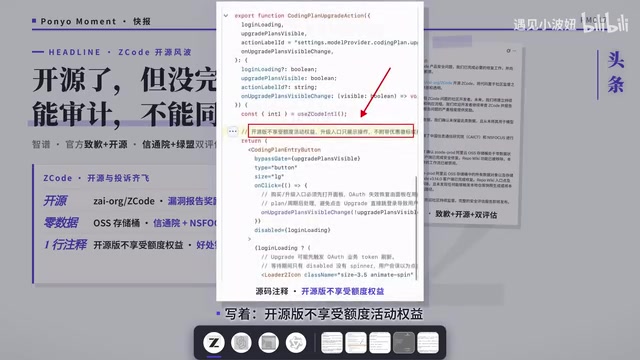
According to Bilibili creator Ponyo's analysis, Zhipu pursued two parallel strategies in handling this incident: on the technical side, they relied on the CAICT audit report for credibility; on the PR side, they chose to file complaints against the original whistleblower posts — with founder Tang Jie reportedly filing a report himself. This approach of "answer technical questions with a report, handle PR problems with complaints" became its own focal point in community discussions.
The Real Test of Open Source
This incident raises a question worth asking across the entire industry: the first step of open source is releasing the code — but the real test is whether you're willing to open up the benefits too. When source code is made public but a comment inside explicitly restricts promotional eligibility, the word "open source" gains an extra layer that deserves scrutiny. For developers, being able to read the code but not enjoy equal treatment means the sincerity of that open source gesture is compromised.
Open source licenses themselves do not require service providers to offer commercial benefits equally to all users. Common licenses like Apache 2.0, MIT, and GPL govern the rights to use, modify, and distribute code — not a product's pricing strategy or eligibility for platform promotions. So it's entirely possible to be fully compliant with open source requirements at the code level while using comments or terms of service to restrict certain perks to official-client users. This isn't unheard of in Commercial Open Source — it's often called the "Open Core" model, where the core code is public but add-on features or services remain commercial. The debate therefore shifts from "is it open source?" to "where's the boundary of open-source sincerity?" When open source is used as a PR tool rather than an ecosystem strategy, developer community trust tends to erode.
The Rise of On-Device Small Models: Why Route Judgment Tasks Through the Cloud?
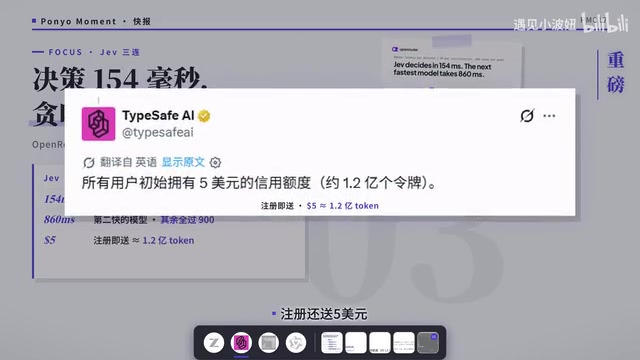
Another highlight this week is progress in on-device inference. Jeff — previously joked about as a model that "can't write a single word" — now has benchmark data from OpenRouter to back it up: decision-making in just 154 milliseconds, compared to 860 milliseconds for the second-ranked model. The platform announced full public access, with $5 in free credits upon registration.
What's even more interesting is the community reaction. Someone ran a 421M-parameter open-source small model called Laya against it on a simple judgment task called "Greedy Tongue," scoring in the 60s out of a possible individual-digit count in 30 seconds. This points to a key insight: if the task is fundamentally just making a judgment call, why send it to the cloud at all? On-device small models are proving that many use cases simply don't need massive cloud-side compute.
AMD MI350P: Not Chasing Peak Performance — Chasing Compatibility
On the hardware front, AMD announced the MI350P. This card is positioned practically — not chasing peak performance, but leading with compatibility. Air-cooled design, 450 to 600 watts of power draw, and direct compatibility with standard servers.
Just last week we noted AMD's profit margins outpacing rivals — and now they're rolling out a card aimed at legacy data center upgrades. The logic is clear: if you can't afford a liquid cooling solution, AMD will sell you an air-cooled version. This "downscale-to-fit" strategy targets the massive installed base of existing data centers looking to upgrade.
On-device inference means running a model directly on the user's local device rather than sending requests to a remote server. Its key advantages are: ultra-low latency (no network round-trip), data stays local (better privacy), and offline availability. 421M parameters (approximately 421M) falls squarely in the "Small Language Model" (SLM) category — inference is far less computationally intensive than models like GPT-4 or Claude, and these can run in real time on consumer GPUs or even CPUs. Judgment tasks (such as classification, intent recognition, or rule-trigger detection) require relatively shallow reasoning depth, which is exactly where small models shine. A 154ms decision latency means near-imperceptible wait times in real-time interactions like game AI, input method suggestions, or shortcut triggers — something cloud models struggle to match under average network conditions.
Open Source Updates: Qwen-Image-2.1 and Youdao Speech Recognition
Two significant updates in the open-source ecosystem this week.
Alibaba's Qwen-Image-2.1 has released weights. Built on a 7B architecture, the model integrates generation and editing in a single model and natively supports transparent layers. NVIDIA's official account even showed up to congratulate the release — a signal of its weight in the image generation space. A single model covering both generation and editing, plus native transparent layer support, is a genuine convenience for design and creative applications.
NetEase Youdao released the Confucius 4R2T2 streaming speech recognition model, with latency ranging from 200 to 600 milliseconds. It uses an "append-only, no-rewrite" subtitle strategy, avoiding the jarring experience of subtitles flickering and changing mid-recognition. The code is under Apache 2.0 and the weights are available for download.
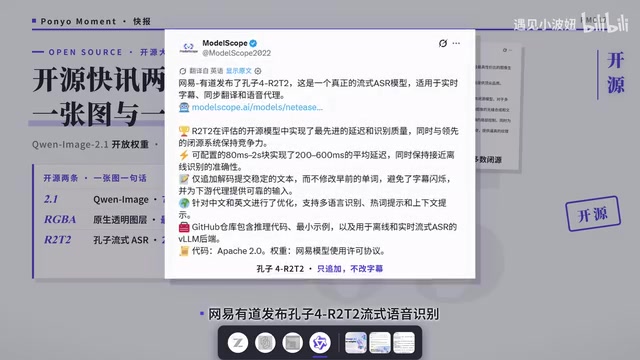
Streaming ASR differs from traditional batch speech recognition in one key way: it outputs text in real time as the user speaks, rather than waiting for a complete utterance before transcribing. The "append-only" strategy (also called Stable Hypothesis) means that once a word is output, it's never modified — preventing subtitles from constantly jumping and rewriting on screen, which is critical for live captions, simultaneous interpretation assistance, and similar use cases. A 200–600ms latency range means subtitles lag behind actual speech by less than half a second under typical network conditions — an acceptable, practical level. Apache 2.0 is one of the most enterprise-friendly open source licenses available, permitting commercial use, modification, and closed-source distribution with only a requirement to retain the original copyright notice. This makes the model essentially barrier-free for enterprise integration.
Free Tier Roundup: Credits Across Multiple Platforms
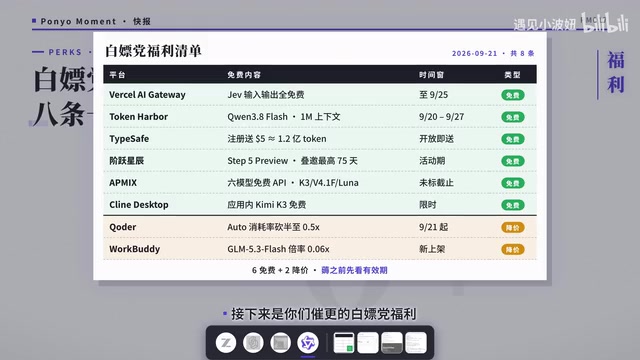
This week's freebies are particularly dense. Notable highlights: the Jeff model on Vercel is free for both input and output through September 25; Token Harbor's Qwen 3.8 Flash is free for one week; stacking login and referral rewards on Jie Yuexing can get you up to 75 days of access. For the rest of the free credit details, check the summary table in the video.
Six Industry Updates: Client and Toolchain News
Finally, a quick rundown: Client Desktop launched just one week ago and is already handling 6% of tasks across all platforms; WorkBody has added GLM 5.3 Flash with a rate as low as 0.06x; DeepSeekAd V4 Pro has been pinned to the Client bottom bar with a new version on the way; Coder's Auto credit allowance has been cut in half starting today.
There's also chatter predicting "2026 is the year of the Linux desktop," with speculation about whether ChatGPT's Codex might launch a Linux desktop version. This wave of dense client and toolchain updates reflects AI applications accelerating their push into desktop environments and local deployment.
Closing Thoughts
This week's news follows a clear thread: from ZCode's "code open, benefits closed" controversy, to on-device small models challenging the necessity of cloud routing, to open weights from Qwen-Image-2.1 and Youdao's speech recognition model — open source is moving from "is it public?" into the deeper waters of "how thoroughly public is it?" For developers, learning to read the fine print in source code comments matters more than taking open-source announcements at face value.
Related articles

Chain of Thought Isn't Just for AI: How Humans Can Use CoT to Improve Thinking Quality
Chain of Thought isn't just a prompt trick for large models. Starting from a Hacker News discussion, this article analyzes why CoT works for human thinking too, breaks down actionable ways to transfer it, and highlights the key differences between human CoT and machine CoT.
Cloudflare Teams Up with OpenAI: Closi…
Cloudflare Teams Up with OpenAI: Closing the Loop from Vulnerability Discovery to Defense with AI
Cloudflare uses OpenAI Daybreak to investigate security vulnerabilities and generate reviewable remediation plans, while developers use Codex to boost coding efficiency and quality.

Orca Multi-Agent Orchestration in Practice: A Guide to Parallel Collaboration with Claude and Codex
Orca is Stable AI's free open-source agent workbench supporting 34 agents like Claude Code and Codex in parallel. Learn its Git worktree isolation, multi-model orchestration, and mobile management.