Zig Creator on AI Code Ban: Don't Smoke in My House
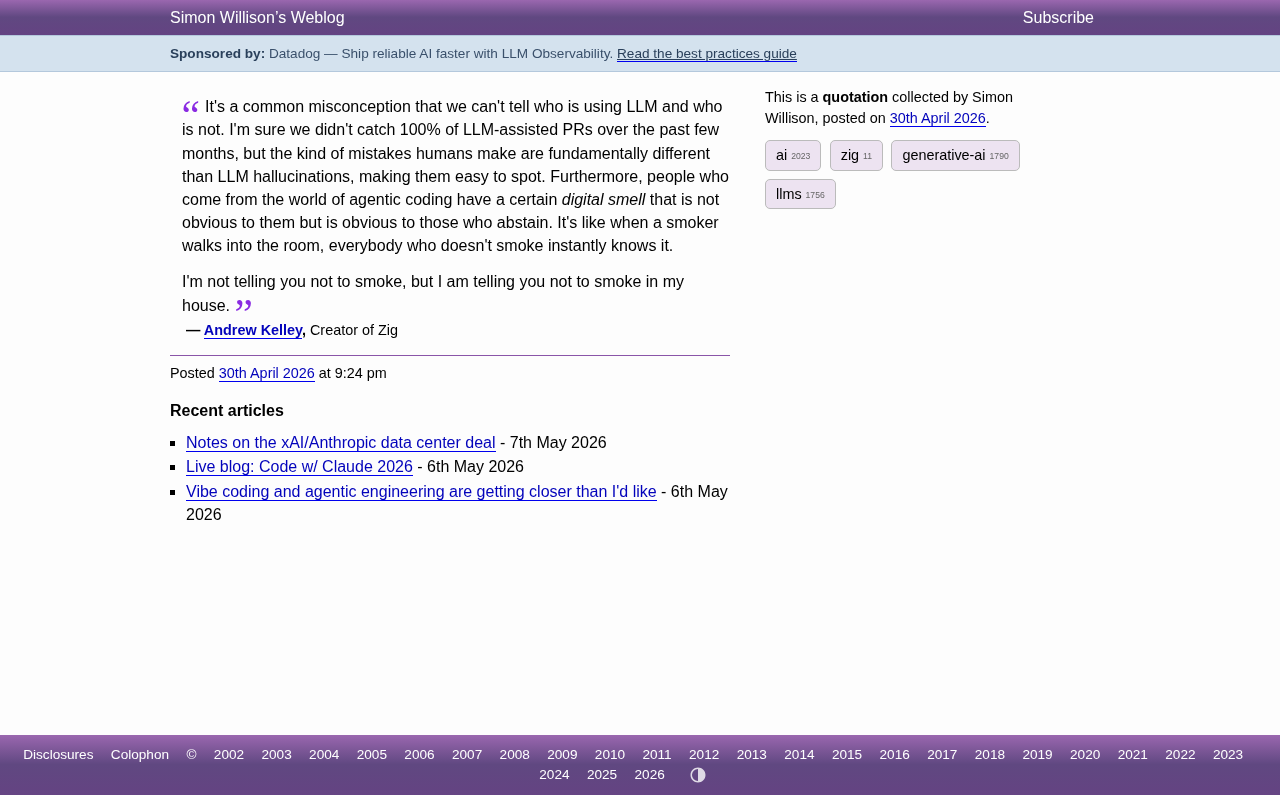
Zig's creator bans AI code contributions, comparing it to asking guests not to smoke in his house.
Zig programming language creator Andrew Kelley has articulated the project's ban on AI-assisted code contributions, arguing that LLM hallucinations are fundamentally different from human errors and carry a detectable "digital smell." Using a smoker analogy, he sets clear boundaries without moral judgment — developers can use AI elsewhere, but not in Zig's codebase. The core concern is that contributors may not understand AI-generated code they submit, shifting cognitive burden to maintainers.
Zig Language's Hard Stance on AI-Assisted Contributions
Zig programming language creator Andrew Kelley recently posted a thought-provoking comment on the Lobsters forum, explaining Zig's position and reasoning for banning AI-assisted code contributions. The statement quickly sparked heated discussion in the developer community, as it touches on one of the most sensitive issues in open source today: Should AI-generated code be accepted into open source projects?
"Digital Smell": Can AI Code Really Be Identified?
Kelley directly refuted a common misconception — "we can't tell who's using an LLM and who isn't." He stated clearly:
The mistakes humans make and LLM hallucinations are fundamentally different in nature, which makes them easy to identify.
This is a remarkably insightful point. When human programmers make mistakes, they're typically logical oversights, missed edge cases, or API misunderstandings — errors that carry clear "human thought patterns." When LLM-generated code fails, it often manifests as plausible-looking but nonexistent API calls, confidently wrong implementations, and a kind of surface-level fluency that lacks deep understanding — a certain "hollowness."
Kelley went further, introducing a vivid concept — "digital smell." He pointed out that people who regularly use agentic coding carry a distinctive odor that isn't obvious to themselves, but is immediately apparent to those who don't use AI tools.
The Smoker Analogy: Respect and Boundaries
Kelley used an elegant analogy to summarize his position:
It's like a smoker walking into a room — every non-smoker notices immediately. I'm not telling you not to smoke, but I am telling you not to smoke in my house.
This analogy works brilliantly because it accomplishes three things simultaneously:
- Acknowledges personal freedom: Kelley doesn't oppose developers using AI tools in their own projects
- Sets clear boundaries: But the Zig project, as "his house," has the right to set its own rules
- Avoids moral judgment: It's not that using AI is "wrong" — it's simply inappropriate in this particular context
A Deeper Reflection: The Code Quality Debate in Open Source
This incident reflects a profound transformation underway in the open source community. As tools like GitHub Copilot, ChatGPT, and Claude become widespread, more and more Pull Requests contain AI-generated code. For a systems programming language like Zig that pursues exceptional quality and consistency, this poses real risks.
The core problem with AI code isn't that it "doesn't work" — it's that contributors may not truly understand the code they're submitting. When maintainers need to review, debug, and maintain this code long-term, a contributor who doesn't understand their own code is effectively offloading cognitive burden onto others.
Notably, Kelley admitted they "probably haven't caught 100% of AI-assisted PRs over the past few months," but this candor actually strengthens his position's credibility — this isn't a perfect detection system, but rather a principle-based community governance decision.
Industry Trends and Reflections
Currently, the open source community's attitudes toward AI code are clearly divided. Some projects actively embrace AI-assisted development, while others, like Zig, choose to resist. This divergence itself isn't a problem — it reflects different projects' varying priorities around code quality, contributor engagement, and community culture.
The key question may not be "should we use AI to write code," but rather "does the contributor have deep understanding of every line of code they submit?" If the answer is no, then whether the code was AI-generated or copied from Stack Overflow, the underlying problem is the same. Zig's AI ban is essentially a reaffirmation of an age-old principle: responsible contribution.
Related articles
 Expert Opinions
Rethinking Scaling Laws: Parameters Are Not the Only Answer
Deep analysis of Scaling Law evolution from Kaplan to Chinchilla to the MoE era, exploring why blindly stacking parameters is a mistake, and how GLM-5.3 proves scaling has multiple knobs.
When AI Treats Humans as Subagents: Ro…
When AI Treats Humans as Subagents: Role Reversal and Hidden Risks in Human-AI Collaboration
Exploring the paradigm shift where humans become "subagents" in AI Agent architectures. Analyzes human node design in LangChain and AutoGen, and the risks of ceding control and cognitive atrophy.
 Expert Opinions
The Lazy Person's Productivity Theory: Why Being 'Lazy' Actually Drives Peak Performance
Explore the engineering philosophy behind 'lazy people are most productive': how constructive laziness drives automation, AI tools amplify efficiency, and systems thinking eliminates wasted effort.