Zoho Cliq 7.0 Deep Dive: No-Code Bots, AI Assistants, and Accessibility-First Collaboration

Zoho Cliq 7.0 upgrades no-code bots, AI assistants, and accessibility to become a full collaboration hub.
Zoho Cliq 7.0 marks a strategic shift from instant messaging tool to team workflow hub, introducing no-code bot building for non-technical users, an AI coding assistant for advanced automation, sign language mode for video meetings, and full WCAG compliance. Combined with multimedia AI summaries and hashtag-based organization, the update positions Zoho Cliq as an ecosystem-first, accessibility-forward alternative to Slack and Microsoft Teams.
Recently, Zoho's team collaboration and instant messaging tool Zoho Cliq released version 7.0, landing on the Product Hunt productivity chart with 83 upvotes, ranking 14th for the day. This update centers on the core philosophy of "Uninterrupted work," delivering systematic upgrades across three major directions: no-code automation, AI assistance, and accessible collaboration.
Zoho Cliq 7.0's Positioning Shift: From Chat Tool to Collaboration Hub
In the team communication market dominated by Slack and Microsoft Teams, Zoho Cliq has long played the role of a "cost-effective alternative," particularly favored by SMBs already within the Zoho ecosystem. After Slack launched in 2013 and rapidly redefined enterprise instant messaging, its 2021 acquisition by Salesforce for $27.7 billion further integrated it into the CRM ecosystem. Microsoft Teams, leveraging the massive installed base of Office 365, achieved explosive growth during the 2020 pandemic, with daily active users surpassing 300 million. Zoho, founded in 1996 by Indian-origin entrepreneur Sridhar Vembu, is known for its distinctive business philosophy of "no fundraising, no IPO." The company offers over 55 cloud applications covering the full business chain including CRM, finance, and human resources. Zoho Cliq serves as the internal communication connector within this comprehensive ecosystem.
The significance of version 7.0 lies in its ambition to transcend being merely an instant messaging tool and become a "connector" for team workflows — as the official tagline emphasizes: "Connect the dots."
Behind this positioning shift is a prevailing trend in enterprise collaboration software: pure messaging is no longer sufficient to retain users. The ability to integrate fragmented communication, tasks, automation, and AI capabilities into a single interface has become the critical competitive differentiator.
No-Code Bot Building: Democratizing Team Automation
One of the most noteworthy features in version 7.0 is support for no-code bot building. Previously, creating automation bots on collaboration platforms typically required writing scripts or calling APIs, effectively locking out non-technical teams.
The no-code/low-code development platform space has experienced explosive growth over the past five years. Gartner predicts that by 2025, 70% of new applications will be developed using low-code or no-code technologies. The core driver of this trend is a global shortage of development talent — by some estimates, enterprise demand for software development is growing more than 5x faster than the supply of developers. In the collaboration tools space, Slack's Workflow Builder and Microsoft Power Automate are pioneers in no-code automation, though they tend to be relatively limited in functionality or require additional fees.
Through a visual no-code builder, business users can independently design bots for specific scenarios — such as automatically summarizing daily standup content, triggering approval workflows, or alerting relevant members when specific keywords appear. Zoho Cliq 7.0 embeds no-code bot building directly into the communication interface, reducing the friction of switching between different platforms. This "democratized automation" approach is a mainstream strategy for current SaaS tools to lower barriers to entry and increase user stickiness.
AI Coding Assistant: A Smooth Transition from No-Code to Professional Development
For advanced users with actual development needs, Cliq 7.0 includes a built-in AI coding assistant that helps write bot logic and automation scripts. This means the platform establishes a smooth progression path between "no-code" and "professional development": beginners get started quickly with visual tools, while advanced users leverage AI to boost development efficiency. This layered design is particularly pragmatic in the context of widespread AI coding capabilities — similar to how GitHub Copilot transformed how professional developers write code, Cliq's AI assistant brings this capability down to business automation scenarios, enabling "citizen developers" who have some technical understanding but aren't full-time developers to write complex logic.
Accessible Collaboration: Sign Language Mode and WCAG Compliance
If AI and automation are mandatory competitive features in the industry, the weight given to accessible collaboration in this update reflects Zoho's differentiation strategy.
Version 7.0 introduces Sign Language Mode for video meetings, providing technical support for deaf and hard-of-hearing users to participate equally in meetings. Additionally, the product as a whole complies with WCAG (Web Content Accessibility Guidelines) standards, covering multi-dimensional accessibility requirements including visual, auditory, and operational aspects.
WCAG is developed by the W3C's Web Accessibility Initiative (WAI), with the current latest version being WCAG 2.2, divided into three compliance levels: A, AA, and AAA. In terms of technical implementation, this means the product must support screen reader compatibility, full keyboard operability, adequate color contrast ratios, pausable dynamic content, and dozens of other specific criteria. In the United States, the Americans with Disabilities Act (ADA) and Section 508 of the Rehabilitation Act require that technology products procured by federal agencies meet accessibility standards. The EU's European Accessibility Act (EAA) will take full effect in June 2025, requiring all digital products and services sold in the EU market to comply with the EN 301 549 standard. This means accessibility compliance has shifted from a "moral bonus" to a "market access requirement."
While most collaboration tools concentrate resources on flashy AI features, Zoho's choice to invest in accessibility capabilities responds to the practical demand for DEI (Diversity, Equity, and Inclusion) compliance among global enterprises, and constitutes a significant advantage in enterprise procurement decisions — especially for government agencies, educational institutions, and large multinational corporations, where accessibility compliance is often a hard requirement. Over 90% of Fortune 500 companies have dedicated DEI officers, and in software procurement evaluations, an increasing number of enterprises include supplier accessibility capabilities as mandatory scoring criteria in their RFPs (Requests for Proposal). Zoho's investment in sign language mode directly addresses the collaboration needs of approximately 466 million people worldwide with hearing disabilities, while also earning the product substantive compliance advantages in government tenders and multinational enterprise centralized procurement.
Multimedia Summaries and Hashtags: Focusing on Daily Collaboration Experience
Beyond the highlights above, version 7.0 brings a series of features that enhance the daily experience:
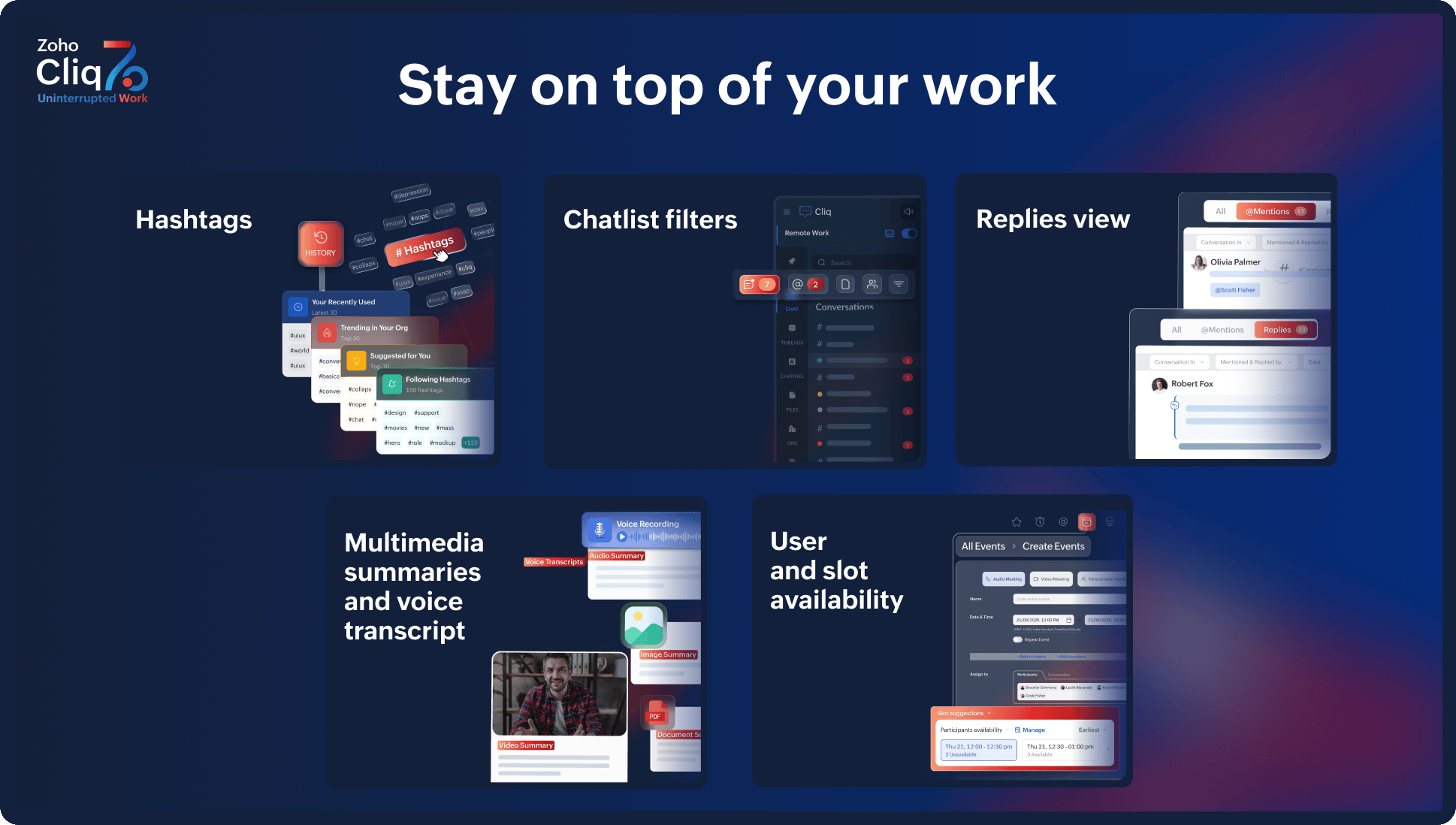
- Multimedia Summaries: Automatically generates summaries for rich media content including images, videos, and audio, helping users quickly grasp the key points of meetings or conversations while reducing information overload.
- Hashtags: Uses # tags to categorize and index discussions, making critical information easier to search and trace within massive message volumes.
- Plus numerous detail optimizations, collectively supporting the "uninterrupted work" product proposition.
The technical foundation of the multimedia summary feature spans multiple branches of multimodal AI: automatic speech recognition (ASR) and summary generation for audio, keyframe extraction and scene understanding for video, and OCR and content description for images. In enterprise collaboration scenarios, research shows that knowledge workers spend an average of 2.5 hours per day processing information not directly related to their work. The "context-switching cost" caused by information overload results in hundreds of billions of dollars in annual productivity losses for enterprises. The core value of AI summaries lies in transforming unstructured rich media content into quickly scannable structured text, enabling members who join conversations late or miss meetings to grasp key information in seconds.
These seemingly minor improvements actually target the most real pain points of knowledge workers: attention being frequently interrupted, information failing to accumulate effectively, and low efficiency in cross-content retrieval. Combining AI summaries with structured tags is precisely Cliq's approach to alleviating "information anxiety."
Summary: Zoho Cliq 7.0's Ecosystem-Level Upgrade Strategy
Overall, Zoho Cliq 7.0 doesn't rely on a single breakthrough feature to win, but rather delivers a systematic iteration covering automation, AI, accessibility, and experience details. It reflects Zoho's consistent product philosophy: not chasing concept hype, but building solid functional integration around real work scenarios.
For enterprises already within the Zoho ecosystem, version 7.0 further strengthens the platform's position as a collaboration hub. For external users, no-code bots and accessibility capabilities provide compelling reasons to migrate. In an era of increasing homogenization in collaboration software, this combination of "ecosystem + inclusivity" may well be the key to Zoho's differentiated breakout.
Related articles

Apple Watch ECG Detects Atrial Fibrillation, Saves Triathlete's Life: A Real-World Story
Triathlete Connor's heart rate spiked to 219 bpm during a race. His Apple Watch ECG detected AFib, leading to open-heart surgery that fixed a hidden heart condition.

Norcross Maine Forest Fire Maps: A Century-Old Cartographic Legacy and Data Visualization Pioneer
Explore Archie G. Norcross's 1918–1922 Maine forest fire maps—a hand-drawn cartographic masterpiece that pioneered early data visualization and remains valuable for climate research, historical GIS, and AI fire monitoring.

Apogee: A Privacy-First Browser Summarization Extension Rebuilt with Local AI After Mozilla Killed Orbit
After Mozilla killed Orbit, an indie developer rebuilt a fully local AI browser summarization extension called Apogee using Ollama, WebGPU, and Transformers.js—no user data ever leaves your device.