ZooWork: An AI Agent Delivery Platform Built for Domain Experts

ZooWork lets domain experts build AI agents without deep coding skills, topping Product Hunt #1.
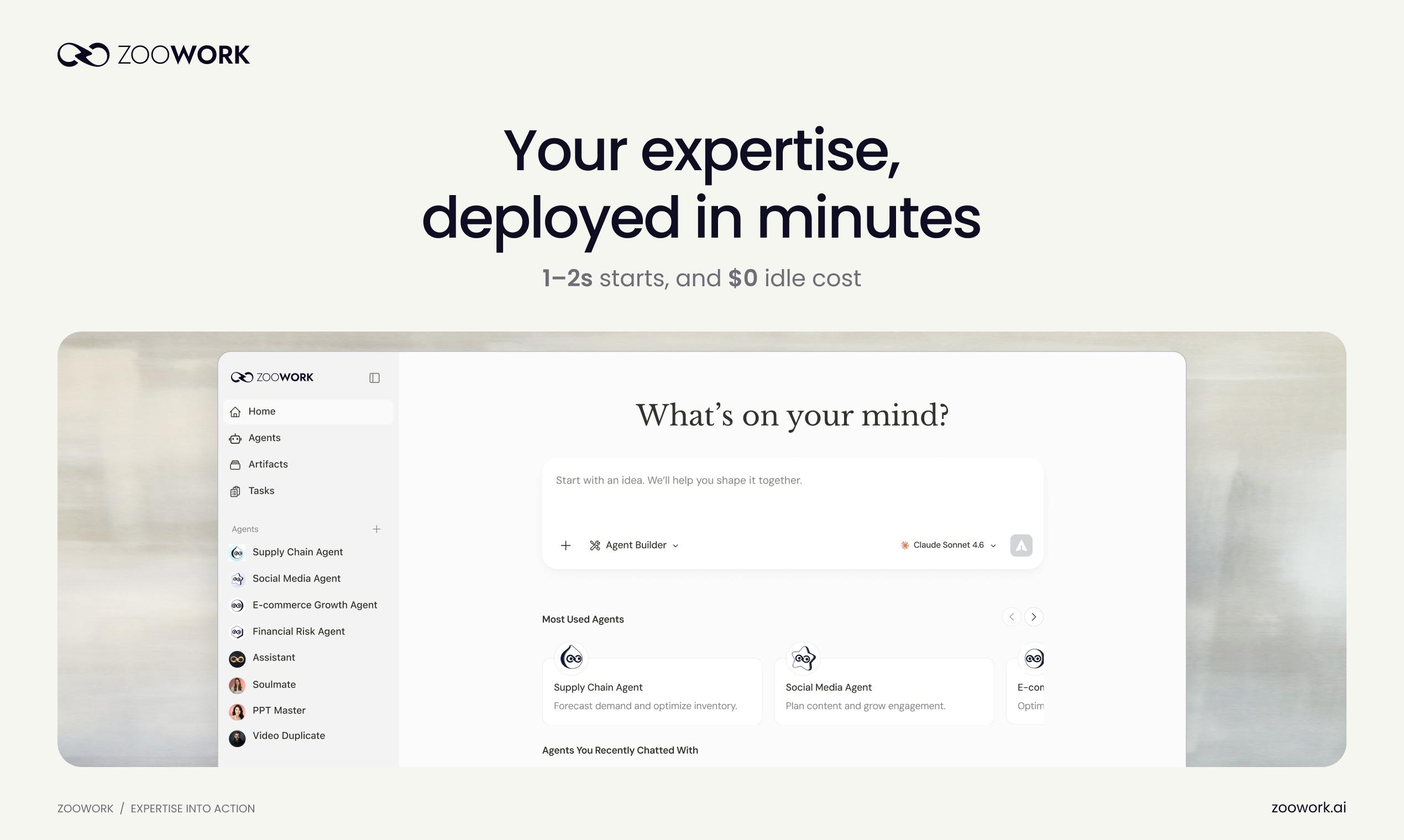
ZooWork is an AI agent delivery platform designed for FDEs (Forward Deployed Engineers) and domain experts, recently topping Product Hunt's daily chart at #1. It addresses the core pain point in AI agent development — domain experts can't code, and developers don't fully understand the business — through a dual entry point design: experts build agents visually via a Builder UI, while developers handle deployment and scale via a Managed Agent API. This allows consultants, operations specialists, and other business-oriented professionals to turn their expertise into working AI solutions without relying on a full engineering team. ZooWork reflects a broader industry shift from developer-first to business-first AI tooling, though whether its low-code capabilities can handle real-world business complexity remains to be proven.
The AI Agent boom has spawned countless development frameworks, yet most tools still keep the barrier firmly in engineers' hands. Domain experts — the people who actually understand business processes — are routinely locked out of the building phase. ZooWork, which topped Product Hunt's daily chart at #1, aims to change that. It positions itself as "an AI agent delivery platform for FDEs (Forward Deployed Engineers) and domain experts."
What Problem It Solves
The typical path to building an AI agent today looks like this: business stakeholders define requirements, engineers write the code, and the two sides go back and forth in endless clarification loops. The chain is long, information gets lost in translation, domain experts can't get their hands dirty, and developers never fully grasp the business nuances.
ZooWork's core proposition is to separate "building" from "delivery" and match each to the right person. According to the official description, experts can start with the Builder UI — a visual construction interface — and assemble agents without deep programming knowledge. Developers, meanwhile, handle deployment and scale-up through the Managed Agent API. This "dual entry point" design essentially lets different roles get what they need from the same platform, cutting down on handoff costs.
For consultants, operations specialists, and seasoned industry practitioners, this means they can translate their expertise directly into working AI solutions and deliver them to teams or clients — without depending on an entire engineering team.
Who It's Built For: FDEs and Domain Experts
The concept of the FDE (Forward Deployed Engineer) has gained traction in recent years, largely through companies like Palantir. It refers to engineers who embed directly in customer environments to bring products to life in real-world business contexts. By listing FDEs and domain experts as co-primary users, ZooWork signals that it's not targeting developer hobbyists — it's aimed at genuinely delivery-oriented, real-world business scenarios.
The platform's one-liner is telling: "Turn your expertise into AI solutions built for real business operations." In other words, ZooWork isn't trying to be yet another Agent development framework. It's positioning itself as a delivery channel that connects specialized knowledge to business outcomes.
This positioning has real-world relevance. In enterprise settings, the value of an AI agent rarely comes from how powerful the underlying model is — it comes from how well the agent fits the specific business process. Who knows that process best? Domain experts, not generalist developers. Letting experts participate directly in the build phase should, in theory, significantly improve how well agents fit the actual business context.
Palantir systematized the FDE model: these engineers don't sit at headquarters writing abstract code. They live on-site with customers for extended periods, adapting software products to fit specific business workflows. They understand both the technology and the industry deeply, making them the rarest kind of bridge between "tech" and "business." This model is widely credited as a key reason Palantir has succeeded in government and large enterprise accounts. But the scarcity of FDEs is itself a problem — training a qualified FDE is expensive and nearly impossible to replicate at scale. ZooWork's decision to center FDEs in its core user definition hints at a product logic of using tooling to partially augment or amplify FDE productivity — enabling the same-sized FDE team to serve more client scenarios, or allowing domain experts without a full engineering background to take on delivery work that would otherwise require an FDE.
Product Shape and Positioning
On Product Hunt, ZooWork is categorized under Productivity, Developer Tools, and Artificial Intelligence simultaneously — consistent with its dual user profile of experts and developers.
- Builder UI: A visual construction environment for domain experts, lowering the barrier to entry.
- Managed Agent API: A managed deployment interface for developers, supporting agent launch and management.
Together, the two form a complete loop from "build" to "deploy" to "deliver to teams or clients." The platform was built by three makers — Anna W, Ning Hu, and David Lu — and earned 176 upvotes and 25 comments on Product Hunt, topping the daily chart. That reception reflects genuine market appetite for lowering the barrier to Agent construction.
The concept of a Managed Agent API deserves a closer look. Unlike a standard API that simply exposes model calls, "managed" means the platform takes responsibility for the agent's runtime infrastructure — session state management, tool call orchestration, error retries, monitoring, and logging. Developers don't need to build their own agent runtime environment; they just call the API to embed a pre-built agent into an existing product or workflow. This architecture technically decouples "building" from "running": the configurations a domain expert creates in the Builder UI are translated by the platform's abstraction layer into standardized, API-callable services — and developers integrating them don't need to understand the agent's internal implementation. This design philosophy echoes the success path of API-first products like Stripe: encapsulate complexity inside the platform, and expose the simplest possible interface to the outside world.
A Few Observations
AI agent tooling is shifting from "developer-first" to "business-first." Early frameworks universally assumed users had programming skills. The emergence of products like ZooWork signals that the industry is starting to acknowledge a reality: what actually determines whether an Agent succeeds is often business understanding, not coding ability.
That said, there's an enduring tension between "low-code construction" and "real-world business complexity." How much genuine business logic can a visual interface actually handle? How stable are expert-built agents under complex edge cases? Is the API delivery layer maintainable enough for production use? These are questions this type of platform needs real deployment stories to answer. Based on a product launch page alone, it's difficult to judge its maturity in production environments.
For individual experts looking to productize their domain knowledge, or consulting teams that need to deliver AI solutions to clients quickly, ZooWork's approach is worth watching. Whether it can truly make the "experts build, developers deliver" collaboration model work in practice remains to be seen — and will depend on the public case studies that follow.
Related articles

Chain of Thought Isn't Just for AI: How Humans Can Use CoT to Improve Thinking Quality
Chain of Thought isn't just a prompt trick for large models. Starting from a Hacker News discussion, this article analyzes why CoT works for human thinking too, breaks down actionable ways to transfer it, and highlights the key differences between human CoT and machine CoT.
Cloudflare Teams Up with OpenAI: Closi…
Cloudflare Teams Up with OpenAI: Closing the Loop from Vulnerability Discovery to Defense with AI
Cloudflare uses OpenAI Daybreak to investigate security vulnerabilities and generate reviewable remediation plans, while developers use Codex to boost coding efficiency and quality.

Orca Multi-Agent Orchestration in Practice: A Guide to Parallel Collaboration with Claude and Codex
Orca is Stable AI's free open-source agent workbench supporting 34 agents like Claude Code and Codex in parallel. Learn its Git worktree isolation, multi-model orchestration, and mobile management.