Zoox Robotaxis Officially Launch on Uber App, Starting in Las Vegas

Amazon-owned Zoox integrates robotaxis into Uber for the first time, launching in Las Vegas.
Amazon-owned autonomous driving company Zoox has integrated its robotaxis into third-party ride-hailing platform Uber for the first time, with Las Vegas as the initial launch city. Previously operating through its own channels, this partnership allows Zoox to directly reach Uber's massive user base, while for Uber it expands autonomous driving supply under its aggregation model. The article analyzes that Las Vegas's regular roads, dry climate, and dense short-distance tourist travel demand fit the cautious expansion site selection logic for robotaxis. This partnership reflects a clearer division of labor between autonomous driving companies and ride-hailing platforms: the former focuses on vehicles and technology, the latter provides demand aggregation and entry points. However, a single-city partnership is still far from scale, and execution details such as vehicle fleet size, operating areas, pricing, and user experience remain undisclosed and warrant continued tracking.
Amazon-owned autonomous driving company Zoox has integrated its robotaxis into a third-party ride-hailing platform for the first time. According to an RSS-sourced report, Zoox's robotaxi service now appears in the Uber app, with Las Vegas as the first launch city.
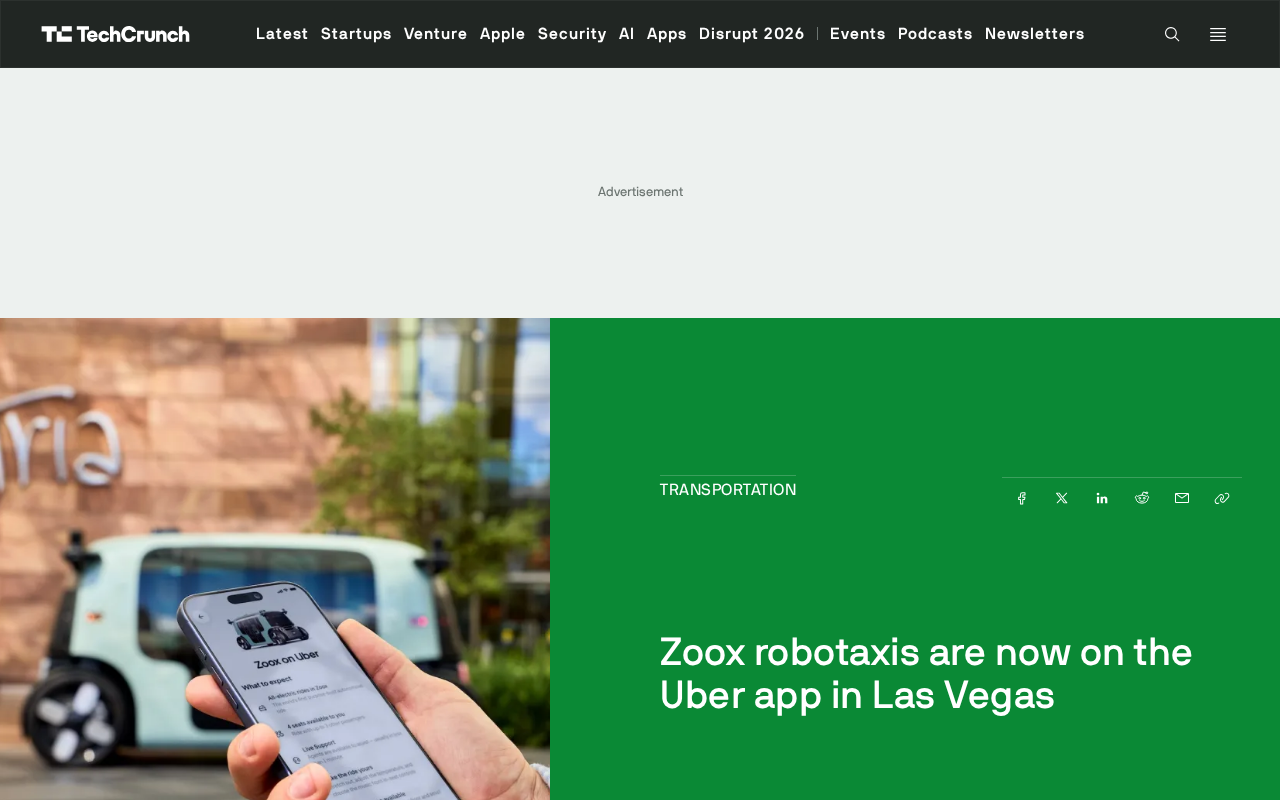
A Landmark Platform Partnership
Previously, Zoox operated its robotaxis through a self-built service, requiring users to hail rides via its own channels. This partnership with Uber marks the first time Zoox has opened its capacity to an external ride-hailing platform. For Uber, this means adding another autonomous driving supplier to its aggregation model; for Zoox, it's a key step in its commercialization path—no longer relying solely on its own traffic but directly reaching Uber's massive user base.
The report explicitly states that this is the first partnership between Amazon-owned Zoox and a ride-hailing platform. Given the potential competitive relationship between Amazon and Uber in the mobility space, this collaboration itself carries a certain ice-breaking significance.
Zoox and Robotaxi
Founded in 2014 and acquired by Amazon in 2020, Zoox is an autonomous driving company that designs purpose-built robotaxis from scratch (rather than retrofitting existing vehicles). Its vehicles feature a symmetrical cabin design with no traditional steering wheel or driver's seat, can travel in both directions, and are specifically built for short-distance urban passenger scenarios. Robotaxi refers to "autonomous taxis," vehicles that complete all driving tasks via autonomous systems and provide per-ride paid mobility services. Zoox has long operated pilot services through its own app and small-scale fixed stops; this integration with Uber is its first distribution of capacity to external parties, signaling a transition from "technology validation" to "channel distribution."
Aggregation Platform Model
In recent years, Uber has pursued an "aggregation" strategy, integrating third-party operators and autonomous driving companies' vehicles alongside its own fleet, with Uber providing a unified entry point for hailing, matching, and payment. For autonomous driving companies, joining such platforms can save the cost of building user traffic, but it also means relinquishing some user relationships and data; for the platform, it expands supply in an asset-light manner. This division of labor is the core logic behind Zoox's partnership.
Why Las Vegas First
Las Vegas is not a random choice. The city has a relatively regular road structure and a dry climate with little rain or snow, making it a friendly environment for autonomous driving perception and decision-making. Meanwhile, Las Vegas has dense tourist travel demand, and short-distance, high-frequency ride scenarios align well with robotaxi operational characteristics. Zoox choosing this location for its first Uber channel launch fits its consistent cautious expansion pace.
Urban Site Selection Considerations for Autonomous Driving
Robotaxi launch cities typically need to satisfy three conditions simultaneously: first, relatively predictable road and traffic environments, such as grid-like road networks with fewer complex constructions and extreme weather; second, local regulations that are open to autonomous driving testing and commercial operations; third, sufficiently dense short-distance travel demand to ensure vehicle utilization. Las Vegas has advantages in dry climate, regular road networks, and high frequency of tourist short-distance trips, and Nevada is relatively friendly to autonomous driving road testing. Compared to cities like San Francisco with many slopes, frequent fog, and complex traffic participants, Las Vegas can reduce technical and compliance risks in early operations—this is the practical reason Zoox chose it as the first Uber channel launch city.
What It Means for the Industry
Zoox's integration with Uber reflects a tightening division of labor between autonomous driving companies and ride-hailing platforms: the former focuses on vehicles and autonomous driving technology, while the latter provides demand aggregation and user entry points. If this model proves successful, it may be emulated by more robotaxi players.
However, a single-city partnership is still far from scale. Zoox's vehicle fleet size, operating areas, and pricing strategy all require observation of subsequent disclosures. This partnership is more of a starting point than an endgame.
Two Commercialization Paths for Robotaxi
Current robotaxi players roughly fall into two paths: one is building own brands and apps to operate directly for passengers, as Waymo does in some cities; the other is integrating into existing ride-hailing platforms to acquire customers through their traffic and dispatch systems. The former controls user experience and data loops but has high customer acquisition costs; the latter expands quickly but depends on platform revenue sharing and rules. Zoox previously leaned toward the former; this Uber integration means transitioning to a hybrid model. Industry observers typically focus on three metrics: "vehicle scale, operating area, and per-vehicle economic model," because robotaxi break-even heavily depends on high utilization and low remote human intervention rates. Whether a single-city partnership can amortize costs still requires actual operational data validation.
Questions to Watch
Currently, public information is limited: how users identify and hail Zoox vehicles in the Uber app, whether pricing matches regular ride-hailing, and how operating hours and areas are defined—the report provides no details. These execution-level arrangements will determine the actual experience and reputation of this partnership.
For readers following autonomous driving commercialization, the Zoox-Uber collaboration is worth continued tracking—it tests not just one company's technology, but also how robotaxi integrates into the existing mobility ecosystem.
Related articles

Michael Nielsen Takes Down His Classic Neural Network Textbook, Sparking Community Discussion
Michael Nielsen's classic free textbook Neural Networks and Deep Learning has been taken offline, sparking discussion on Hacker News about the reasons and impact.

Inside the AI Training Data Market: The Trade-off Between Exclusivity and Discounts
G2i founder Gabe Greenberg reveals the dual-track pricing of the AI training data market: labs pay a premium for exclusive data or accept discounts that allow others to buy it.

SessionGraph: Unifying All Coding Agent Sessions in One Interactive Graph
SessionGraph aggregates coding agent sessions into an interactive graph, helping developers review, debug, and manage AI coding workflows across sessions. This article examines its positioning, value, and open questions.