Zotero MCP Plugin: Let AI Directly Read and Analyze Your Reference Library

Zotero MCP Plugin connects AI assistants to your Zotero library for intelligent literature search and analysis.
Zotero MCP Plugin is an open-source project that deeply integrates the Zotero reference manager with AI assistants like Claude and ChatGPT via Anthropic's MCP protocol. It supports three core features: literature search, full-text PDF analysis, and intelligent Q&A based on your personal library, using RAG technology to generate verifiable answers. Running locally for privacy while representing the broader trend of AI evolving from generic tools into personal knowledge assistants.
Project Overview
Anyone who does academic research has probably been through this: chatting with an AI about research ideas while manually digging through Zotero for papers, copying abstracts, and pasting them back into the conversation. Switching between windows constantly, breaking your train of thought each time.
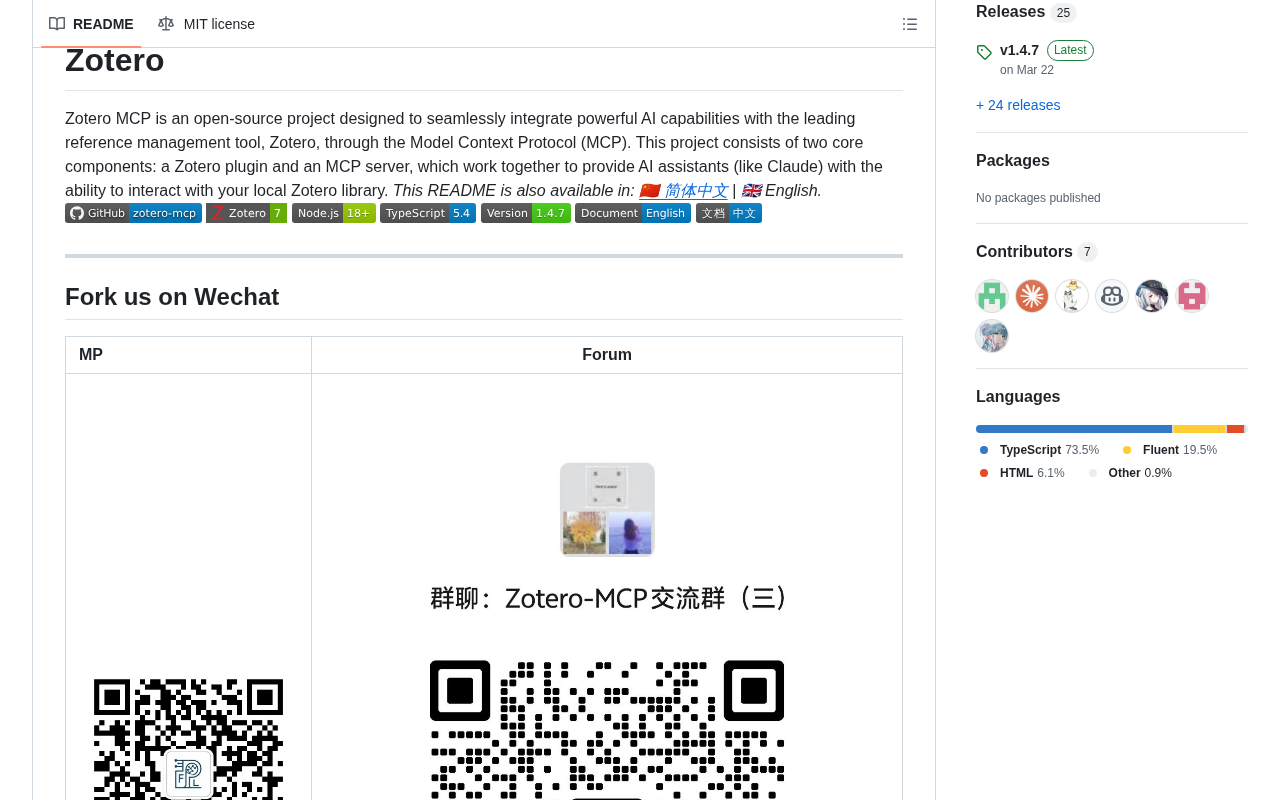
Zotero MCP Plugin (zotero-mcp) is an open-source project built to eliminate this unnecessary step. Through the MCP (Model Context Protocol), it directly connects the Zotero reference manager with AI assistants like Claude and ChatGPT—allowing AI to proactively search your reference library, read full-text PDFs, and answer questions based on your literature, so you no longer need to serve as a "human relay station."
The project has earned 724 Stars on GitHub, is built with TypeScript, has 57 forks, and maintains a healthy update cadence from the community.
As for Zotero itself, it's an open-source reference management tool initiated in 2006 by George Mason University's Roy Rosenzweig Center for History and New Media, now with over ten million users worldwide. Unlike commercial or semi-commercial competitors such as EndNote and Mendeley, Zotero is completely free and open-source, supporting one-click browser capture of citation metadata, automatic PDF downloads, reference formatting, and an extremely active plugin ecosystem. It's precisely this open architecture that makes third-party extensions like the Zotero MCP Plugin possible—if Zotero were a closed system, this kind of deep integration would be out of the question. For academic researchers, their Zotero library is often one of their most valuable digital assets, containing years or even decades of accumulated reading and research threads.
What Is the MCP Protocol? Why Does It Matter?
MCP (Model Context Protocol) is an open protocol officially released by Anthropic in November 2024, aiming to establish a universal set of "communication rules" between AI models and external tools. With these rules in place, AI assistants can invoke external services in a unified way—whether reading files, querying databases, or operating third-party applications.
To understand MCP's value, you need to first see what problem it solves. Before MCP, if you wanted ChatGPT to access your Google Drive, Claude to query your database, or another AI tool to read your local files, each integration required separate development—different AI platforms had different plugin specifications, different API formats, and different authentication mechanisms. This is the classic M×N problem: M AI clients and N external tools require M×N adapters. MCP's approach is to insert a standard protocol layer in the middle, reducing M×N to M+N—each AI client only needs to implement the MCP client once, and each external tool only needs to implement the MCP server once, enabling mutual communication. This follows the same logic as how USB unified peripheral interfaces.
MCP's core architecture adopts a Host-Client-Server three-layer model: the Host is the AI application users interact with directly (e.g., Claude Desktop), the Client is the internal module within the Host responsible for communicating with external services, and the Server is the external tool endpoint exposing specific capabilities. The protocol defines three core primitives—Tools (tool invocation), Resources (resource reading), and Prompts (prompt templates)—covering the vast majority of scenarios for AI interaction with the external world.
In the Zotero MCP Plugin scenario, the MCP protocol plays the role of "translator":
- The AI assistant sends commands via the MCP protocol (e.g., "search for literature on deep learning")
- The plugin translates the command into operations Zotero can understand
- After Zotero executes the operation, the plugin returns results to the AI in MCP format
The advantage of this architecture lies in decoupling—as long as an AI client supports MCP, it can connect to Zotero without needing platform-specific adapters. The MCP ecosystem is already quite rich; beyond Zotero, the community has developed hundreds of MCP servers connecting GitHub, Slack, PostgreSQL, file systems, browser automation, and more, forming a rapidly growing tool ecosystem. The Zotero MCP Plugin is an important piece of this ecosystem for academic scenarios.
Core Features in Detail
Literature Search and Metadata Management
The traditional workflow looks like this: open Zotero → manually enter keywords to search → find a paper → copy the title and abstract → switch back to the AI conversation and paste. Four or five steps, repeated every single time.
With the Zotero MCP Plugin installed, you can directly say in an AI conversation, "Find me papers about deep learning applications in medical imaging," and the AI will automatically search your Zotero library, returning matching entries with titles, authors, publication years, abstracts, and other metadata.
The key difference: the AI searches your own library, not the open web. This means every result returned is a paper you've previously collected, read, or annotated—far more relevant than a generic search.
Full-Text PDF Analysis
This feature is where the real differentiation happens. The plugin supports letting AI read the full-text PDFs attached to your references, not just titles and abstracts.
However, having AI process academic PDFs is far less simple than it sounds, involving multiple technical challenges. First is the document parsing problem: academic paper PDF formats vary enormously—two-column layouts, mathematical formulas, tables, figures, footnotes, reference lists—accurate extraction of these elements requires specialized PDF parsing engines. Simple text extraction often mixes two-column content together or loses the structural information of formulas and tables. Second is the context window limitation: even the latest large language models have limited context windows (Claude 3.5 ~200K tokens, GPT-4 Turbo ~128K tokens). A 30-page paper converted to text might consume tens of thousands of tokens, and analyzing multiple papers simultaneously can easily hit the ceiling. The plugin needs to make trade-offs between completeness and efficiency, potentially using chunked processing, key paragraph extraction, and other strategies. Additionally, the abundant figures and formulas in academic papers are multimodal content—pure text extraction loses this information, which remains a limitation of current technology.
Understanding these challenges makes the feature's value clearer. You can ask AI to do things like:
- Generate a 500-word structured summary of a 30-page paper
- Extract the core arguments and experimental methods from a specific paper
- Compare the methodological differences between two or three papers side by side
- Ask questions about specific data or conclusions in a paper
For PhD students and researchers who need to digest large volumes of papers daily, this feature genuinely saves reading time.
Intelligent Q&A Based on Your Library
This is the feature that best demonstrates the Zotero MCP Plugin's value. Here's a practical scenario:
You're writing the literature review section of a paper and need to organize the limitations of Transformer architectures in NLP. Previously, you'd have to go through papers one by one, take notes, and compile them. Now you can directly ask the AI: "Which papers in my library discuss the limitations of Transformers in NLP? What are their main points?"
The AI will traverse your library, find relevant papers, and provide a structured answer with citation sources. What you get isn't AI-fabricated content, but genuine summaries based on your existing literature.
From a technical perspective, this feature is essentially an implementation of RAG (Retrieval-Augmented Generation). RAG is one of the most mainstream technical paradigms for solving the "hallucination" problem in large language models. Its core idea: don't let AI generate answers from thin air, but first retrieve relevant content from an external knowledge base, then generate responses based on the retrieved real materials. This process has two steps—the Retrieval stage finds the documents or passages most relevant to the user's question from the library, and the Generation stage feeds the retrieved results as context into the large model, which then organizes language to produce the final answer.
In the Zotero MCP Plugin scenario, your Zotero library serves as the external knowledge base in the RAG system. Compared to pure LLM generation, this approach has two key advantages: first, significantly improved accuracy, because every argument has a clear literature source rather than vague information "remembered" from training data; second, traceability—every conclusion the AI provides can be traced back to a specific paper, which you can go back and verify in the original text. This is crucial for the rigor of academic writing. This is also why library-based Q&A is far more reliable than directly asking ChatGPT "What are the limitations of Transformers?"—with the latter, you can't verify the sources, while with the former, every point is anchored to papers in your own collection.
Technical Architecture and Installation
From a technical standpoint, the Zotero MCP Plugin's operating mechanism is fairly straightforward:
- The plugin installs as a Zotero extension and launches a local MCP server
- AI clients (Claude Desktop, MCP-compatible ChatGPT clients, etc.) connect to this local server via the MCP protocol
- All data exchange happens locally—library data is not uploaded to third-party servers
Regarding communication mechanisms, the MCP protocol supports two transport methods: stdio (standard input/output) and HTTP SSE (Server-Sent Events). In stdio mode, the AI client directly launches the MCP server process and communicates through the process's standard I/O streams—the entire process is completely local, involves no network ports, and offers maximum security. HTTP SSE mode communicates through a local HTTP service, suitable for scenarios requiring remote access or multi-client sharing. The Zotero MCP Plugin typically uses stdio mode, meaning data doesn't even traverse the local network—it passes directly between processes.
Because it uses local communication, response speed is fast, and there's no concern about library data leakage. However, it's important to clearly distinguish two data flow paths: the first is communication between the AI client and the Zotero MCP server, which is entirely local—your library data never leaves your computer; the second is communication between the AI client and the AI provider's cloud—when the AI needs to generate responses based on retrieved literature content, relevant literature excerpts are sent as context to the AI provider's servers (such as Anthropic or OpenAI's cloud). This is particularly worth noting in academic scenarios—if your research involves unpublished data, patent-related content, or confidential projects, you should carefully evaluate which literature content is acceptable to send to AI providers.
Practical Use Cases
Based on project documentation and community feedback, the following scenarios see the highest usage frequency:
- Literature review writing: Have AI organize the research landscape of a topic based on your library and generate a review draft framework
- Research direction exploration: Ask AI "What application domains do the federated learning papers in my library mainly focus on?" to quickly understand your reading coverage
- Real-time citations during paper writing: When writing about a specific argument, directly have AI find supporting materials from your library, saving manual searching time
- Library organization: Have AI help identify duplicate entries, suggest classification tags, and discover missing important citations
The Trend This Project Represents
Behind the Zotero MCP Plugin lies a larger shift: AI is evolving from a general Q&A tool into a personal knowledge assistant.
Previously, AI could only answer questions based on training data—answers were "generic." Now, through protocols like MCP, AI can access users' private data—reference libraries, notes, code repositories, emails—providing services truly relevant to you personally.
This trend isn't unique to Zotero; it's an AI-ification wave sweeping the entire PKM (Personal Knowledge Management) space. The Obsidian community has already produced multiple AI plugins (such as Smart Connections, Copilot) that let AI answer questions based on your note vault; Notion launched built-in Notion AI that can generate summaries and answers based on your workspace content; Logseq, Roam Research, and other tools are also actively exploring AI integration. But the Zotero MCP Plugin has a unique advantage: it connects to structured academic literature data, not loose note text. Every Zotero record contains standardized metadata (DOI, authors, journal, publication date, etc.), and this structured information makes AI retrieval and citation more precise, better meeting the strict citation requirements of academic writing.
From a more macro perspective, this represents AI applications evolving from "conversation as product" toward "embedded intelligence." Early AI product forms were chat windows—users actively asked questions, AI passively answered. The direction MCP ecosystem is pushing is letting AI capabilities permeate users' existing workflows and toolchains—you don't need to leave Zotero to find AI; AI is right there in your work environment. This shift from "you go find AI" to "AI comes to you" may be one of the most important structural changes in the AI application layer over the next few years.
For academic researchers, their reference library may be their most valuable private knowledge asset. Hundreds or thousands of carefully collected papers contain years of accumulated research. What the Zotero MCP Plugin does is activate this knowledge "sleeping" in local databases, turning it into context that AI can access at any time.
Summary
The Zotero MCP Plugin precisely solves a specific problem: letting AI assistants directly access and analyze your Zotero reference library. Its three core features—literature search, full-text analysis, and intelligent Q&A—cover the most common literature processing needs in academic research.
If you're using both Zotero for reference management and AI tools like Claude for research assistance, this plugin can save you significant amounts of repetitive manual work. As the MCP ecosystem expands and more AI clients add support, plugins that bridge local tools with AI will become increasingly common and increasingly capable.
Key Takeaways
- The Zotero MCP Plugin achieves deep integration between AI assistants and Zotero libraries via the MCP protocol, supporting mainstream AI tools like Claude and ChatGPT
- Core features cover literature search, metadata management, full-text analysis, and library-based intelligent Q&A, significantly improving academic research efficiency
- The plugin runs locally—library data doesn't need to be uploaded to third-party servers, balancing functionality with privacy protection
- With 724 Stars, the project represents the important trend of AI evolving from general conversation tools toward personal knowledge assistants
- Typical use cases include literature review writing, research direction exploration, paper writing assistance, and library organization
Related articles
 Product Reviews
The Programmer's Desk Setup Guide: Building a Workspace That Feels Like Home
Discover how programmers build productive, comfortable workspaces. From multi-monitor setups to ergonomic design, explore the desk philosophy that drives focus and flow.
 Product Reviews
Qoder vs Cursor Real-World Comparison: Which $20/Month AI IDE Is Better?
Hands-on comparison of Qoder vs Cursor AI IDEs: Agent autonomy, human interaction count, and architecture decisions. Qoder needed only 2 interactions vs Cursor's 8.
 Product Reviews
Cursor Cloud Agent Demo: Eliminating Bottlenecks Across the Entire Software Development Lifecycle
Deep analysis of Cursor's Cloud Agent demo showing how cloud VMs, automated test artifacts, and a full-chain control plane systematically eliminate human bottlenecks across the software development lifecycle.