Zuckerberg Says AI Will Run Your Entire Business — But Data Ownership Risks Can't Be Ignored

Zuckerberg says AI agents can run your whole business — but who really owns the data?
Meta's new enterprise AI agent promises to automate customer service, scheduling, and sales, with Zuckerberg claiming it can "run your entire business." But behind the efficiency lies a critical risk: data ownership. This article breaks down the commercial value, data sovereignty dangers, and strategies for balancing convenience against control.
Zuckerberg's Bold Prediction
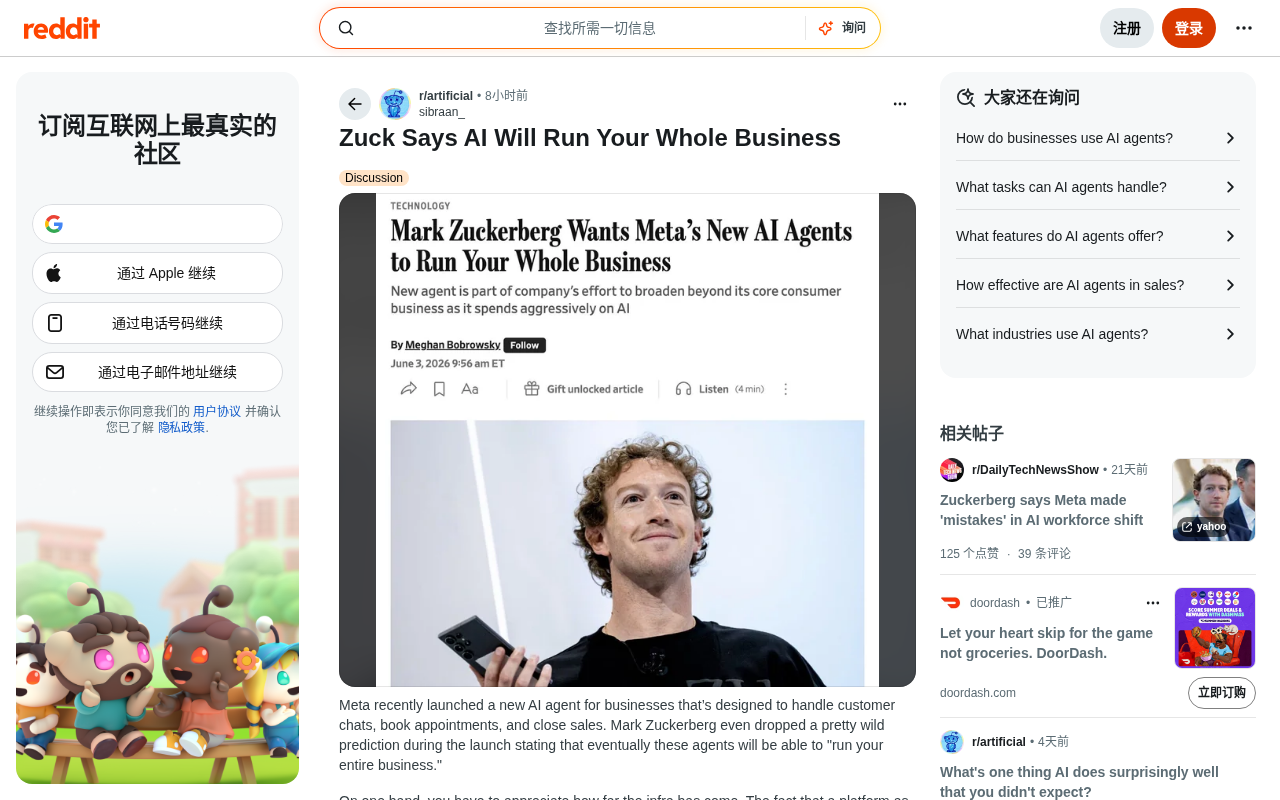
Meta recently launched an enterprise-facing AI agent designed to automatically handle customer conversations, appointment scheduling, and sales conversions. At the launch event, Mark Zuckerberg made a rather aggressive claim: these agents will eventually be able to "run your entire business."
What is an AI agent? An AI agent is an AI system capable of autonomously perceiving its environment, making decisions, and executing actions to accomplish specific goals. Unlike traditional chatbots, AI agents possess a closed-loop capability of "plan-execute-feedback": they can not only understand natural language instructions but also invoke external tools (such as databases, APIs, calendar systems), breaking down complex tasks into multi-step subtasks and completing them autonomously.
From an architectural standpoint, modern AI agents typically consist of four core modules: the perception layer (parsing natural language input and context), the planning layer (task decomposition based on the ReAct framework or Chain-of-Thought), the execution layer (interacting with external systems via Function Calling), and the memory layer (combining short-term context windows with vector databases for long-term knowledge retrieval). It is precisely the maturation of this architecture that has elevated AI from single-turn Q&A to multi-step autonomous execution — OpenAI's official release of Function Calling for GPT-4 in 2023 was a key milestone, marking the beginning of LLMs having a systematic interface for interacting with the external world. Meta's newly launched enterprise AI agent essentially packages these capabilities into its social commerce ecosystem, enabling small and medium-sized businesses to deploy them directly without any AI engineering expertise.
The technical origins of the ReAct framework and Chain-of-Thought: The ReAct framework was jointly proposed by research teams at Google and Princeton University in 2022, with its name derived from the combination of "Reasoning + Acting." In traditional LLMs, the reasoning process and action steps are disconnected when executing tasks. ReAct interleaves the chain of thought (thinking process) with tool invocation (action steps), enabling the model to observe results after each action and dynamically adjust subsequent strategies, significantly improving success rates for multi-step tasks. Chain-of-Thought was proposed by the Google Brain team in 2022; by requiring the model to explicitly output intermediate reasoning steps before giving a final answer, it dramatically improved the accuracy of complex mathematical reasoning and logical judgments — with accuracy improvements exceeding 40% in some benchmark tests. The combination of the two forms the core technical foundation of the planning layer in today's mainstream AI agents. Additionally, the vector database in the memory layer cannot be overlooked: it transforms historical customer conversations, product knowledge bases, and FAQ documents into high-dimensional vectors (Embeddings), using approximate nearest neighbor (ANN) algorithms for semantic similarity retrieval. This allows the agent to retrieve relevant historical context when answering new questions, fundamentally addressing the LLM's inherent flaw of "short-term memory." Meta's own open-source FAISS (Facebook AI Similarity Search) library is one of the industry's most widely used underlying vector retrieval tools, but it was designed as a research-grade batch retrieval tool. Enterprises building their own agents typically opt for production-grade solutions such as Pinecone, Qdrant, or Milvus, which offer complete APIs and monitoring capabilities.
At first glance, these words sound like science fiction, but in light of current technical progress in generative AI and autonomous agents, they are not without basis.
The evolution from ChatGPT in 2022 to multimodal agents in 2024 is essentially a paradigm shift for large language models from "language understanding systems" to "cognitive execution systems." In this process, three key technical milestones form the technical prerequisites for the current commercialization of AI agents. First, the InstructGPT paper in late 2022 established RLHF (Reinforcement Learning from Human Feedback) as the mainstream method for model alignment, evolving LLMs from "predicting the next word" to "understanding and executing human intent." Second, the Function Calling capability released alongside GPT-4 in 2023 standardized LLM interactions with external systems into structured interfaces for the first time — a turning point that transformed agents from "conversationalists" into "executors." Third, Anthropic's Claude 3 series, released in 2024, introduced a 200K-token ultra-long context window, which, together with Google Gemini 1.5 Pro's 1-million-token context, fundamentally expanded the boundaries of agents' ability to handle complex, long-chain tasks. It is precisely the convergence of these three breakthroughs that enabled Meta to bring enterprise-grade AI agents to market as a mature product in 2024-2025. Since ChatGPT ignited public attention in 2022, generative AI has undergone rapid evolution from "conversational assistant" to "autonomous executor": in 2024, Anthropic's Claude and Google's Gemini successively strengthened multi-step reasoning and tool-use capabilities. The maturation of Agentic AI frameworks such as ReAct (Reasoning + Acting) and Chain-of-Thought has significantly improved the reliability of agents in complex tasks. When a platform of Meta's scale directly embeds native autonomous tools into business workflows, it demonstrates that AI agents are no longer experimental toys for tech enthusiasts, but a maturing capability steadily heading toward production environments.
The reliability boundaries of AI agents: Despite significant technical progress, current AI agents still have limitations that cannot be ignored. The "hallucination" problem of large language models can cause false promises or misleading information in customer service scenarios — its root cause lies in the fact that LLMs are fundamentally probabilistic prediction systems, whose goal is to generate "statistically plausible" output rather than to guarantee absolute factual accuracy. The industry primarily mitigates hallucinations through three approaches: RAG (Retrieval-Augmented Generation, forcing the model to answer based on enterprise knowledge base content), confidence threshold mechanisms (automatically escalating to a human when certainty is low), and fact-checking layers (cross-verifying key information before output). Error propagation in multi-step tasks can significantly reduce the success rate of complex workflows; additionally, adversarial inputs — abnormal questions deliberately constructed by users — remain an important reason why enterprises must preset human fallback mechanisms when deploying agents. Meta's native tools have an inherent advantage in optimizing for its ecosystem scenarios, but for high-value transactions or business with strong compliance requirements, human review nodes remain indispensable.
AI Agent Infrastructure Has Reached Commercial Scale
From an industry perspective, the most noteworthy aspect of Meta's move is not the product itself, but the signal it sends: the underlying infrastructure for AI agents is now robust enough to be deployed commercially at scale.
For high-frequency, repetitive scenarios with relatively clear rules — such as customer service and scheduling — AI agents can indeed save substantial labor. Imagine an e-commerce business handling hundreds or thousands of Instagram DMs daily — from "Is this still in stock?" to "When will it ship?" — these highly templated interactions are exactly where agents excel.
The strategic depth of Meta's commercial ecosystem: Meta's enterprise AI agent is not a standalone product, but a key piece of its "super app" strategy. Since 2021, Meta has been opening the WhatsApp Business API to small and medium-sized businesses, and in 2023 launched Meta Business Suite to integrate advertising, content, and DM management. The addition of the AI agent marks Meta's move to fully bring the entire chain of "traffic entry → user interaction → sales conversion → customer service" into its own ecosystem as a closed loop.
Worth examining closely is that the underlying logic of this strategy is highly consistent with Meta's expansion path over the past decade: the 2012 acquisition of Instagram was to capture mobile visual content traffic, the 2014 acquisition of WhatsApp was to seize the DM and instant messaging space, and now embedding AI agents into business workflows is a move to contend for control over the commercial interaction data between businesses and consumers. Each product expansion is essentially about broadening and deepening data collection, thereby continuously strengthening the precision of its ad targeting engine.
From a technical standpoint, when businesses conduct customer conversations through Meta's native AI agent, this data may be incorporated into its Conversions API (CAPI) system — a server-side data reporting mechanism Meta launched after the impact of Apple's ATT framework, allowing businesses to upload website, CRM, and even offline sales data directly to Meta's servers to enhance ad attribution accuracy. In other words, the more deeply a business uses the native AI agent, the more complete the conversion signals Meta obtains, creating an implicit "data-for-service" relationship between the business's operational data and the improvement of Meta's advertising capabilities. This asymmetry is often masked by the convenience of native integration. Understanding this strategic depth helps accurately assess the intent behind the agent tool: it is not merely an efficiency tool, but a key move in Meta's construction of an enterprise-level moat.
Who Benefits Most?
For local small and medium-sized businesses (SMBs) and e-commerce stores, this native integration is a major boon. They already depend on Meta's social ecosystem for customer acquisition, and handing customer service and conversion over to the platform's native tools both lowers the technical barrier and completes the workflow loop. Being able to handle massive volumes of DMs with off-the-shelf tools is a tangible efficiency gain.
However, SMB dependence on social platforms is not a new issue. The risk of small and medium-sized businesses' dependence on social platforms has been repeatedly demonstrated as a cautionary tale throughout internet commerce history. After Facebook's IPO in 2012, it began compressing the organic reach of brand pages; by 2014, brand pages' organic reach had plummeted from a historical peak of 16% to about 2%, forcing businesses to turn to paid promotion. The 2018 algorithm update further shifted content distribution weight from brand pages toward individual users' posts, and content e-commerce brands reliant on free traffic saw traffic declines exceeding 70%. After Apple's ATT framework landed in 2021, Meta's ad attribution accuracy was compromised, and the customer acquisition costs for some DTC (direct-to-consumer) brands relying on Instagram ads rose 40%-80% within six months. These historical cases reveal a pattern: when a platform's business model conflicts with merchants' interests, the cost of rule changes falls entirely on merchants. Over the past decade, countless small merchants staked their entire brand building, customer acquisition and conversion, and even customer service systems on Facebook or Instagram, only to suffer heavy losses when algorithms were adjusted or platform policies tightened. The introduction of AI agents pushes this dependency into a new, deeper stage: it is no longer just traffic dependence, but the full outsourcing of operational data and customer relationships, extending the risk exposure from the customer acquisition stage to the entire customer relationship lifecycle.
The Unavoidable Core Issue: Data Ownership
Yet behind all the excitement lies a critical hidden risk that must be confronted head-on — the question of who owns the data.
Understanding the strategic value of data ownership: First-party data refers to data collected by a business through direct interaction with users — including purchase records, inquiry history, and preference behaviors — whose value far exceeds data purchased from third parties, because it is authentic, timely, and exclusive.
Currently, the scarcity of first-party data is being driven up by multiple compounding factors. On the regulatory front, data privacy legislation in major economies over the past five years has created systemic pressure. The EU's GDPR (General Data Protection Regulation) came into effect in 2018, establishing the "data minimization principle" and the "right to be forgotten," and setting an astronomical maximum fine cap of 4% of global annual revenue for violators — in 2023, Meta was fined €1.2 billion by the Irish Data Protection Commission for violating GDPR, the highest penalty since GDPR's implementation. The California Consumer Privacy Act (CCPA) took effect in 2020, and China's Personal Information Protection Law was enacted in 2021. The privacy regulatory frameworks of major economies are now largely in place, and the cost of legally acquiring user data from third-party channels has risen sharply. On the technical front, Google is accelerating its third-party cookie deprecation plan, and Apple's iOS 14.5 introduced the App Tracking Transparency (ATT) framework. According to Meta's own disclosures, ATT's rollout directly caused its ad attribution accuracy to drop by about 30%, with estimated single-year losses exceeding $10 billion. The deeper implication of this regulatory framework is that when businesses fully outsource customer data to third-party platforms, they not only face the business risk of losing data sovereignty, but may also become collateral victims when the platform experiences a compliance incident. Against this backdrop, if a business fully outsources customer interactions to Meta's platform, it not only faces the risk of losing data sovereignty, but may also instantly lose all ability to communicate with customers when platform rules change or accounts are banned — a risk already validated by numerous real cases over the past several years.
Handing over the entire operational data pipeline, customer interaction records, and potential lead information to a super-platform whose business model relies heavily on advertising inherently carries structural risk. Meta owns three major platforms — Facebook, Instagram, and WhatsApp — with a combined monthly active user base exceeding 3.8 billion, and advertising revenue accounts for over 97% of its total revenue. Meta's advertising system is essentially a data-driven precision targeting engine — every interaction, every DM, and every purchase behavior a user makes on the platform is incorporated into its user profiling system, thereby improving ad targeting accuracy. Its core technical architecture, "Meta Advantage+," integrates cross-platform behavioral data, social graph relationships, device signals, and purchase intent data, making it one of the most powerful ad targeting systems in the industry.
The core contradiction lies in a misalignment of interests: when a platform simultaneously controls both your customer acquisition channel and the infrastructure running your sales operations, businesses may face an awkward future scenario — paying to buy back their own data in the form of ad optimization. In other words, the platform first uses AI agents to accumulate your customer data, then monetizes that data in reverse as more precise ad targeting, for which you must continuously pay.
The Essential Trade-off Between Convenience and Control
This is a classic trade-off between "convenience" and "data sovereignty." The plug-and-play experience that native integration provides comes at the cost of entrusting your most core business assets — customer relationships and data — to a third-party platform. For small merchants dependent on platform traffic, this deal may be worthwhile; but for businesses that view customer data as a core competitive advantage, the risk is dramatically amplified.
Strategies for Different Business Models
Whether to embrace Meta's native AI agent is not a black-and-white answer — it depends on the specific business model.
Scenarios suited for native integration:
- Local small and medium-sized businesses and offline service providers
- E-commerce stores handling high-frequency Instagram DMs
- Businesses with low order values, short transaction chains, and fast decision cycles
For these players, using platform tools to handle massive inquiries and appointments offers an extremely high return on investment.
Scenarios where data independence is recommended:
- High-order-value B2B SaaS companies
- Startups and marketing agencies
- Businesses with high-value leads and long sales cycles
For the latter, building an independent, open workflow remains the safest strategy — building a standalone site (e.g., Shopify), an in-house CRM system (e.g., HubSpot), and independent communication channels (e.g., an email list) are all effective means of hedging against platform dependence risk, and form the foundation for autonomously controlling the data pipeline and reach-assurance mechanisms.
CDP and the technical path to data independence: For businesses hoping to maintain data sovereignty, building an autonomous data system is not out of reach — modern tech stacks offer a practical decoupling solution.
The CDP (Customer Data Platform) is the core hub. Unlike traditional CRMs, CDPs focus on "Identity Resolution" — integrating fragmented behaviors left by the same user across different channels (Meta DMs, website visits, email clicks, offline purchases) into a unified customer profile through deterministic matching (email/phone number) and probabilistic matching (device fingerprints, behavioral patterns). Its strategic value lies in this: even if Meta undergoes a policy change or account ban, the business still holds a complete copy of the customer data and can continue reaching customers through other channels — this is the infrastructure guarantee for business resilience in the digital age.
Data collection layer: CDPs such as Segment or the open-source RudderStack can unify the collection of user behavior data from Meta, websites, email, offline, and other multi-channel sources. Customer management layer: HubSpot's free tier covers most CRM needs for small and medium-sized businesses, while the open-source SuiteCRM supports on-premises deployment, thoroughly avoiding uploading data to third parties. Automation sync layer: Make (formerly Integromat) or the open-source self-hosted n8n can sync conversation data from Meta channels to a proprietary database in real time via Webhooks, achieving "dual-track parallelism" — Meta handles traffic acquisition and conversations, while the in-house system handles data accumulation and customer lifecycle management. This architecture retains full data sovereignty while enjoying platform traffic dividends, and is currently the most pragmatic engineering practice balancing efficiency and risk control.
When every lead is worth a fortune and every conversion is a matter of life and death, holding data sovereignty in your own hands is far more important than short-term convenience.
Walking the Line Between Efficiency Dividends and Data Risks
Meta's move clearly shows that AI agents are moving from concept toward commercial mainstream — an irreversible trend. The maturation of the technology is exciting, but the business structure behind it is equally worthy of caution.
While Zuckerberg's vision of "AI running your entire business" is enticing, what business owners truly need to consider is: while handing your business over to AI, are you also handing over the data sovereignty that defines your business's fate?
How to walk the tightrope between efficiency dividends and data risks will be a strategic choice every business that wants to embrace AI agents must make.
Key Takeaways
- AI agents have entered the commercial stage: The maturation of the technical architecture (the four-layer perception-planning-execution-memory model) — including the synergy of the ReAct framework, Chain-of-Thought reasoning chains, and vector database memory layers — has moved AI agents from the lab to production environments. Meta's large-scale deployment is an important signal of industry maturity. From RLHF alignment to Function Calling standardization to the breakthrough of ultra-long context windows, three key milestones together form the technical foundation of this commercialization leap.
- SMBs are the most direct beneficiaries: For high-frequency, low-decision-complexity customer service and scheduling scenarios, native integration offers an extremely high return on investment — but one must be wary of the deepening risk of platform dependence. Historical cases where brands' organic traffic plummeted 70% serve as a sobering warning about SMB platform dependence risk.
- Data ownership is a core strategic issue: Against the backdrop of third-party cookie phase-out and tightening global privacy regulation (the triple framework of GDPR, CCPA, and China's PIPL), the scarcity of first-party data continues to rise, and outsourcing customer interaction data to an advertising platform carries structural risk; Meta's CAPI mechanism further extends this risk from the traffic layer to the conversion data layer.
- Decoupling doesn't mean abandoning the platform: Through the technical combination of CDP + CRM + automation sync, businesses can retain a complete copy of their data in their own systems while enjoying Meta's traffic dividends, using the CDP's identity resolution capability to build a cross-channel unified customer view, achieving the optimal dual-track parallel strategy.
- High-value businesses must prioritize data sovereignty: For businesses with high order values, long sales cycles, and high-value leads, the long-term benefits of building independent data infrastructure far exceed the short-term convenience offered by platform-native tools. In a global environment of increasingly strict compliance regulation, data sovereignty also serves as a firewall against collateral compliance risk.
Related articles

Felix Rieseberg Personal Homepage
Felix Rieseberg's personal homepage sparks attention on Hacker News. This article covers the Slack engineer's technical background, the rise and fall of nativefier, and the value of a developer homepage as a tech calling card.

@ai-sdk/vue 3.0.306 Patch Release Syncs with [email protected] Update
@ai-sdk/vue 3.0.306 released, synced with [email protected]. A routine patch release for the Vercel AI SDK ecosystem with no public API changes; the Vue adapter layer stays version-aligned with the core package.

Gemini 4 Argon API Launches: The Era of Million-Token Output Begins
Google launches Gemini 4 Argon with sparse MoE architecture, up to 1M output tokens, and a 68.90% Vals Index score, available across API, AI Studio, and the Gemini app.