ZUS: An AI-Native IDE with Agentic Coding + Human Review, 20MB Installer

ZUS is an AI-native IDE built on Tauri 2 and Rust where agents execute code changes but every diff requires human review.
ZUS is a desktop IDE designed from the ground up around agentic coding, with a built-in AI agent that reads the codebase, plans, edits files, and runs commands within granted permissions. Unlike plugin-style AI tools, it emphasizes human gating: every diff must be reviewed before being kept, changes can be undone, and Team Inspector shows each sub-agent's tool calls. It keeps indexing and context local, supports bring-your-own AI providers, and is built on Tauri 2 and Rust with a ~20MB Windows installer across Windows, macOS (Apple Silicon), and Linux. It received 74 upvotes and ranked #20 on Product Hunt; as an early-stage product, its differentiation depends on agent reliability and review workflow smoothness.
Why Do We Need an AI-Native IDE?
Traditional IDEs are being redefined by AI capabilities. ZUS is a desktop IDE with a built-in AI agent that can read your codebase, make plans, edit files, and execute commands within granted permissions. Unlike many tools that bolt AI on as a plugin, ZUS was designed from the ground up around "agentic coding" while emphasizing human review—you inspect every diff before deciding whether to keep it, and you can undo changes when the agent makes a mistake.
ZUS received 74 upvotes and 4 comments on Product Hunt, ranking #20, with categories spanning software engineering, developer tools, and artificial intelligence. It seeks to strike a balance between automation efficiency and developer control.
Core Mechanism: Agent Executes, Human Gates
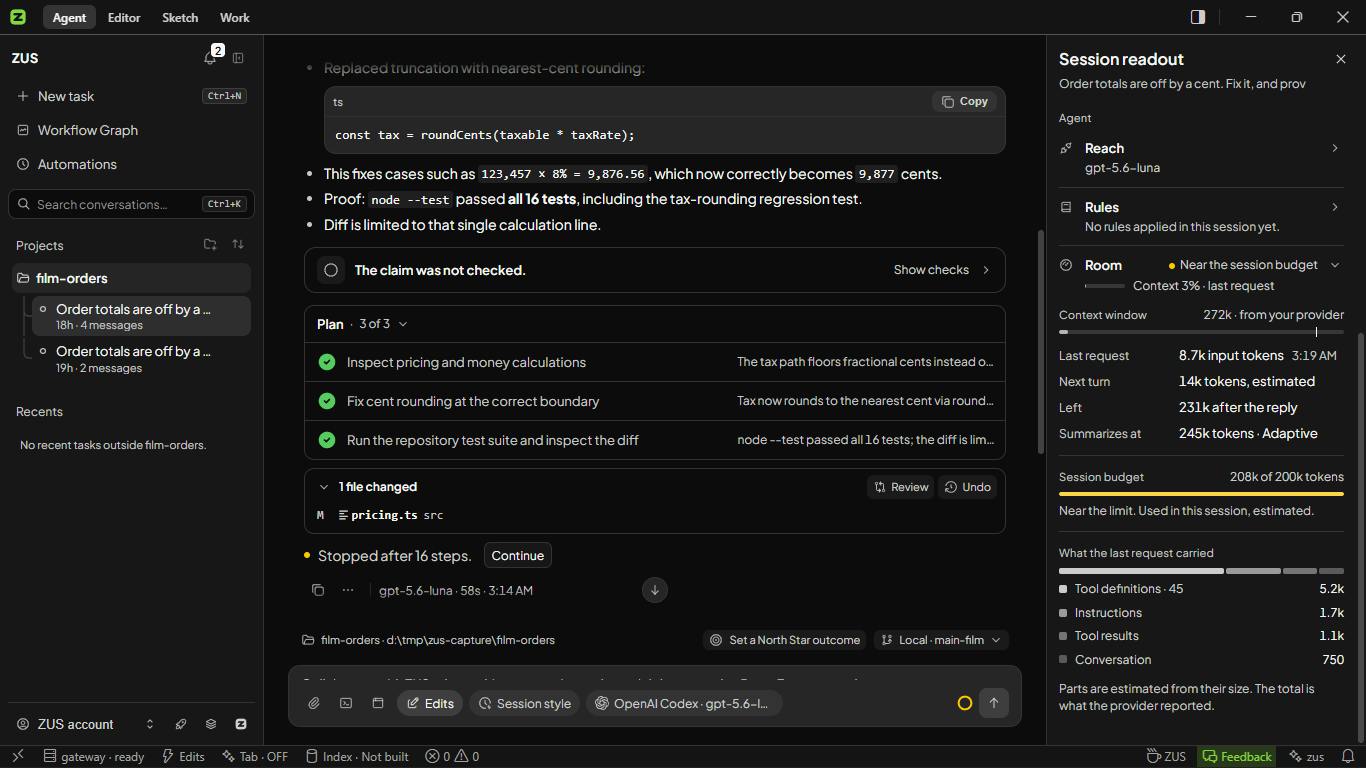
ZUS's workflow is clear: the AI agent reads your codebase, plans tasks, edits code, and runs commands. Every step happens within the permissions you grant. Crucially, every diff the agent generates must be reviewed and confirmed by you before it's kept. If it does something wrong, you can undo it. This "review-before-merge" model reduces the risk of blindly trusting AI.
For complex tasks involving multiple sub-agents, ZUS provides Team Inspector, letting you see each sub-agent's tool calls. This helps you understand the agent's decision path and makes troubleshooting easier. Compared to black-box tools that automatically modify code, ZUS offers greater transparency.
Sub-agent is an architectural pattern in agentic coding: the main agent decomposes a complex task into subtasks, each executed by an independent sub-agent with its own context and tool-call permissions. This divide-and-conquer approach improves stability for long-chain tasks but introduces observability challenges—developers struggle to track what each sub-agent did. ZUS's Team Inspector is designed precisely to solve this, visualizing each sub-agent's tool-call sequence and turning the decision path from a black box into an auditable process.
Privacy and Local-First
ZUS explicitly keeps project indexing and context on your machine and lets you connect your own AI provider. This means code data is not uploaded to third-party services by default—a selling point for privacy-conscious teams and individual developers.
This local-first strategy contrasts with the current trend of AI coding tools relying on the cloud. Developers can choose compatible AI model providers themselves, flexibly controlling costs and data flow.
Project Indexing is a prerequisite step for AI coding tools to understand a codebase: the tool scans project files, extracts structural information such as functions, classes, and dependencies, and typically combines it with embedding techniques to build a searchable semantic index, enabling precise recall of relevant code snippets during conversation or generation. Where the index is stored directly affects privacy—uploading the index to the cloud is equivalent to exposing your code structure to third parties. ZUS keeps the index on the local machine and, combined with a bring-your-own AI provider, ensures code context flows only between the developer and the chosen model service, not through the tool vendor's servers.
Technical Foundation: Tauri 2 + Rust, Lightweight Installation
ZUS is built on Tauri 2 and Rust, with a Windows installer of only about 20 MB. Compared to Electron-based IDEs that routinely run hundreds of MB, this size advantage is significant. It supports Windows, macOS (Apple Silicon), and Linux.
The lightweight installer and Rust's performance characteristics may bring faster startup and lower memory usage, though the actual experience still needs real-world testing. Tauri 2's cross-platform capabilities also allow ZUS to cover mainstream desktop systems.
Tauri is a cross-platform desktop application framework written in Rust, architecturally distinct from Electron: Electron bundles a full Chromium browser and Node.js runtime into every app, resulting in installers that are often hundreds of MB; Tauri reuses the operating system's built-in WebView to render the UI, with backend logic written in Rust and compiled to a native binary, so installers can be an order of magnitude smaller. The trade-off is that WebView rendering behavior may differ slightly across systems, requiring additional adaptation. Tauri 2 extends the original with mobile support and a more granular permission system, which is the technical prerequisite enabling ZUS to cover three major desktop platforms at around 20 MB.
Who Is It For?
ZUS suits developers who want to introduce AI agent-assisted coding but are unwilling to give up code review authority. If you need an agent to automate repetitive tasks while retaining full control over code changes, ZUS's combination of "diff review + undo + Team Inspector" offers a viable solution. For privacy-sensitive teams or those needing to bring their own AI provider, local indexing and custom model connections are additional draws.
However, ZUS is still an early-stage product, with limited discussion on Product Hunt. Whether it can differentiate itself in the fiercely competitive AI IDE market depends on the agent's actual reliability and the smoothness of the review workflow.
One-line Summary
ZUS is an AI-native IDE built on Tauri 2 and Rust, where agents execute code changes but every diff requires human review.
Paragraph Summary
ZUS is a desktop IDE designed from the ground up around "agentic coding," with a built-in AI agent that can read the codebase, make plans, edit files, and execute commands within granted permissions. Unlike tools that bolt AI on as a plugin, ZUS emphasizes human gating: every diff must be reviewed and confirmed by the developer before it's kept, and mistakes can be undone; multi-sub-agent tasks can be inspected via Team Inspector to view each sub-agent's tool-call path. On privacy, project indexing and context stay local, and it supports connecting your own AI provider. Technically built on Tauri 2 and Rust, the Windows installer is about 20 MB, covering Windows, macOS (Apple Silicon), and Linux. The product received 74 upvotes, 4 comments, and ranked #20 on Product Hunt; it remains an early-stage product whose differentiation depends on agent reliability and the smoothness of the review workflow.
Related articles

Abnormal Error Rate Spike in Claude Mythos 5.2 and Fable 5.2
Claude Mythos 5.2 and Claude Fable 5.2 show an abnormal spike in request error rates, marked as investigating on the official status page. This article covers the incident overview, practical impact on developers, and recommended responses.

ReAct Runtime Context Trimming: Why Claude Code Acts at 70%
A deep dive into ReAct runtime context trimming: why Claude Code compresses at ~70% usage, why tool calls dominate, why messages must be dropped in pairs, and why codebases don't need RAG.

AI Agent vs LLM: How Cursor and Claude Code Actually Work
An in-depth analysis of the essential difference between AI Agents and LLMs: LLMs generate code suggestions, while Agents modify files and run tests via tool calls. Using a Spring Boot bug fix as an example, it breaks down the workflows, permission control, and verification mechanisms of Cursor and Claude Code.