#AI evaluation
2370 related articles

·2 min
Google Gemini for Science: A Detailed Look at the Experimental AI Toolkit Empowering Scientific Research
Google officially releases Gemini for Science, an experimental AI toolkit for researchers covering hypothesis exploration, large-scale validation, and literature interpretation to accelerate scientific discovery.
Read more →

·2 min
Google Gemini 3.5 Flash Released: A Generational Leap Focused on Agentic and Coding Capabilities
Google releases Gemini 3.5 Flash, skipping version 3.0 in a generational leap focused on agentic capabilities and coding performance, positioning it as a new AI model family bridging frontier intelligence with real-world action.
Read more →

·2 min
Do Sales Prove Your Product Is Good? A Product Quality Perspective for Indie Developers
An indie developer claims 'if my products wouldn't work they wouldn't sell.' Does this logic hold? We analyze the relationship between sales and quality, explore survivorship bias, and offer practical advice.
Read more →

·2 min
AI Agent Permission Management: How Sandboxing Mechanisms Limit Potentially Destructive Operations
An in-depth look at AI Agent sandboxing for permission management — how OpenAI uses execution isolation, resource limits, and progressive trust models to contain potentially destructive operations.
Read more →

·4 min
OpenAI Codex Pixel Identicons: A Visual Identification Solution for Multi-Agent Collaboration
OpenAI introduces Pixel Identicons for Codex background agents, using stable visual identifiers to solve multi-agent recognition challenges and reduce cognitive load in AI programming workflows.
Read more →

·2 min
Firebase A/B Testing Upgrade: Real-Time Service and Custom Signal Conditions Explained
Firebase A/B Testing gets a major upgrade with Remote Config real-time service integration and custom signal conditions, offering faster experiments and precise user targeting.
Read more →

·4 min
Five Common Misconceptions in AI Agent Development: An Essential Guide Before You Start
Debunking 5 common AI Agent development misconceptions: Agents aren't smarter ChatGPTs, complexity doesn't equal power, and RAG can't cure hallucinations. Learn the right approach to building Agents.
Read more →

·3 min
Firebase Integrates with AI Studio: Four Core Capabilities for Production-Grade Agent Applications
Deep dive into Google Firebase's integration with AI Studio, covering four core capabilities—database auto-configuration, authentication, security rules drafting, and zero-config deployment—for production-grade AI agent apps.
Read more →

·4 min
Firebase AI Logic Update: Expanded Model Support and Enhanced Output Integrity Explained
Firebase AI Logic gets major updates at Google I/O, expanding AI model support and enhancing output integrity. Learn how these changes impact developers.
Read more →

·4 min
OpenAI Red Team Testing Revealed: How Models Get 'Broken' Before Release
OpenAI reveals a critical pre-release step: dedicated red teams break and stress-test AI models. Learn how red teaming works, industry safety trends, and practical implications for developers.
Read more →
·4 min
OpenAI Red Teaming Revealed: How Models Get 'Broken' Before Release
OpenAI reveals a critical pre-release step: dedicated red teams break and stress-test AI models. Learn how red teaming works, industry safety trends, and practical implications for developers.
Read more →
·3 min
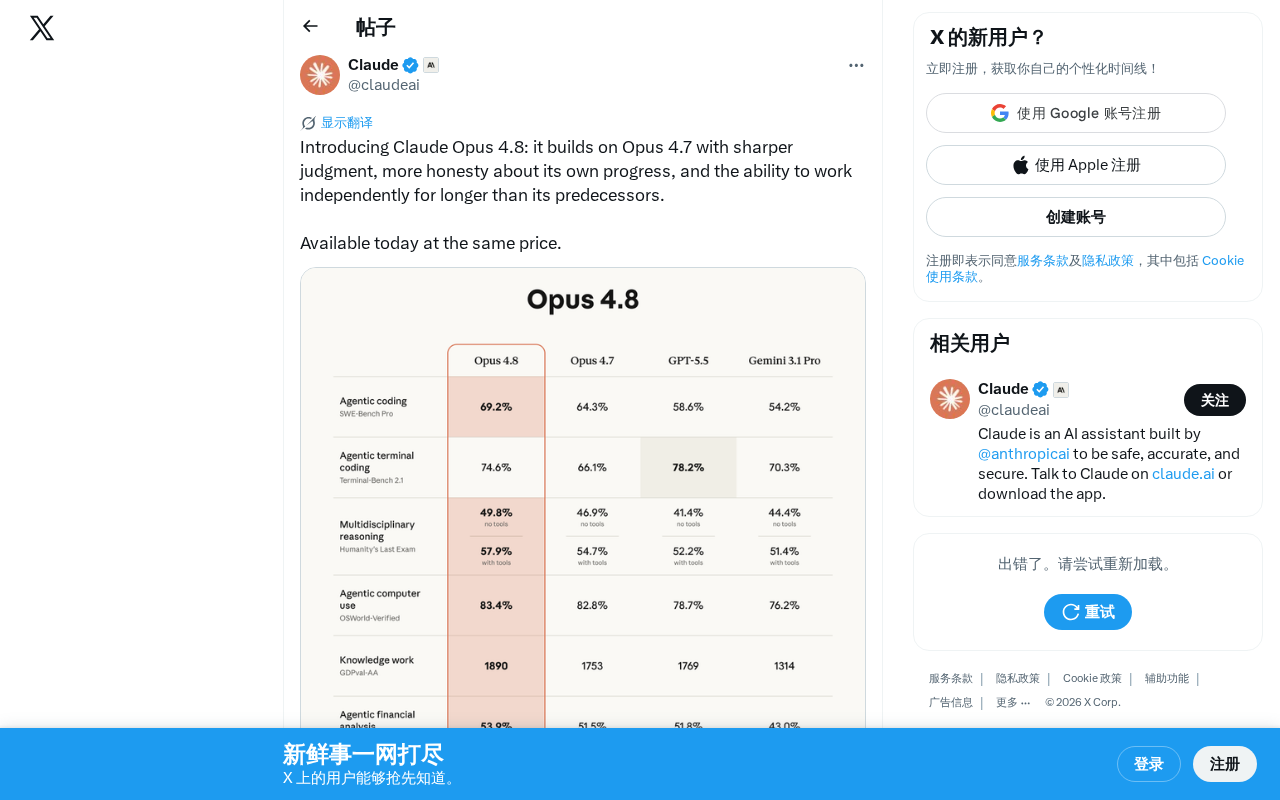
Claude Opus 4.8 Released: Comprehensive Upgrades in Judgment, Honesty, and Autonomous Work Capabilities
Anthropic releases Claude Opus 4.8 with three core upgrades: sharper judgment, more honest self-awareness, and longer independent work duration — all at the same price.
Read more →

·3 min
Anthropic Enters Biodefense: How AI Is Safeguarding Global Public Health Security
Anthropic applies AI to biodefense — from early epidemic warnings and rapid vaccine R&D to threat assessment — exploring AI's critical role in global public health security.
Read more →

·4 min
7 Core Features of Hermes Agent Explained: The Real Reasons Users Are Abandoning OpenCore
Deep dive into Hermes Agent's 7 core features including Kanban multi-tasking, /goal deep execution, and multi-agent architecture, compared with OpenCore's stability and performance issues.
Read more →

·3 min
Dify Local Deployment Tutorial: A Beginner's Guide Using Virtual Machine + BT Panel
Step-by-step Dify local deployment guide using VMware, Ubuntu, BT Panel, and Docker. Perfect for beginners with zero Linux experience to set up this open-source AI development platform.
Read more →
 Industry Insights
·2 min
AI Product Development in Practice: Model Selection, Building Moats, and Paths to Commercialization
Practical strategies for AI product development: why not to train models from scratch, when to use APIs vs. fine-tuning, building product moats, and the full path from evaluation systems to commercialization.
Read more →
 Tutorials
·3 min
Agent Tuning: A Complete Guide to Training LLMs with Agent Capabilities
A deep dive into Agent Tuning principles and practices, covering why Agent training is needed, the evolution from Prompt to RAG to Agent, development workflows, and cost assessment for private deployment.
Read more →
 Tutorials
·2 min
Building a Financial Analysis Agent with Cursor + MCP: From Architecture Design to Production Deployment
A complete guide to building a financial analysis Agent system from scratch using Cursor AI and MCP protocol, covering three-layer architecture design, MCP Server development, and production deployment.
Read more →
 Tech Frontiers
·3 min
GitHub Agent HQ Launch: AI Coding Tools Enter the Era of Platform Competition
GitHub Universe unveils Agent HQ platform for unified coding agent management, Copilot upgrades with multi-model support. OpenAI completes restructuring, Anthropic tests new model, NVIDIA open-sources AI models.
Read more →
 Tutorials
·2 min
MCP Protocol in Practice: Building an AI Investment Analysis Agent with TradingView + Notion
A detailed guide on MCP protocol vs Skills, integrating TradingView and Notion MCPs to build an automated investment analysis Agent with market scanning, backtesting, and report generation.
Read more →