#Devin
360 related articles

·4 min
AI Engineering in Practice: The Right Way to Build Enterprise Projects with Claude Code
Learn how to use Claude Code with Specification-Driven Development (SDD) to build enterprise projects, solving common AI coding pitfalls like infinite bug loops, code quality issues, and hallucination risks.
Read more →

·3 min
Hands-On Test: Codex Autonomously Completes the Entire Video Production Pipeline — From Idea to Final Cut, Zero Human Code
Hands-on test of OpenAI Codex autonomously completing the full video production pipeline — from script planning and coding to audio, subtitles, and rendering — with zero human code.
Read more →

·3 min
Building a WeChat Mini Program with Zero Code: A 3-Day Hands-On Journey with Codex + Antigravity
A developer used OpenAI Codex and Antigravity to build and launch a WeChat Mini Program in 3 days with zero code. Full breakdown of the AI recipe app's design, tool workflow, and development process.
Read more →

·2 min
How to Claim Your Free OpenAI Codex Rate Limit Reset Pack
OpenAI is giving Plus, Pro, and Business users free Codex rate limit resets — 1 free reset per user, plus up to 3 more via referrals. Learn how to claim and use them before the 30-day deadline.
Read more →

·3 min
Cloudflare Acquires VoidZero: How the Vite Ecosystem Changing Hands Reshapes the Cloud Development Landscape
Deep analysis of Cloudflare's VoidZero acquisition: why the Vite ecosystem is key, how it fixes Cloudflare's DX gap, and what it means for cloud platform competition in the AI Agent era.
Read more →

·3 min
Building a DeepSeek Agent from Scratch: Principles, Token Optimization, and Bootstrapped Development
Learn how to build a DeepSeek V3 AI Agent from scratch with zero dependencies, covering Agent loop mechanics, token optimization, cache hit strategies, and bootstrapped development.
Read more →

·2 min
Moonshot K2.7 Code Released: 30% Fewer Reasoning Tokens, Comprehensive Coding Performance Improvements
Moonshot releases K2.7 Code, cutting reasoning tokens by 30% vs K2.6 while boosting coding benchmarks. Now live on Fireworks with serverless API access.
Read more →
·3 min
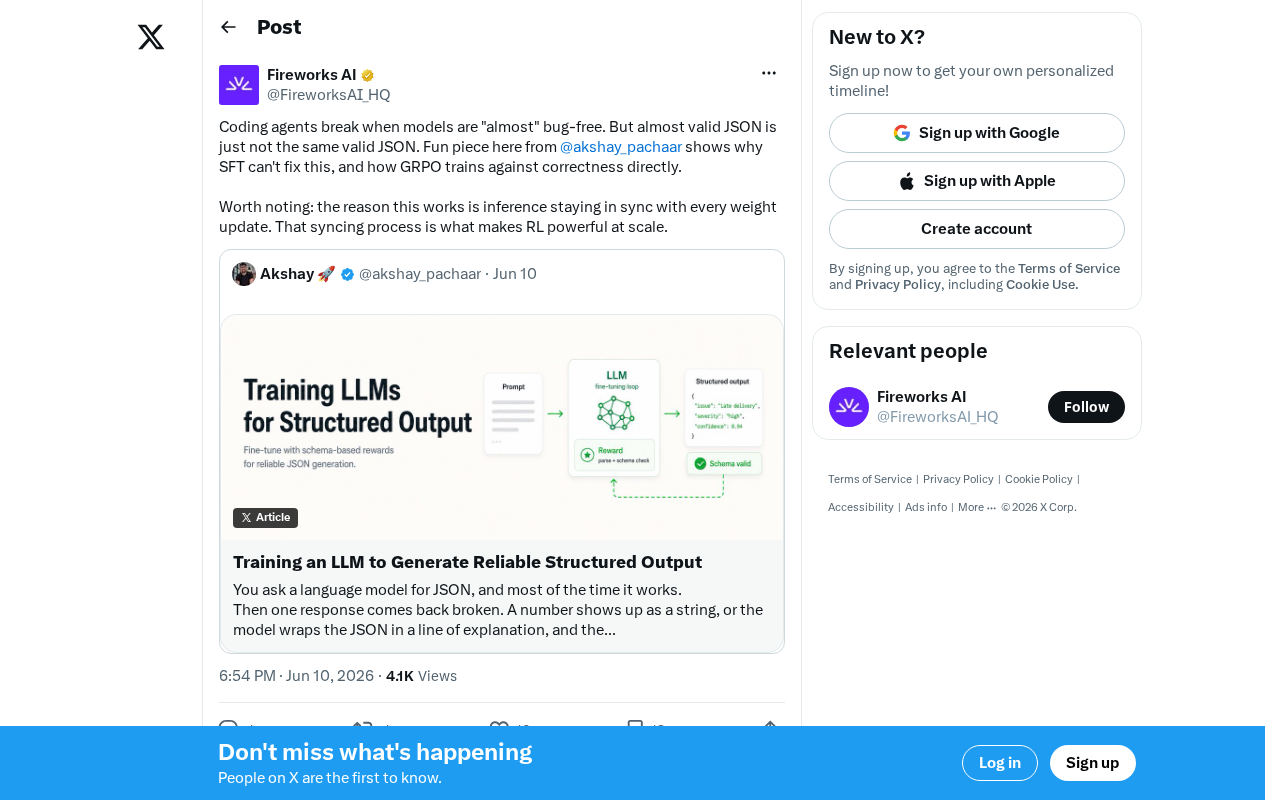
Why SFT Can't Fix the Root Cause of JSON Errors: How GRPO Correctness Training Breaks Through Coding Agent Bottlenecks
Analysis of why SFT can't fix coding agent JSON errors and how GRPO's binary reward signals and synchronized weight updates train directly for correctness.
Read more →

·3 min
AI Coding Efficiency: A Complete Methodology for Writing Effective Skill Specifications
A deep dive into writing Skill specifications for AI-assisted coding, covering template design, script selection for complex orchestration, and six standardized elements to constrain Agent behavior.
Read more →

·2 min
OpenAI Acquires Ona: Codex Enters a New Era of Cloud-Based Asynchronous Execution
OpenAI acquires Ona to integrate secure cloud execution into Codex, enabling AI coding agents to run long background tasks. Analysis of the deal's technical impact and the async AI agent trend.
Read more →

·3 min
Getting Started with Claude Code: An AI Programming Tool Anyone Can Learn Quickly
A complete guide to Claude Code: installation, setup, natural language programming, CLAUDE.md configuration, real-world use cases, and pricing plans for beginners.
Read more →

·3 min
AI Can't Kill Old-School Programming: Why Fundamentals Are Still a Developer's Moat
Vibe Coding is trending, but can it replace solid fundamentals? A deep analysis of why core principles, systems thinking, and knowledge frameworks remain a developer's moat in the AI era.
Read more →

·3 min
The Complete Guide to Codex Superpowers: 14 Skills That Make AI Follow Industrial-Grade Development Workflows
A complete guide to Codex Superpowers: 14 composable skills covering brainstorming, planning, TDD, and code review, with a real-world WeChat Mini Program case study.
Read more →

·2 min
Claude Proactively Discovers Bugs in an Open-Source Library: AI Evolves from Coding Assistant to Collaborator
Simon Willison releases asyncinject 0.7, fixing bugs proactively discovered by Claude. This case shows AI evolving from passive coding assistant to active code reviewer and collaborator.
Read more →

·2 min
Pre-Installation Guide for Codex: Setting Up Git, Node.js, and VS Code
Step-by-step guide to installing Git, Node.js, and VS Code before setting up OpenAI Codex. Covers download, version selection, and verification for beginners.
Read more →

·2 min
Xiaomi MiMo Code Goes Open Source: How Cross-Session Memory Is Changing AI Programming Collaboration
Xiaomi's MiMo Code is an open-source terminal programming Agent with cross-session memory and multi-Agent collaboration. Explore its memory system, self-evolution mechanism, and how it differs from Claude Code.
Read more →

·3 min
Deep Dive into LangChain's Social Media Agent Open-Source Project: Architecture, Features, and Practical Value
In-depth analysis of LangChain's open-source social-media-agent: content sourcing, AI curation, scheduled publishing, Human-in-the-Loop design, and LangGraph architecture.
Read more →

·3 min
8 AI Coding Tools Compared: A 5-Tier Buying Guide
In-depth comparison of 8 mainstream AI coding tools including GitHub Copilot, Cursor, Windsurf, and Claude Code, ranked into 5 tiers with tips to avoid bad plugins.
Read more →

·2 min
Cursor Team Hints at Major Update: What's the Next Game-Changing Move?
Cursor's team tweeted a hint at a game-changing update. We analyze the competitive landscape, possible directions including stronger Agents and new paradigms.
Read more →

·2 min
Fable 5 Released: An AI Coding Tool Built for Complex Software Engineering
Fable 5 officially launches, targeting high-complexity software engineering with five core capabilities: code review, architectural reasoning, large-scale project planning, multi-step task orchestration, and high-stakes engineering support.
Read more →