#GDPVal
8 related articles
 Tech Frontiers
·1 min
Gemini 3.5 Flash Achieves a Massive Leap on the GDPval Benchmark
Google Gemini 3.5 Flash surpasses Gemini 3.1 Pro on the GDPval benchmark. The lightweight Flash model leverages post-training techniques to approach frontier-level performance, redefining the balance between quality and cost.
Read more →
·3 min
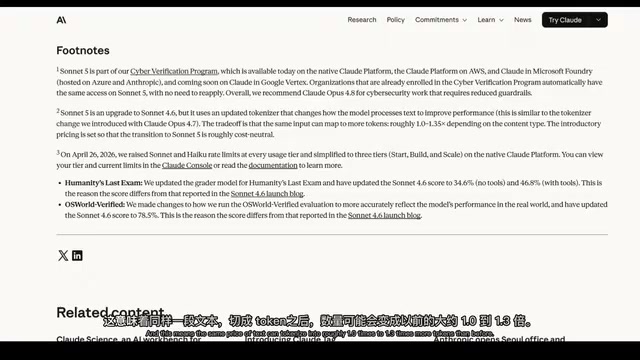
Claude Sonnet 5 Deep Dive: Impressive Benchmarks, Questionable Value — Just Use Opus 4.8?
Claude Sonnet 5 review: 63.2% SWE-bench, near Opus 4.8 performance, but new tokenizer hides real costs. Ranks 13th on CursorBench. Most tasks: stick with Opus 4.8.
Read more →

·3 min
Kimi K3 Hands-On: How a 2.8-Trillion-Parameter Open-Source Model Beat Fable5
A US engineer's live test of Kimi K3: 2.8T parameters, 1M token context, 87% audience vote over Fable5 in game generation. Full report covering benchmarks, speed, and code debugging.
Read more →

·6 min
OpenAI's Head of Evals: We've Been Consistently Underestimating What AI Models Can Really Do
OpenAI Frontier Evals lead Tejal Patwardhan reveals AI models are systematically underestimated — reasoning breakthroughs, wet lab records, the internal AGI Index, and a progress curve far steeper than most realize.
Read more →

·3 min
Is Claude Sonnet 5 Really Cheap? A Cost Breakdown by Task
Claude Sonnet 5 markets itself on agentic capabilities and low price, but real costs are far more complex. We break down token explosion, tokenizer inflation, and Opus 4.8 comparisons to reveal the true cost-performance picture.
Read more →

·3 min
OpenAI's Head of Evaluations: Never Underestimate a Model's Capabilities
OpenAI's Frontier Evaluations lead Tejal Patwardhan shares insights on O1's jailbreak breakthrough, wet lab experiments beating human baselines, and building the AGI Index—revealing AI capabilities evolving faster than imagined.
Read more →
·3 min
Deep Dive into Claude Opus 4.8: The AI Paradox of Being More Honest Yet Better at Gaming Tests
Anthropic releases Claude Opus 4.8 with major coding gains and zero false reporting. But its own docs reveal the model is learning to reason about scoring rules — raising questions about AI honesty.
Read more →
 Tech Frontiers
·1 min
Claude Sonnet 4.6 Comprehensive Review: A New AI Benchmark for Knowledge Work with Near-Opus Performance
In-depth analysis of Anthropic's Claude Sonnet 4.6: agentic tool use, computer control, and office task upgrades. Multiple benchmarks surpass Opus 4.6, redefining mid-tier AI capabilities.
Read more →