#engineering reliability
882 related articles
 Product Reviews
·3 min
Zenflow Hands-On Review: Spec-Driven AI Coding vs. Pure Prompt-Based Development
In-depth review of Zenflow's spec-driven AI coding vs Google AI Studio's prompt-based approach. Covers multi-agent execution, automated validation, version rollback, and the paradigm shift in AI programming.
Read more →
 Tutorials
·2 min
Open-Source MCP Tool: A Definitive Solution to AI Coding Hallucinations
Explore the open-source MCP tool with 20K+ GitHub Stars that eliminates AI coding hallucinations by fetching real-time official docs for Cursor and VS Code.
Read more →
 Product Reviews
·2 min
Warp Terminal Deep Dive: A Smart Command-Line Tool with Built-in AI Agent
Deep dive into Warp intelligent terminal, a high-performance CLI tool built with Rust. Explore Agent Mode for natural language commands, smart debugging, Warp Drive team collaboration, and how it differs from Cursor and other AI coding tools.
Read more →
 Product Reviews
·3 min
Devin 2.0 In-Depth Review: Is the $20/Month AI Coding Agent Actually Worth It?
In-depth analysis of Devin 2.0: dropped from $500 to $20/month, 12x efficiency in code migration, but only 15% completion on complex tasks. Real test data on use cases and limitations.
Read more →
 Expert Opinions
·3 min
Gumloop Founder: 50 AI Agents Running Your Company? Don't Fall for It
Gumloop founder Max shares the truth about AI automation: processing 4M daily workflows taught him why 50 AI Agents running a company is a lie, and why the real AI philosophy is acceleration, not replacement.
Read more →
 Research
·3 min
110K PRs Tested: Which of 5 AI Coding Agents Is Most Reliable?
Empirical study of 110K open-source PRs comparing 5 AI coding agents (GitHub Copilot, Claude Code, Devin) on merge rates, code survival, and long-term maintainability—revealing AI code's 50% one-year survival rate.
Read more →
 Product Reviews
·3 min
OpenCLI: Wrapping Websites and Desktop Apps into Reusable CLI Commands for AI
OpenCLI is an open-source tool that wraps websites and desktop apps into reusable CLI commands for AI Agents. With 90+ built-in adapters, browser login state reuse, and auto-generated adapters.
Read more →
 Product Reviews
·2 min
ZenFlow Hands-On: Testing the Spec-Driven Fully Autonomous AI Software Engineer
Hands-on review of ZenFlow—the first spec-driven fully autonomous AI software engineer. Multi-agent parallel collaboration with built-in verification delivers end-to-end development from ideation to production.
Read more →
 Product Reviews
·3 min
AI Coding Tools Deep Dive: How to Choose Between Qoder, Cursor, Windsurf, and Devin
Deep comparison of Qoder, Cursor, Windsurf, and Devin across autonomy, reliability, and context capabilities to help developers choose the right AI coding assistant.
Read more →
 Tutorials
·3 min
SubAgent Architecture: The Core Implementation for Context Isolation
Deep dive into SubAgent context isolation architecture, covering parent-child Agent roles, tool definitions, run_subagent implementation, and differences from TodoList and Agent Teams.
Read more →
 Tutorials
·2 min
Claude Code Sub-Agent: A Practical Guide to Multi-Agent Collaboration for Enhanced Development Efficiency
Deep dive into Claude Code Sub-Agent mechanism with a practical blog writing + Git commit case study, showing how multi-agent collaboration solves instruction loss and context bloat issues.
Read more →
 Tech Frontiers
·3 min
xAI Merges with SpaceX, GPT-5.5-Cyber Preview, Gemini 3.1 Flash Released
Musk announces xAI-SpaceX merger as SpaceX AI, OpenAI launches GPT-5.5-Cyber security model, Google releases Gemini 3.1 Flash, and Airbnb reveals AI writes 60% of new code.
Read more →
 Tutorials
·3 min
LangGraph + MCP: A Practical Guide to Building Enterprise-Grade ChatBI Data Analysis Agents
Learn how to build a ChatBI data analysis Agent from scratch using LangGraph + multi-MCP architecture, covering centralized-to-decentralized evolution, NL2SQL, agent orchestration, and enterprise deployment.
Read more →
 Industry Insights
·2 min
Devin's Client List Revealed: Why Goldman Sachs, the U.S. Military, and Mercedes-Benz Are Choosing Autonomous AI Programming
Cognition's AI programming tool Devin reveals major clients including Goldman Sachs, U.S. military, and Mercedes-Benz. Analysis of three key signals marking the commercialization tipping point for enterprise AI programming.
Read more →
 Deep Dives
·3 min
Harness Engineering Explained: Building Stable and Efficient Work Systems for AI
Deep dive into Harness Engineering: how to build execution environments, toolchains, and feedback loops for AI. From Prompt Engineering to system-level engineering for stable AI production.
Read more →
 Tutorials
·3 min
From Programmer to Agent Developer: A Detailed Four-Stage Learning Roadmap
A systematic four-stage learning roadmap for programmers transitioning to AI Agent development, covering core theory, ReAct and classic paradigms, Prompt engineering, and hands-on projects.
Read more →
 Deep Dives
·2 min
Agents Need Control Flow, Not More Prompts
Why do longer Prompts make AI Agents less stable? This article explains the control flow first architecture, replacing natural language control flow with code orchestration to boost multi-step reliability from 40% to over 90%.
Read more →
 Tech Frontiers
·3 min
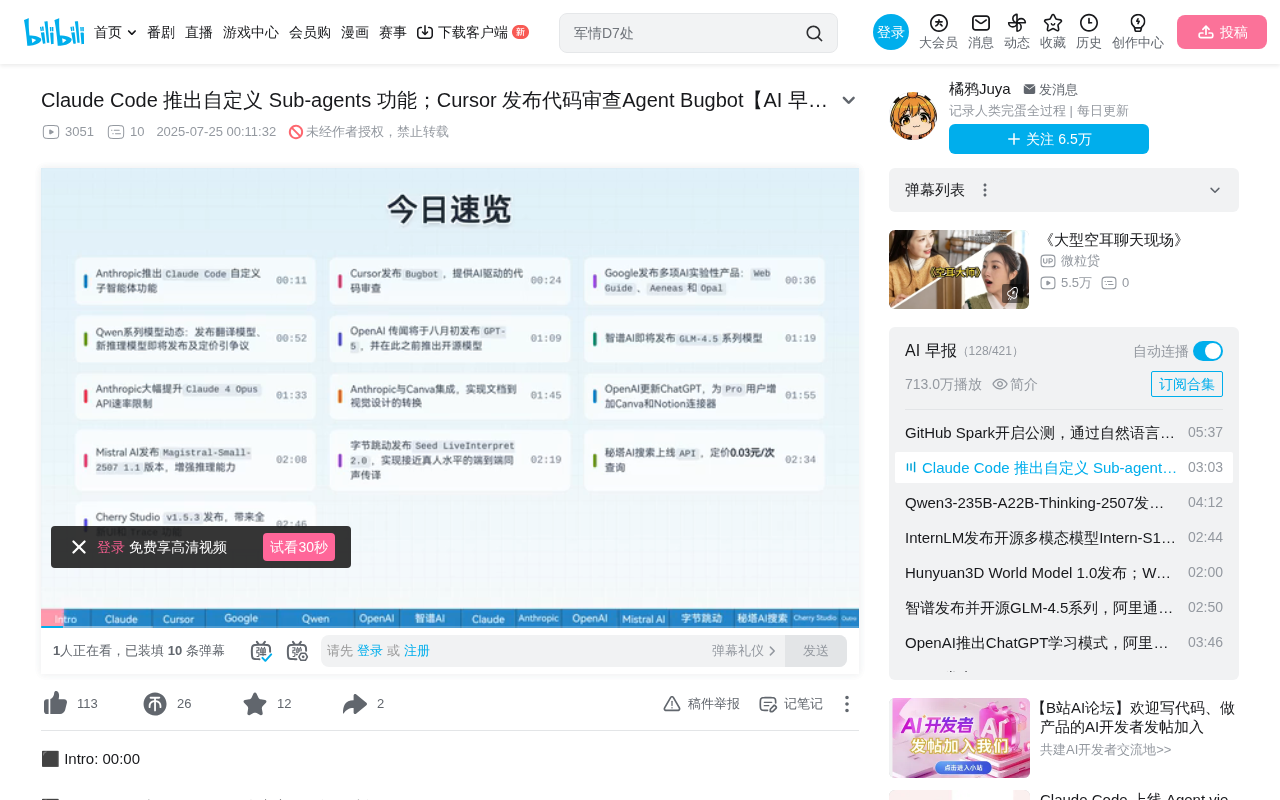
Claude Code Sub-Agents and Cursor BugBot Launch: AI Programming Tools Get Major Upgrades
Anthropic adds custom sub-agents to Claude Code, Cursor launches code review Agent BugBot, Qwen releases 92-language translation model, and Google unveils three experimental AI products.
Read more →
 Tutorials
·2 min
The Three-Layer Pyramid Model for Agent Development: From Beginner to Industrial-Grade Deployment
Deep dive into the Three-Layer Pyramid Model for Agent development, covering autonomous agents, collaborative multi-agent systems, and universal orchestration agents with a complete learning path from beginner to industrial-grade deployment.
Read more →
 Product Reviews
·3 min
Running Qwen3.6-27B Locally on Mac: 4 Solutions Benchmarked
Benchmarking 4 solutions for running Qwen3.6-27B locally on Mac: GGUF, MLX Diflash, and MTP-LX. MTP-LX 4bit leads at 43.6 tok/s with solid coding, writing, and reasoning quality.
Read more →