#multi-agent RL
1398 related articles
 Tutorials
·4 min
Fengxing Story AI Novel Expansion Suite: Installation, Configuration & Seven-Stage Creative Writing Tutorial
Complete guide to Fengxing Story AI novel expansion suite: installation, model API configuration, and seven-stage automated creative workflow from synopsis to full-length text.
Read more →
 Tutorials
·3 min
DeepSeek Multi-Agent Matrix + UE5.8 Official MCP: A Collaborative Development Workflow in Practice
A complete workflow for collaborative UE5 development using DeepSeek multi-Agent matrix and UE5.8 official MCP, covering pure C++ architecture, agent roles, cache optimization, and automated code review.
Read more →
 Tech Frontiers
·3 min
Hermes Agent 0.14.0 Update: Native Windows Support and 180x Performance Boost
Hermes Agent 0.14.0 Foundation Update: local proxy unified auth, 180x browser automation speedup, native Windows support, AI video generation, free DeepSeek V4, and lossless Handoff context switching.
Read more →
 Product Reviews
·3 min
Local Claude Code Hands-On: How Well Does a Terminal Agent Make PPTs?
Hands-on test of local Claude Code with MiniMax 2.7 for creating pitch deck PPTs, exploring its precise file history rollback mechanism vs. Cursor's rollback pain points.
Read more →
 Tutorials
·3 min
Claude Code with GLM 4.6: A Guide to Deploying a Programming Agent with Chinese Domestic Models
A detailed guide on deploying Claude Code programming Agent with Zhipu GLM 4.6, covering installation, model replacement, commands, thinking modes, and SubAgent parallel development.
Read more →
 Tech Frontiers
·3 min
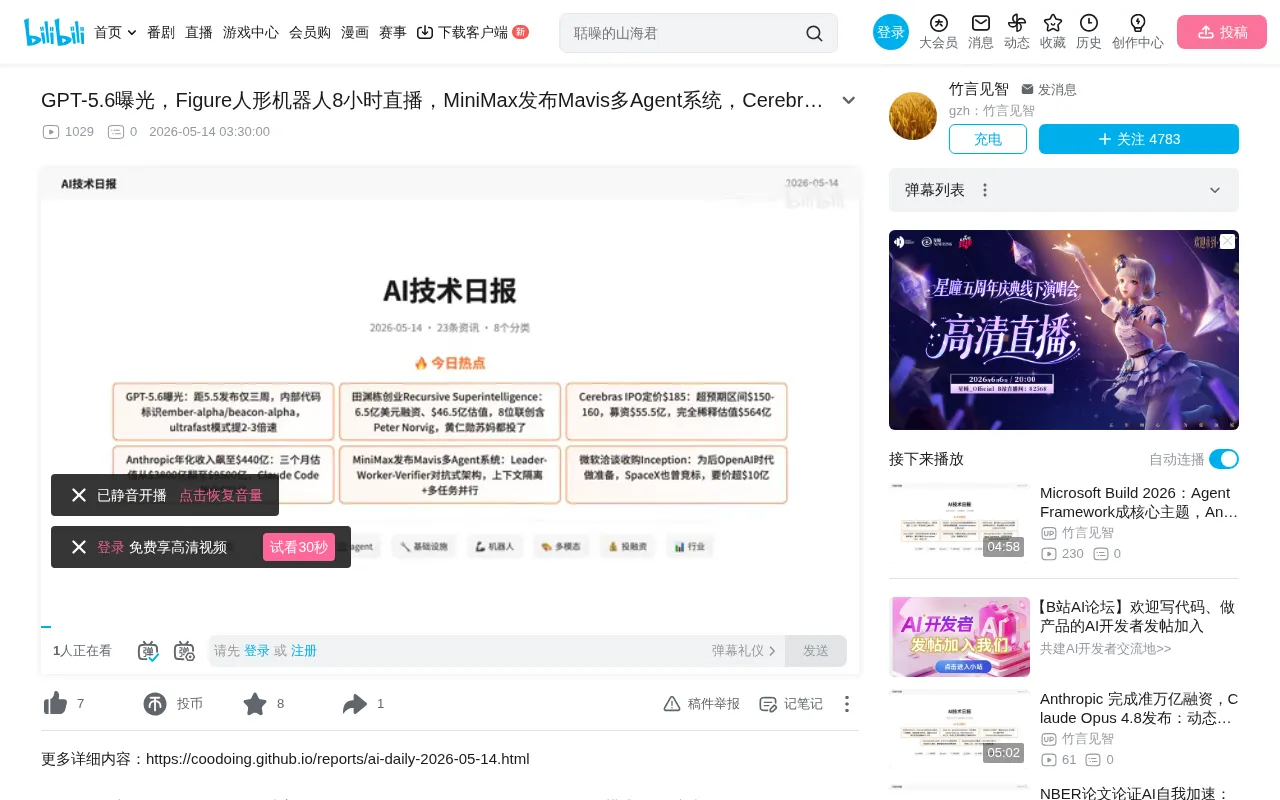
GPT-5.6 Internal Testing Begins: A Complete Breakdown of the Week's Biggest AI Developments
GPT-5.6 internal testing launches UltraFast mode, Codex goal-driven mode revolutionizes AI programming, MiniMax cuts costs 360x, Anthropic vs OpenAI valuation war, Cerebras IPO raises $5.55B, Figure robot validates 8-hour autonomous ops, Google Vio 3.1 leads AI video.
Read more →
 Tech Frontiers
·2 min
AI Daily: Claude Autonomous Tasks Exceed 16 Hours, GPT 5.5 Proves Mathematical Theorems
May 10, 2025 AI roundup: Claude autonomous tasks exceed 16 hours, GPT 5.5 Pro aids Fields Medalist in math proof, Cloudflare cuts 20% of staff due to AI.
Read more →
 Tutorials
·2 min
LangChain 1.0 Complete Guide: Architecture, Core Modules, and Learning Path
Deep dive into LangChain 1.0's three-layer architecture (LangChain, LangGraph, Deep Agents), core components like Models, Tools, and Memory, plus a complete learning path from semantic search to multi-agent collaboration.
Read more →
 Tutorials
·4 min
Claude Code Agent Architecture Source Code Deep Dive: Agent Loop and Tool System in Practice
Deep dive into Claude Code's four core agent modules: system prompt, Agent Loop, tool system, and memory mechanism. Build a Mini Claude Code from scratch in TypeScript.
Read more →
 Tutorials
·1 min
Harness Engineering: Essential Architecture Guide for Agent Development
Deep dive into Harness Engineering architecture for AI agents: multi-agent collaboration, memory management, middleware design, MCP integration, and LangChain's DeepAgent framework.
Read more →
 Tutorials
·1 min
Getting Started with Agent Development: 3 Agent Types × 8 Core Mechanisms Fully Explained
A complete breakdown of AI Agent development: 3 agent types (autonomous, collaborative, orchestration-based), 8 core mechanisms, a 5-stage learning path, and framework selection guidance.
Read more →
 Tutorials
·3 min
Zero2Agent: An Open-Source Job Interview Prep Tutorial for Agent Engineer Positions at Top Tech Companies
Zero2Agent is an open-source interview prep tutorial covering Agent fundamentals, LangGraph/Claude Code analysis, interview question banks, and coding practice tools for landing Agent engineer roles at top tech companies.
Read more →
 Tutorials
·4 min
Zion No-Code Platform: A Complete Hands-On Tutorial for Building AI Agents with Drag-and-Drop
Learn how Zion's no-code platform lets you build AI agents via drag-and-drop, with a hands-on prompt optimization assistant tutorial covering knowledge base integration, UI building, and API access.
Read more →
 Expert Opinions
·3 min
The Hotter AI Gets, the More We Need Tech-Savvy People: Embrace the Tool, Don't Fear the Replacement
Jensen Huang advises everyone to embrace AI rather than fear it. As AI advances, demand for tech talent grows. Those who get displaced are people who refuse to use new tools. Learn strategies for thriving in the AI era.
Read more →
 Tutorials
·3 min
Building an Automated Money-Making System with AI Agents: A Multi-Agent Hands-On Tutorial
Learn how to build a full-pipeline automated money-making system using Multi-Agent architecture, covering Customer Service Agent, Cashier Agent, Delivery Agent setup, workflow orchestration, RAG knowledge bases, and MCP tool calling.
Read more →
 Tutorials
·2 min
Claude Code Multi-Agent Orchestration: The tmux Dilemma on Windows and Solutions
Explaining how Claude Code's multi-Agent orchestration fails on Windows due to tmux incompatibility, analyzing WSL limitations, and exploring native alternatives and best practices.
Read more →
 Industry Insights
·4 min
In-Depth Analysis of the AI Large Model Job Market: Two Core Directions and Future Trends
In-depth analysis of the AI large model job market, breaking down the two core directions—algorithm research and engineering deployment—covering requirements, barriers, and career prospects.
Read more →
 Tutorials
·3 min
One Person, Three Machines: Local Agent Deployment and Multi-Machine Collaborative Operations in Practice
Deploy Cloud Code and Hermes AI Agents to efficiently manage three physical hosts solo. Covers Ventoy single-file deployment, BTRFS+RAW Image setup, Agent task division, and risk control strategies.
Read more →
 Tech Frontiers
·3 min
Windsurf Rebrands as Devin Desktop: A Complete Breakdown of the Multi-Agent Collaborative IDE Platform
Windsurf rebrands as Devin Desktop with Agent Command Center for multi-agent management, open-source ACP protocol, and a Rust-rewritten local Agent. Full breakdown of the upgrade and platform strategy.
Read more →
 Deep Dives
·3 min
How Multi-Agent Teams Solve AI Hallucination and Make AI Reliable
Deep analysis of how multi-agent architecture solves AI hallucination. From context rot to adversarial debate mechanisms, see how Anthropic, xAI, and Kimi reduce hallucination rates from 12% to 4.2%.
Read more →