#reliability engineering
1160 related articles

·2 min
Qwen3-Coder Deep Dive: A Coding Model Built for Long-Horizon Agent Loops
Deep dive into Qwen3-Coder: 11 hours continuous operation, 10K+ lines of code, 1000+ calls. Explore its long-horizon agent loop architecture, reasoning persistence, thinking mode switching, and deployment on Fireworks.
Read more →
·3 min
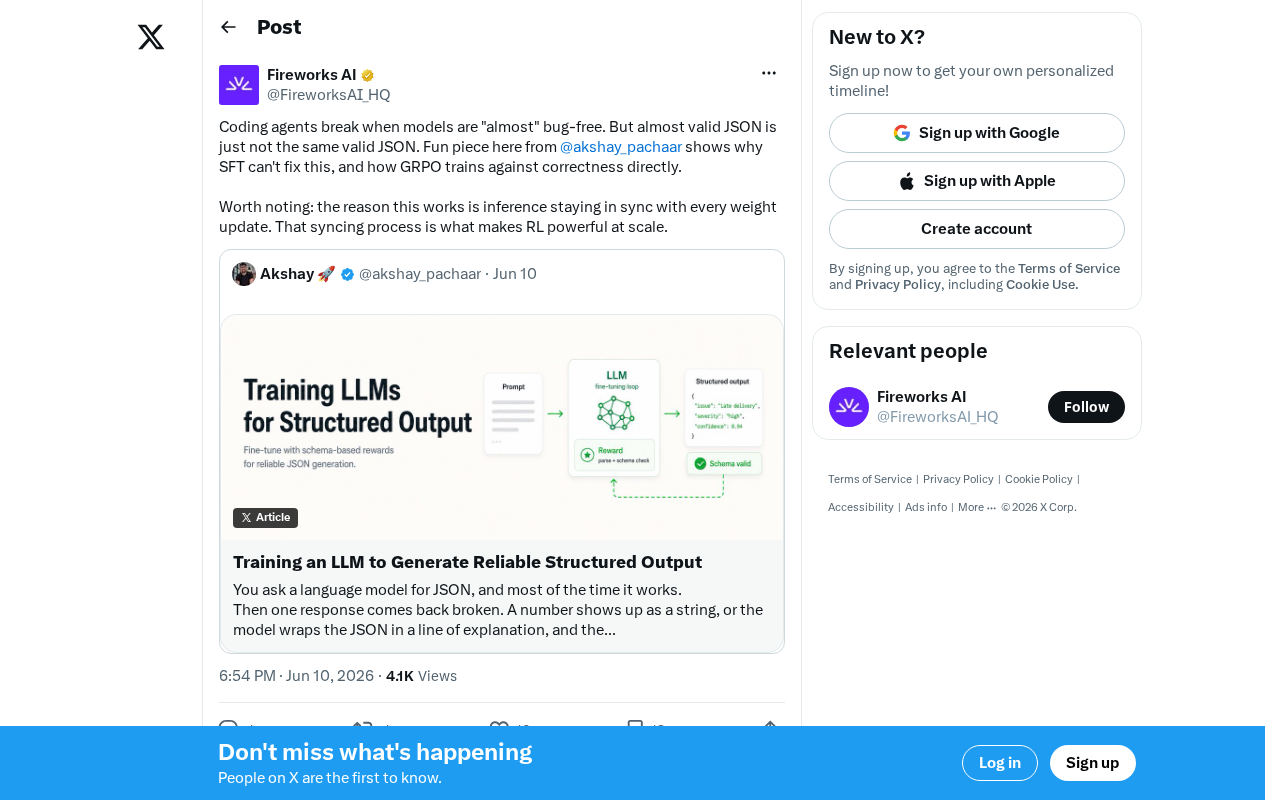
Why SFT Can't Fix the Root Cause of JSON Errors: How GRPO Correctness Training Breaks Through Coding Agent Bottlenecks
Analysis of why SFT can't fix coding agent JSON errors and how GRPO's binary reward signals and synchronized weight updates train directly for correctness.
Read more →

·3 min
AI Agent Hands-On Learning Path: A Complete Guide from Beginner to Enterprise-Level Development
A systematic AI Agent development learning roadmap covering prompt engineering, RAG, multi-Agent collaboration, tool calling, and more—with phased learning advice and 28 hands-on project references.
Read more →

·4 min
Agent Tool Selection Guide: A Comprehensive Comparison of API, CLI, MCP, Browser Use, and Computer Use
Compare 5 Agent tool types: CLI, API, MCP, Browser Use & Computer Use on speed, accuracy, and token cost. Includes a selection priority table to cut costs and boost Agent efficiency.
Read more →

·3 min
Loopcraft Explained: Loop-Stacking Architecture Design in AI Agent Development
Deep dive into Loopcraft loop-stacking architecture for AI Agent development, covering retry, self-validation, and meta-learning loops to boost reliability.
Read more →

·2 min
Harness: An Open-Source Framework That Generates Multi-Agent Teams from a Single Sentence
Harness is a 4.6K-star open-source multi-Agent framework that auto-generates AI teams from a single sentence, with six built-in collaboration architectures.
Read more →

·3 min
Hermes AI Kanban: A Five-Layer Autonomous Architecture for Fully Automated Delivery from Idea to Finished Product
Deep dive into Hermes Kanban 2.0's five-layer autonomous architecture covering intelligent planning, human approval gates, multi-agent execution, and Obsidian integration for fully automated delivery.
Read more →

·2 min
Struggling to Deploy AI Agents? Engineering Is the Key to Going from Demo to Product
57% of projects have deployed AI Agents, but 40% will be killed. This article analyzes the engineering methodology for taking AI Agents from Demo to enterprise product, covering the full process from requirements to deployment.
Read more →

·2 min
Perplexity Computer: An AI-Powered Startup Operating System to Create and Run Companies from Scratch
Perplexity CEO announces Perplexity Computer will integrate all business connectors, enabling users to create and run companies from scratch with AI.
Read more →

·3 min
Building a Cold Chain Logistics Optimization Research Project with Codex: A Complete Workflow from Scratch to PDF Paper
Learn how to use OpenAI Codex to build a complete cold chain logistics optimization research project from scratch, including simulated annealing implementation, experiments, figures, and LaTeX paper compilation.
Read more →

·3 min
X API Sudden 403 Errors: A Troubleshooting Guide for Vanishing Free Credits and Subscriptions
X API suddenly returns 403 Forbidden errors as developer free credits and subscriptions vanish. A deep dive into causes, troubleshooting steps, and long-term risk management strategies.
Read more →

·3 min
Four Core Advantages Frontend Developers Have When Transitioning to AI Agent Development
Frontend developers have key advantages for AI Agent development: TypeScript ecosystem fit, low-barrier full-stack bridging, and state management isomorphism. Learn the transition path here.
Read more →

·3 min
Replit President: Writing Code Will Become Insignificant — Ideas Are Everything
Replit's president shares insights on AI programming's future: how a 40M-user platform uses Claude to eliminate coding barriers, making natural language the new programming language.
Read more →

·2 min
Perplexity Computer Integrates Deep Research as a Native Skill: A New Paradigm for AI Agent Capability Fusion
Perplexity integrates Deep Research as a native skill in Computer, enabling automatic invocation without manual mode switching. Analyzing the Agent Harness design philosophy and AI capability fusion trends.
Read more →

·3 min
Hands-On with Tencent Cloud ADP 4.0: How an Enterprise-Grade Agent Development Platform Tackles the Agent Commercialization Challenge
Hands-on review of Tencent Cloud ADP 4.0: testing its full-lifecycle Agent management — from rapid creation and enterprise integration to automated evaluation and Skill governance for real-world deployment.
Read more →

·2 min
Datasette Agent 0.2a0: A New Mechanism for AI Agents to Ask Users Questions During Tool Execution
Datasette Agent 0.2a0 introduces an ask_user() mechanism enabling AI agents to pause during tool execution and ask users questions, with three interaction modes and a save_query tool for human approval.
Read more →

·2 min
AI Agent Development Learning Path: A Practical Guide from Zero to Commercial Deployment
A complete AI Agent development learning path covering theory, frameworks, tool integration, and commercial deployment with real enterprise use cases.
Read more →

·3 min
Kunpeng AI Agent Architecture: Why General-Purpose Computing Matters as Much as AI Computing
Deep dive into Huawei Kunpeng's AI Agent solution — why general-purpose computing matters as much as AI computing for agent architecture, from memory systems to tool calling and secure runtimes.
Read more →

·2 min
In the Era of Incremental Model Upgrades, AI Platforms Are the Real Productivity Variable
AI model upgrades are hitting diminishing returns. The real differentiator is AI Agent platforms like Codex that restructure workflows — task orchestration, cross-device collaboration, and automation are what truly eliminate human overhead.
Read more →

·3 min
LangChain Beginner's Guide: From Environment Setup to RAG — A Complete Hands-On Walkthrough
A systematic guide to LangChain covering environment setup, model invocation, Prompt Templates, Output Parsers, LCEL chain expressions, and hands-on RAG implementation for beginners.
Read more →