#streaming AI
839 related articles

·3 min
PiDeck 0.5.0 Released: Ten Versions in One Week, a Complete Overhaul of the Desktop AI Agent
PiDeck 0.5.0 completes the rebrand from PiDesktop, shipping 10 versions with ~100 changes in one week: design system overhaul, dark mode, LAN sharing, Git integration, and dual-layer proxy config.
Read more →

·3 min
AI Agent Hands-On Learning Path: A Complete Guide from Beginner to Enterprise-Level Development
A systematic AI Agent development learning roadmap covering prompt engineering, RAG, multi-Agent collaboration, tool calling, and more—with phased learning advice and 28 hands-on project references.
Read more →

·4 min
Local Deployment of Claude Code: Principles and Practical Guide for Three Approaches
A detailed guide to locally deploying Claude Code with three approaches (LM Studio, Ollama, vLLM), covering architecture, protocol translation, hardware selection, and model recommendations.
Read more →

·3 min
Complete Guide to LangChain 0.3: Module Architecture & Core Development in Practice
A deep dive into LangChain 0.3's module architecture, message abstraction, prompt templates, output parsers, LCEL chains, LangSmith tracing, and LangGraph for mastering LLM application development.
Read more →
·3 min
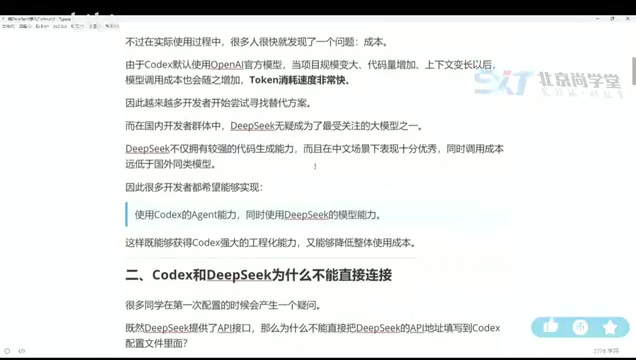
DeepSeek + Codex Tutorial: Achieve Low-Cost AI Coding with Codex++
Learn how to connect DeepSeek to Codex using the open-source tool Codex++. Covers provider setup, connection testing, and launch verification for low-cost AI coding.
Read more →

·4 min
AI Full-Stack Development Architecture: A Three-Layer Progressive Path from Prototype to Production
A detailed guide to AI full-stack development architecture covering Node.js+TypeScript+Monorepo engineering, Docker CI/CD deployment, and AI engine design with interview tips.
Read more →

·3 min
A Three-Month Roadmap to LLM Development: A Deep Dive into the Learning Path from Zero to Freelancing
A deep dive into the three-step LLM development learning path: from prompt engineering and RAG knowledge bases to AI Agent development, with realistic timelines for beginners and experienced developers.
Read more →

·2 min
Gemini 3.5 Live Translate Launch: A Deep Dive into the Speech-to-Speech Translation Model Supporting 70+ Languages
Google launches Gemini 3.5 Live Translate, a speech-to-speech translation model supporting 70+ languages. Learn about its end-to-end architecture, Grab partnership, and developer access via Live API.
Read more →

·2 min
Simon Willison Updates WebRTC Voice Tool: Now Supports Document Context Conversations and GPT-Realtime-2
Simon Willison updates his OpenAI WebRTC voice tool with document context support and GPT-Realtime-2, enabling low-latency voice conversations grounded in specific documents.
Read more →

·3 min
Four Core Advantages Frontend Developers Have When Transitioning to AI Agent Development
Frontend developers have key advantages for AI Agent development: TypeScript ecosystem fit, low-barrier full-stack bridging, and state management isomorphism. Learn the transition path here.
Read more →

·2 min
DiffusionGemma: Google's Open-Source Diffusion Language Model Exceeding 500 Tokens/s
Google releases DiffusionGemma, an open-source diffusion language model with Apache 2.0 license. The 26B-parameter MoE model achieves over 500 tokens/s in real-world tests.
Read more →

·3 min
Claude Code with Local LLMs: Token-Free Deployment Guide & Configuration
Learn how to connect Claude Code to local LLMs for token-free AI coding. Covers three-layer architecture, Ollama/LM Studio/vLLM setup, protocol translation, and hardware selection.
Read more →

·3 min
Use Claude Code for Just ¥7.9: A Complete Guide to Affordable Alternatives with Chinese AI Models
Learn how to set up Claude Code with affordable Chinese AI model alternatives. Use providers like SiliconFlow and DeepSeek starting from just ¥7.9, with full environment variable configuration guide.
Read more →
·3 min
Deep Dive into Claude Opus 4.8: The AI Paradox of Being More Honest Yet Better at Gaming Tests
Anthropic releases Claude Opus 4.8 with major coding gains and zero false reporting. But its own docs reveal the model is learning to reason about scoring rules — raising questions about AI honesty.
Read more →

·3 min
OpenAI Codex Beginner's Guide: From Environment Setup to Enterprise-Level Practice
A systematic guide to OpenAI Codex and AI LLM learning, covering Transformer basics, dev environment setup, prompt engineering, RAG deployment, LoRA fine-tuning, and AI Agent enterprise projects.
Read more →

·2 min
Claude Code Anti-Ban Guide: Practical Tips from Two Months of Stable Usage
Practical Claude Code anti-ban tips from $400+ of real testing: lock your network region, control concurrency, match system time, and clean local fingerprints for stable long-term use.
Read more →

·2 min
DeepSeek GUI Hands-On Review: How Powerful Is This Cache-First Local AI Coding Assistant?
Hands-on review of DeepSeek GUI's full agent workbench: KUN local runtime, cache-first architecture, task scheduler, and Token cost advantages for developers.
Read more →
·3 min
LangChain Beginner's Guide: From Environment Setup to RAG — A Complete Hands-On Walkthrough
A systematic guide to LangChain covering environment setup, model invocation, Prompt Templates, Output Parsers, LCEL chain expressions, and hands-on RAG implementation for beginners.
Read more →

·3 min
The Complete Guide to DeepSeek TUI: Installation, Configuration, and Hands-On Use of a Terminal AI Coding Agent
A deep dive into DeepSeek TUI: the terminal AI coding agent with chain-of-thought visualization, million-token context, and multi-task parallelism. Covers installation, configuration, and real-world use cases.
Read more →

·3 min
Claude Code Local Deployment: A Practical Guide to Connecting Local LLMs
Complete guide to deploying Claude Code locally with Ollama, LM Studio, or vLLM. Covers architecture, protocol translation, hardware requirements, and model selection for zero-cost, private AI coding.
Read more →