#wrapper
351 related articles

·4 min
Claude Code Practical Guide: From Installation & Configuration to Production-Ready Business Projects
Complete guide to Claude Code + Opus setup via CCSwitch for unified model management. Real-world case: payment system built in 4 hours with zero hand-written code, covering installation, Prompt engineering, and model selection.
Read more →

·3 min
A Systematic Guide to Claude Code: From Deployment to Architectural Analysis of 510K Lines of Source Code
A systematic guide to Claude Code covering environment deployment, domestic model integration, six core systems (memory, multi-Agent, etc.), a full-stack ChatBot project, and eight design patterns from 510K lines of open-source code.
Read more →

·3 min
Complete Guide to the Coze Platform: Build AI Agents with Zero Code
A deep dive into ByteDance's Coze platform: zero-code AI agent development, China vs. international editions, use cases, and how non-technical users can quickly build AI applications.
Read more →

·3 min
PiDeck 0.5.0 Released: Ten Versions in One Week, a Complete Overhaul of the Desktop AI Agent
PiDeck 0.5.0 completes the rebrand from PiDesktop, shipping 10 versions with ~100 changes in one week: design system overhaul, dark mode, LAN sharing, Git integration, and dual-layer proxy config.
Read more →

·4 min
Building a Personal Blog from Scratch with Cursor: A Complete AI-Powered Development Tutorial
Learn how to build a personal blog from scratch using Cursor AI — covering UI prototyping, full-stack code generation, database setup, and bug debugging with almost no hand-written code.
Read more →

·3 min
Kuaima Client Tutorial: A Detailed Guide to Pay-Per-Use Pricing for Cursor's Premium Models
A detailed guide to downloading, installing, configuring, and using the Kuaima client for pay-per-use access to Cursor's premium AI models, with troubleshooting tips and security advice.
Read more →

·3 min
Complete Guide to LangChain 0.3: Module Architecture & Core Development in Practice
A deep dive into LangChain 0.3's module architecture, message abstraction, prompt templates, output parsers, LCEL chains, LangSmith tracing, and LangGraph for mastering LLM application development.
Read more →

·3 min
5 Ways to Deploy LLMs Locally: From Getting Started to Production
A complete guide to 5 local LLM deployment methods: LlamaCPP, Ollama, LM Studio, vLLM/SGLang, and MLX-LM — from personal dev to production environments.
Read more →

·3 min
Agent Skills: Folders as Skills — Making AI Produce Precise, Template-Based Output
Agent Skills splits AI capabilities into independent skill folders with on-demand loading and progressive disclosure, cutting token costs by 80% and reducing hallucinations for template-based output.
Read more →

·1 min
Claude Code GUI: CC Park Lets You Ditch the Command Line with One Click
CC Park gives Claude Code a beautiful Web GUI you can access in your browser with one command, lowering the barrier to entry while preserving full coding power.
Read more →

·4 min
Fable 5 vs Opus 4.8 Real-World Showdown: Three Projects to Determine the AI Coding Champion
Real-world comparison of Fable 5 vs Opus 4.8 across three demanding projects: e-commerce site, 3D art museum, and an RTS game. Analyzing code quality, 3D rendering, and design aesthetics.
Read more →

·3 min
LFM2.5 Local Deployment Hands-On: An 8B Parameter Model That Outperforms GPT-o3s in Tool Calling
Hands-on test of Liquid AI's LFM2.5 local deployment: architecture breakdown, 16GB VRAM troubleshooting, and GraphRAG tool-calling benchmarks vs GPT-o3s.
Read more →

·2 min
In the Era of Incremental Model Upgrades, AI Platforms Are the Real Productivity Variable
AI model upgrades are hitting diminishing returns. The real differentiator is AI Agent platforms like Codex that restructure workflows — task orchestration, cross-device collaboration, and automation are what truly eliminate human overhead.
Read more →

·4 min
The Complete AI Agent Engineering Tech Stack: A Practical Guide to 100x Development Efficiency
Deep dive into the AI agent engineering stack: from Cursor framework, model selection to context engineering and automated review loops — a complete workflow guide to achieving 100x development efficiency.
Read more →

·2 min
Claude Fable 5 Coding Stress Test: Three Hardcore Tasks, All Passed — Plus a Hybrid Cost-Saving Strategy
Hands-on test of Claude Fable 5 on 3D world generation, real repo bug fixing, and physics coupling simulation — all passed first try. Plus a hybrid cost-saving strategy with DeepSeek.
Read more →

·3 min
AI-Driven Zero-Code Automated Testing: A Complete Path from Python Basics to Hands-On Practice
A detailed guide to AI-driven automated testing: from Python basics to PyTest, covering API automation, Playwright UI testing, and AI-assisted coding for beginners.
Read more →
·3 min
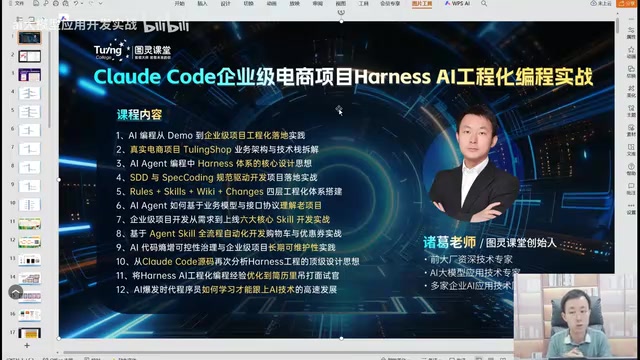
Harness AI Engineering Programming: A Detailed Methodology for Enterprise-Level Project Development
Deep dive into Harness AI Engineering Programming methodology, covering SDD, Skill development patterns, and core practices for enterprise-level AI-assisted development.
Read more →

·3 min
8 AI Coding Tools Compared: A 5-Tier Buying Guide
In-depth comparison of 8 mainstream AI coding tools including GitHub Copilot, Cursor, Windsurf, and Claude Code, ranked into 5 tiers with tips to avoid bad plugins.
Read more →

·3 min
CrewAI Multi-Agent Collaboration in Practice: A Complete Guide from Setup to API Service
A detailed guide to CrewAI multi-Agent collaboration covering core concepts, FastAPI service setup, and real-world comparisons of GPT-4o Mini, Qwen Max, and Llama 3.1.
Read more →

·2 min
Skill and MCP: The Two Pillars of Agent Engineering Architecture
Deep dive into how Skill and MCP work together in Agent engineering. Skill handles business logic; MCP provides standardized connections. Together they form the core of modern Agent architecture.
Read more →