AgentChat Open Source Project: An AI Agent Platform Integrating MCP, RAG, and LangChain

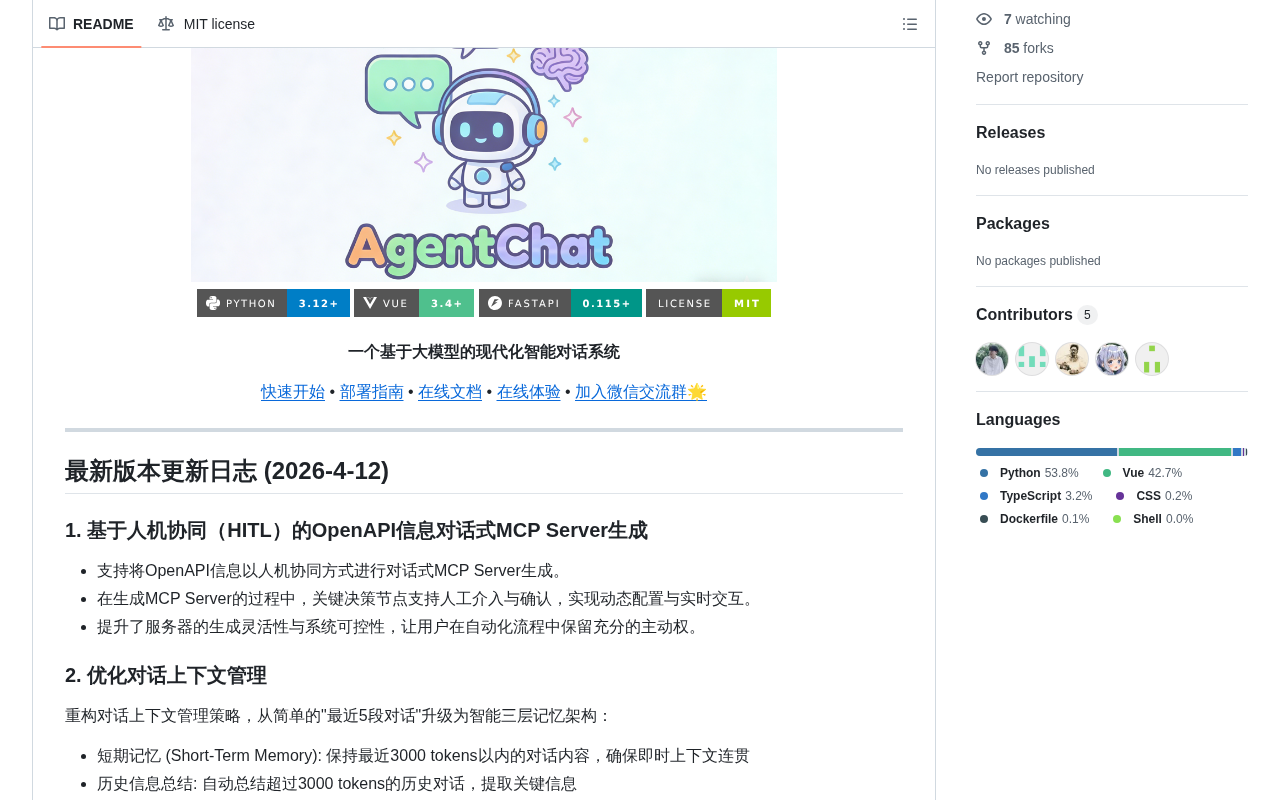
AgentChat is an open-source AI agent collaboration platform integrating LangChain, MCP, RAG, and more.
AgentChat is an open-source AI agent platform on GitHub with 694 Stars, built on LLMs for multi-Agent collaboration. It integrates LangChain framework, MCP protocol, and Function Call tool invocation, while implementing hybrid RAG retrieval through Milvus and ElasticSearch dual engines. It also supports Memory mechanisms, HITL human-AI collaboration, and a modular Skill system, with a layered FastAPI backend architecture suitable for enterprise knowledge Q&A and complex business collaboration scenarios.
AgentChat Project Overview: An Open Source Agent Platform with 694 Stars
AgentChat is an open-source AI agent communication platform developed by Shy2593666979 on GitHub. Built on Large Language Models (LLMs), the project has garnered 694 Stars so far. Primarily developed in Python, it aims to provide developers with a fully-featured Agent collaboration environment.
Large Language Models are deep learning models based on the Transformer architecture, trained on massive text datasets, capable of text understanding, generation, reasoning, and other general-purpose abilities. Representative products include OpenAI's GPT series, Anthropic's Claude, and Meta's LLaMA. AI Agents, on the other hand, are autonomous systems built on top of LLMs with added capabilities for perception, planning, action, and memory—they can not only generate text responses but also proactively decompose tasks, invoke tools, interact with environments, and adjust strategies based on feedback.
The project's core philosophy is clear: enable multiple agents to decompose and complete complex tasks through multi-turn dialogue and task collaboration. Multi-Agent collaboration allows multiple agents with different specializations to work together through communication protocols, similar to division of labor among different roles in a human team. This is the core paradigm driving the evolution of AI applications from simple Q&A to complex task automation. Beyond built-in default Agents, users can customize Agents according to their business needs, greatly enhancing the platform's flexibility and applicability.
Deep Dive into the Core Technology Stack
LangChain Framework and Function Call Integration
AgentChat integrates LangChain at its foundation—one of the most mainstream development frameworks for building LLM applications today. Created by Harrison Chase in 2022, LangChain quickly became the de facto standard framework for LLM application development. Its core design philosophy abstracts LLM calls into composable "Chains," allowing developers to connect prompt templates, model calls, output parsing, tool usage, and other components into complex workflows like building blocks. LangChain provides core modules including Agents, Chains, Memory, and Retrievers, where the Agent module allows LLMs to dynamically decide their next action rather than following a fixed process. In 2024, LangChain launched the LangGraph sub-project, further supporting stateful, multi-step Agent workflow orchestration, enabling complex control flows like loops, conditional branches, and parallel execution.
Through LangChain, AgentChat achieves chained LLM calls and complex workflow orchestration.
Meanwhile, the introduction of Function Call ensures Agents are no longer limited to text generation. Function Call was introduced by OpenAI in June 2023 alongside the GPT-3.5/GPT-4 API update and has since been widely adopted by major model providers. It works as follows: developers define available functions using JSON Schema descriptions (including function names, parameter types, and purpose descriptions) in the API request; after understanding user intent, the model outputs a structured function call request rather than a plain text response. The application receives this request, executes the actual function, and returns the result to the model for the next round of reasoning.
This mechanism addresses the fundamental limitation of LLMs being "all talk and no action." Agents can automatically invoke external tools and functions based on user intent, extending LLM capabilities to the operational level—such as querying databases, calling APIs, or performing specific computational tasks.
MCP Protocol: Standardized Model Context Interaction
MCP (Model Context Protocol) is a protocol standard that has gained significant traction in the AI space recently. Officially released and open-sourced by Anthropic in November 2024, MCP aims to solve the fragmentation problem of integrating AI models with external tools and data sources. Before MCP, every AI application that needed to connect to N external services required N separate sets of adapter code, creating M×N integration complexity. MCP reduces this complexity to M+N by defining a unified client-server protocol—any MCP-compatible AI application can plug-and-play connect to any MCP server.
The protocol is based on JSON-RPC 2.0 communication and supports three core primitives: Resources (such as files and database records), Tools (such as API calls), and Prompts (prompt templates). Hundreds of MCP Server implementations currently exist, covering common services like GitHub, Slack, databases, and file systems, with the ecosystem expanding rapidly.
AgentChat fully integrates the MCP protocol, providing a standardized interface for interactions between AI models and external data sources and tools. This means Agents can connect to various services and resources in a unified manner without writing separate adapter code for each external tool, significantly reducing integration complexity. As the MCP ecosystem matures, the long-term value of this design choice will become increasingly apparent.
RAG Retrieval-Augmented Generation: Milvus + ElasticSearch Dual Engine
For knowledge retrieval, AgentChat implements a RAG (Retrieval-Augmented Generation) architecture. First proposed by Meta AI's research team in 2020, RAG's core idea is to retrieve relevant information from an external knowledge base and inject it as context into the prompt before the LLM generates an answer. This addresses two inherent LLM limitations: outdated information due to knowledge cutoff dates, and lack of private/specialized domain knowledge.
The standard RAG pipeline includes: document chunking → vectorization (Embedding) → storage in a vector database → user query vectorization → similarity search → concatenating retrieved results with the user question → feeding into the LLM for answer generation. RAG technology evolved rapidly in 2024, with variants such as Advanced RAG (introducing query rewriting and reranking), Modular RAG (modular plug-and-play components), and Graph RAG (combining knowledge graphs), continuously improving retrieval quality and generation accuracy.
AgentChat integrates two major retrieval engines simultaneously:
-
Milvus Vector Database: Milvus is a cloud-native vector database open-sourced by Zilliz, designed for unstructured data retrieval in the AI era, and is a CNCF (Cloud Native Computing Foundation) graduated project. It supports efficient storage of trillion-scale vectors with millisecond-level retrieval, implementing multiple approximate nearest neighbor (ANN) search algorithms including HNSW, IVF_FLAT, and DiskANN. Milvus's core advantage lies in its distributed architecture—with separate compute, storage, and coordination layers that can be independently scaled. In RAG scenarios, documents are transformed into high-dimensional vectors through Embedding models (such as OpenAI's text-embedding-3, BGE, etc.) and stored in Milvus. During queries, cosine similarity or Euclidean distance is used to find the semantically closest document fragments, making it ideal for fuzzy matching of "similar meaning" scenarios.
-
ElasticSearch Full-Text Search Engine: ElasticSearch (ES) is a distributed search engine built on Apache Lucene, created in 2010, and has long been the benchmark product in full-text search. It uses inverted indexes for efficient keyword retrieval, supports classic text relevance algorithms like BM25, and provides rich text analysis capabilities including tokenization, synonym expansion, and fuzzy matching. In RAG systems, ES's keyword retrieval excels at exact term matching (such as product codes, names, and proper nouns), making it suitable for queries requiring precise targeting.
This dual-engine combination gives AgentChat hybrid search capabilities—semantic understanding and keyword matching complement each other along two paths. Results from both retrieval paths are typically merged using algorithms like RRF (Reciprocal Rank Fusion), delivering more comprehensive retrieval results than any single engine. This hybrid retrieval strategy has become a best practice for production-grade RAG systems.
Memory Mechanism and HITL Human-AI Collaboration
Memory mechanism enables Agents to maintain contextual coherence across multi-turn conversations. Agent Memory mechanisms are typically implemented in two layers: short-term memory and long-term memory. Short-term memory (Working Memory) is the context window of the current conversation, limited by the LLM's context length (e.g., GPT-4 Turbo's 128K tokens); when conversations exceed the window limit, strategies like summary compression or sliding windows are needed. Long-term memory persists important information in external databases, allowing Agents to actively retrieve historical memories in subsequent conversations. LangChain provides multiple memory implementations including ConversationBufferMemory, ConversationSummaryMemory, and VectorStoreRetrieverMemory. More advanced approaches like MemGPT simulate an operating system's virtual memory mechanism, enabling Agents to autonomously manage memory access and hierarchical scheduling.
Through the Memory mechanism, Agents remember previous interactions, avoiding the need for users to repeatedly restate background information, resulting in a more natural and fluid conversational experience.
HITL (Human-In-The-Loop) mechanism is a critical design for production environments. HITL is not a new concept in the AI Agent space—it originated from control theory and the active learning paradigm in machine learning. In Agent systems, HITL's core design philosophy is "trust but verify"—letting AI handle most routine tasks to improve efficiency while introducing human judgment at high-risk decision points to ensure safety.
Typical implementations include: approval gating (requiring human confirmation before Agents execute critical operations), confidence thresholds (the model proactively requests human intervention when uncertain), and anomaly detection (the system pauses and notifies humans when abnormal patterns are detected). In actual production, HITL also serves a continuous improvement function—human correction feedback can be used to fine-tune models or optimize prompts, creating a positive cycle of "AI executes → human feedback → AI improves."
At critical decision points, humans can intervene in the Agent's execution flow for review and correction. This is particularly important in fields like finance and healthcare where accuracy requirements are extremely high, striking a pragmatic balance between automation efficiency and human oversight.
Skill System: Modular Capability Extension
The Skill system provides Agents with a modular approach to capability extension. Users can configure different skill combinations for different Agents, giving them specialized abilities in specific domains. For example, one Agent can simultaneously possess "code generation" and "document retrieval" skills, while another Agent focuses exclusively on "data analysis." This plugin-style design makes the platform highly extensible.
System Architecture Design and Technology Choices
AgentChat uses FastAPI to build its backend services. Created by Sebastián Ramírez in 2018, FastAPI is built on Python 3.6+ Type Hints and the Starlette async framework. Its performance approaches that of Node.js and Go web frameworks, ranking among the top Python frameworks in TechEmpower benchmarks.
FastAPI's core advantages include: native async/await support for efficiently handling I/O-intensive tasks (such as waiting for LLM API responses); Pydantic data validation ensuring type safety for requests/responses; and auto-generated Swagger UI and ReDoc documentation that greatly reduces API debugging and frontend-backend collaboration costs. For AI services specifically, FastAPI is particularly suitable because LLM calls typically involve several seconds of network waiting—the async architecture allows the server to handle other requests during this waiting period, significantly improving throughput. Additionally, FastAPI's native WebSocket support facilitates real-time interaction features like streaming output.
The overall architecture adopts a clear layered design:
Frontend Interaction Layer → FastAPI Service Layer → Agent Orchestration Layer → LLM / Tool Call Layer → Data Storage Layer
Each layer has distinct responsibilities: the frontend handles user interaction, FastAPI manages request routing and business logic, the Agent orchestration layer manages multi-Agent collaboration scheduling, the LLM layer interfaces with large models and external tools, and the data layer relies on Milvus and ElasticSearch for storage and retrieval tasks. This layered architecture facilitates independent maintenance and horizontal scaling.
Typical Application Scenarios and Practical Value
AgentChat's technology combination makes it suitable for multiple real-world scenarios:
- Enterprise Knowledge Base Intelligent Q&A: Through the RAG architecture connecting internal enterprise documents, employees can query company policies, technical documentation, and other knowledge using natural language, significantly improving information access efficiency
- Multi-Agent Collaboration for Complex Business Processes: Multiple specialized Agents each handle their responsibilities, collaboratively completing cross-department, cross-stage business processes—for example, one Agent handles information gathering while another handles analysis and decision-making
- Custom Workflow Construction: Users customize Agent behavior logic and skill combinations according to specific business needs, rapidly building automation processes tailored to their business
- AI Agent Development Learning Reference: The project covers mainstream technology stacks including LangChain, MCP, RAG, and Function Call, making it an excellent hands-on reference for learning Agent development
Summary and Outlook
AgentChat's core value lies in organically integrating the mainstream technologies in today's AI Agent space—LangChain, MCP protocol, RAG retrieval-augmented generation, Function Call, and HITL human-AI collaboration—into a unified open-source platform. For developers looking to quickly build agent applications, this project provides a well-structured starting point with a complete technology stack.
As the MCP protocol ecosystem continues to mature and AI Agent technology keeps evolving, the practical value of such integrated platforms will only increase. If you're exploring Agent development, AgentChat is well worth a deep dive.
Related articles
 Product Reviews
The Programmer's Desk Setup Guide: Building a Workspace That Feels Like Home
Discover how programmers build productive, comfortable workspaces. From multi-monitor setups to ergonomic design, explore the desk philosophy that drives focus and flow.
 Product Reviews
Qoder vs Cursor Real-World Comparison: Which $20/Month AI IDE Is Better?
Hands-on comparison of Qoder vs Cursor AI IDEs: Agent autonomy, human interaction count, and architecture decisions. Qoder needed only 2 interactions vs Cursor's 8.
 Product Reviews
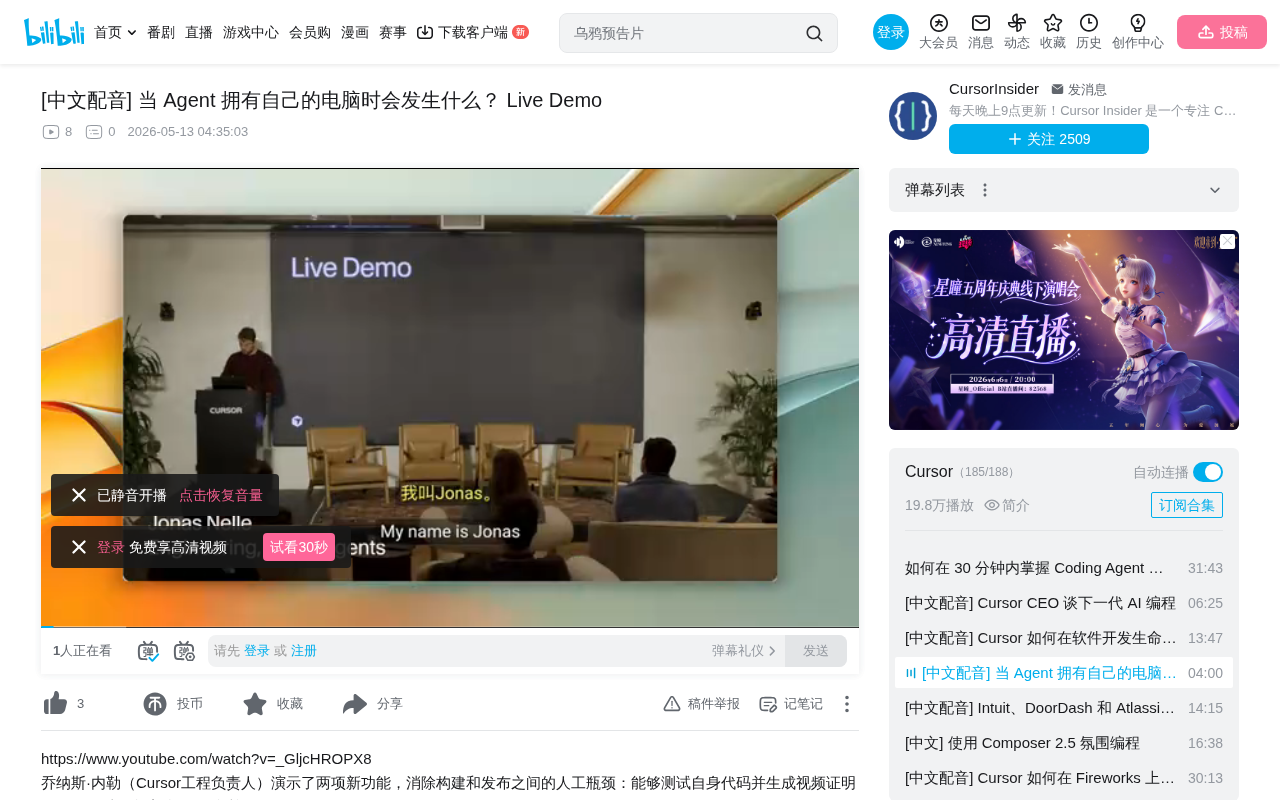
Cursor Cloud Agent Demo: Eliminating Bottlenecks Across the Entire Software Development Lifecycle
Deep analysis of Cursor's Cloud Agent demo showing how cloud VMs, automated test artifacts, and a full-chain control plane systematically eliminate human bottlenecks across the software development lifecycle.