AI Zero-Code Development of a Procurement Management System: Uploading a Requirements Document to Auto-Generate a Complete Application — A Hands-On Test

An AI Agent auto-generates a complete procurement management system from a requirements document with zero code.
Using the SurfaceFree platform as an example, this article demonstrates how an AI application generation Agent can automatically build a complete procurement management system — including supplier management, material management, purchase orders, receiving and warehousing, and inventory alerts — simply by uploading a requirements document. The results feature field designs conforming to real manufacturing standards, strict document chain linkages, and data validation, reflecting system-level business architecture thinking and representing a paradigm shift from manual coding to AI-native generation in enterprise application development.
Procurement is one of the most cumbersome cross-departmental and externally fragmented business processes in any enterprise — long workflows, difficult coordination, and hidden compliance risks. The reason procurement management is widely recognized as one of the toughest nuts to crack in enterprise digitalization is that it inherently spans multiple organizational boundaries: internally, it involves at least five roles including the requesting department, procurement, quality inspection, warehousing, and finance; externally, it requires high-frequency interactions with suppliers for inquiries, price comparisons, contract signing, and reconciliation. Traditionally, developing a procurement management system takes weeks to months, with custom development costs often exceeding hundreds of thousands of dollars. More critically, there's an inherent "translation loss" between business and IT departments — requirements described in natural language by business users go through multiple rounds of communication before being converted into technical solutions, and the final delivered system often deviates from business expectations, leading to repeated rework.
Now, with AI application generation Agents, you only need to upload a business requirements document, and the system automatically builds a procurement management application with a complete business closed loop. These Agents are essentially intelligent systems that combine large language models (LLMs), code generation, and low-code platform capabilities — they first extract business entities and rules through a semantic understanding layer, then automatically plan data models and process orchestration based on industry knowledge, and finally convert the design into a runnable application. This article uses the SurfaceFree platform as an example to fully dissect this process.
From Requirements Document to Complete Application: Three Steps
The entire workflow is remarkably simple:
- Create a new application on the platform and enable "Expert Mode" — this mode invokes an industry experience knowledge base, allowing the AI to more accurately understand business semantics. The industry experience knowledge base essentially uses RAG (Retrieval-Augmented Generation) technology to inject structured knowledge such as manufacturing procurement best practices, field specifications, and process templates into the generation process, ensuring the AI's output not only meets functional requirements but also conforms to industry conventions;
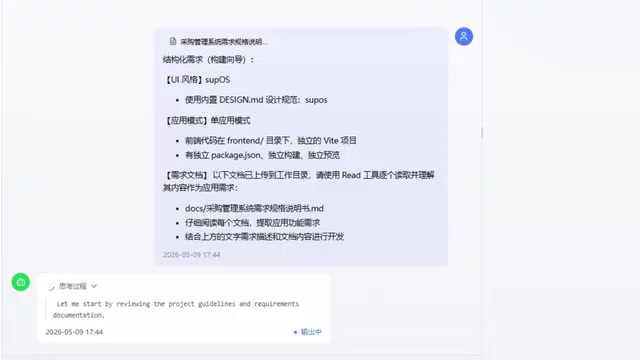
- Select an interface style;
- Upload the pre-prepared procurement requirements specification in full.
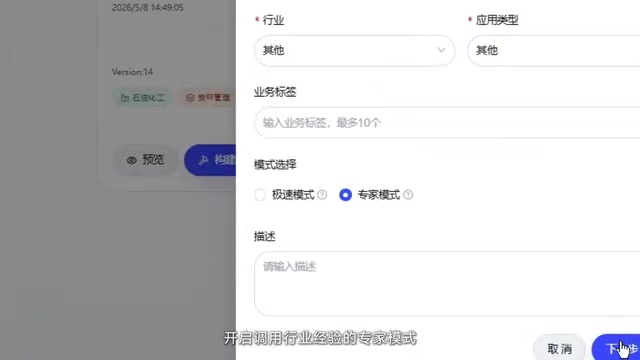
The manual part ends here. After submitting the requirements, the AI automatically takes over all subsequent development work: it's not just building visual front-end pages — it's also automatically decomposing the sourcing and price comparison logic in the document and organizing cross-departmental approval workflows in the background. The entire process requires zero lines of code, truly achieving "requirements as development."
Breaking Down the Results: Business Completeness Far Exceeds Expectations
Once the application is generated, entering the dashboard reveals a very clear business SOP (Standard Operating Procedure) from order creation to inventory updates. SOP is a core concept in manufacturing quality management systems — it breaks complex business processes into standardized, repeatable operational steps to ensure consistent results regardless of who executes the process. What's most surprising is that the AI not only built the data tables but even automatically mapped out the complete procurement closed-loop flowchart.
Supplier, Material, and Warehouse: Three Master Data Sets Automatically Built
In the foundational modules, the three master data sets — suppliers, materials, and warehouses — are already fully constructed. In the enterprise IT domain, Master Data Management (MDM) is a dedicated discipline whose core objective is to ensure that critical business entities remain unique, accurate, and consistent across the entire organization. Suppliers, materials, and warehouses are called the "three master data sets" of procurement systems because they form the foundation on which all business processes operate — without accurate master data, subsequent processes like orders, receiving, and warehousing become impossible.
Clicking the "Add New" button to view the form fields reveals a design that closely aligns with real factory standards — including supplier qualification information (such as business license, ISO certification status, cooperation level), material coding rules (typically including multi-segment structures like material classification code, specification code, and version number), and warehouse bin management — rather than a simple generic template.
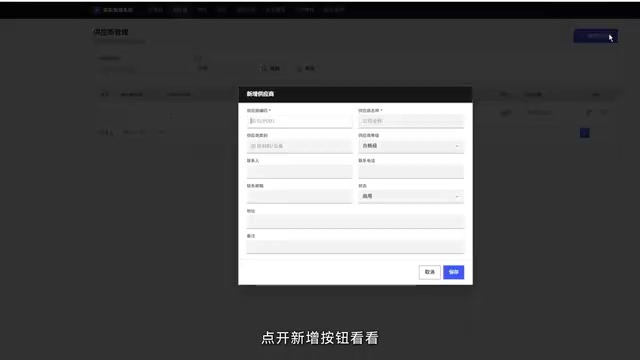
This demonstrates that when the AI parsed the requirements document, it not only understood the surface-level functional requirements but also incorporated best practices from the industry knowledge base to automatically fill in many business details. It understood not just "what fields are needed" but also "why these fields are needed" — this reflects deep modeling of the manufacturing procurement management knowledge system.
Full Process Closed-Loop Verification: Order → Receiving → Warehousing → Inventory, Each Step Linked
With the foundational data in place, let's walk through the entire process to verify whether the business closed loop is airtight.
Purchase Order Placement
First, create a new purchase order. In this step, the system automatically links to the previously maintained supplier list — no manual input needed, improving efficiency and avoiding data inconsistency.
Data Linkage Between Receiving and Warehousing
When goods arrive, we enter the receiving and warehousing phase — this is the most rigorous part of the system design. The mandatory linkage between purchase orders → receiving documents → warehousing documents is known in enterprise management software as a "document flow" or "Document Chain" design pattern. This design philosophy originates from the core thinking of ERP (Enterprise Resource Planning) systems — every business operation must be supported by upstream documentation, forming a complete Audit Trail. In traditional ERP systems like SAP and Oracle, this design is called "Three-Way Matching," meaning that the purchase order, receiving document, and invoice must match in quantity and amount before the payment process can be triggered.
The system implements very strict data linkage:
- Receiving documents must be linked to purchase orders — ensuring every receipt is traceable
- Warehousing documents must be linked to receiving documents — guaranteeing warehousing data perfectly matches actual receipts
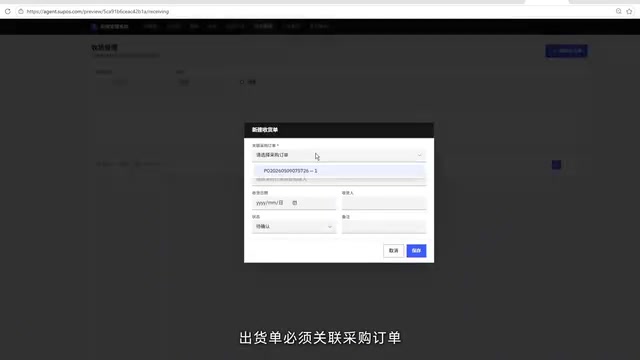
This step-by-step linked design effectively prevents data disconnection and human error, while providing a complete audit trail for compliance. This is not only a means of preventing human error and fraud but also a basic requirement of enterprise internal controls (such as the SOX Act and ISO 9001 quality management systems). The fact that AI can automatically build such strict data association constraints means it already possesses system-level business architecture thinking, rather than simple CRUD (Create, Read, Update, Delete) page stacking.
Real-Time Inventory Updates and Low-Stock Alerts
After each warehousing operation is completed, the inventory query dashboard updates in real time. The system also includes a built-in low-stock alert function: when a material's inventory falls below a set threshold, it automatically triggers a reminder, helping procurement staff replenish in time and avoid production material shortages.
Behind the low-stock alert function is the Safety Stock theory from supply chain management. Safety stock refers to the buffer inventory held beyond normal cycle stock to cope with demand fluctuations and supply uncertainty — its calculation typically involves the standard deviation of historical demand, supplier lead times and their variability. In real production environments, the cost of a stock-out is often far greater than inventory holding costs — one hour of production line downtime can cost tens of thousands of dollars. The AI's automatic inclusion of this feature shows it understands that procurement management isn't just about "buying things" but about ensuring the continuity of the entire production supply chain.
What This Development Approach Means
The core value of this case isn't that it generated a particularly complex system, but that it validated an entirely new paradigm for enterprise application development. The development paradigm represented by AI application generation can be viewed as the fourth stage in the evolution of software engineering: the first stage was pure hand-coding (Pro-Code), where developers wrote every line of code from scratch; the second stage was Low-Code/No-Code, reducing development barriers through visual drag-and-drop and configuration; the third stage was AI-Assisted Coding (like GitHub Copilot), where AI serves as a programmer's "copilot" providing code suggestions; and the fourth stage is AI-Native Generation, where users only need to provide business intent described in natural language, and AI completes the entire process end-to-end from requirements analysis to application delivery.
Business users directly lead development. In the traditional model, business departments submit requirements and IT departments write code — communication costs are high and misunderstandings are common. Now business users directly upload requirements documents, and AI completes the transformation from requirements to application, dramatically shortening delivery cycles. The deeper significance of this paradigm shift is that it moves the bottleneck of software development from "technical implementation capability" to "business requirements articulation capability," truly achieving "letting those who understand the business directly create the tools."
AI has acquired industry knowledge comprehension capabilities. The generated field designs, process linkages, and data validation rules all conform to real manufacturing procurement standards, indicating that the underlying model has accumulated considerable industry expertise.
Closed-loop design reflects system-level thinking. The AI doesn't simply generate a few tables and pages — it understands the complete lifecycle of procurement business from requirement issuance to inventory update, and implements strict association constraints at the data level.
Of course, for complex procurement scenarios in large enterprises — such as multi-level approvals, framework agreements, and reconciliation settlements — the AI-generated system may still require further customization and optimization. But as a rapid prototyping tool and lightweight solution for SMEs, this approach has already demonstrated strong practical value. Gartner predicts that by 2026, over 80% of enterprises will adopt AI-enhanced development tools to some degree — this trend is accelerating.
Summary
From a procurement requirements specification written in natural language to a complete business system encompassing supplier management, purchase orders, receiving and warehousing, and inventory alerts, AI application generation Agents are redefining how enterprise software is developed. Zero code, low barrier, high fidelity — this may well be the next direction for industrial application development.
Related articles
 Product Reviews
The Programmer's Desk Setup Guide: Building a Workspace That Feels Like Home
Discover how programmers build productive, comfortable workspaces. From multi-monitor setups to ergonomic design, explore the desk philosophy that drives focus and flow.
 Product Reviews
Qoder vs Cursor Real-World Comparison: Which $20/Month AI IDE Is Better?
Hands-on comparison of Qoder vs Cursor AI IDEs: Agent autonomy, human interaction count, and architecture decisions. Qoder needed only 2 interactions vs Cursor's 8.
 Product Reviews
Cursor Cloud Agent Demo: Eliminating Bottlenecks Across the Entire Software Development Lifecycle
Deep analysis of Cursor's Cloud Agent demo showing how cloud VMs, automated test artifacts, and a full-chain control plane systematically eliminate human bottlenecks across the software development lifecycle.