awesome-LLM-resources: A Deep Dive into GitHub's 8K-Star Comprehensive LLM Resource Repository

A deep dive into awesome-LLM-resources, the 8K-Star comprehensive LLM resource repository on GitHub.
awesome-LLM-resources on GitHub (8200+ Stars) is one of the most popular LLM resource aggregation repositories in the Chinese community, covering model training and inference, Agent and MCP, multimodal generation, small language models, o1 reasoning paradigm, AI-assisted coding, AI paper reviewing, and over a dozen other core areas. This article provides an in-depth analysis of each section's technical background and highlights three key advantages: strong systematization, keeping pace with cutting-edge tech, and Chinese-friendliness.
Project Overview: The Most Popular LLM Resource Aggregation in the Chinese Community
Large Language Model (LLM) technology iterates at breakneck speed, and systematically tracking and learning cutting-edge resources is a challenge every AI practitioner and researcher faces. Large Language Models refer to deep learning models based on the Transformer architecture that acquire powerful language understanding and generation capabilities through pre-training on massive text data, typically with parameter scales ranging from billions to trillions. Since ChatGPT captured global attention in 2022, the LLM field has seen significant advances published almost weekly, with technical documentation, open-source projects, and academic papers growing explosively — information overload has become a universal pain point for practitioners.
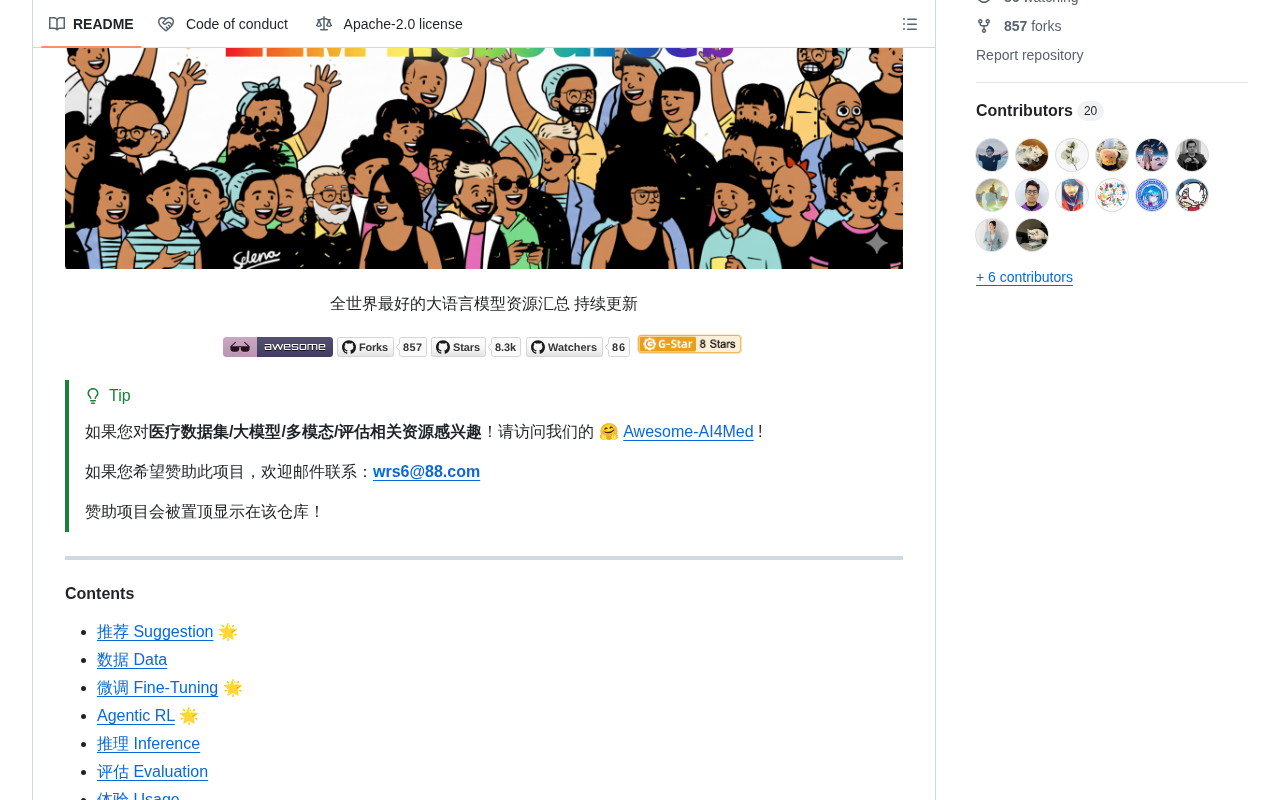
The awesome-LLM-resources project maintained by WangRongsheng on GitHub has become one of the most popular LLM resource aggregation repositories in the Chinese community, with over 8,200 Stars. The "awesome" series on GitHub represents a community-driven curation tradition — domain experts or enthusiasts manually select and categorize high-quality resources in a specific technical area, typically achieving quality far superior to random search engine results.
The project positions itself as "the world's best LLM resource compilation," covering the complete technology stack from foundational model training to cutting-edge applications — multimodal generation, Agent, AI-assisted coding, AI paper reviewing, data processing, model training and inference, o1 models, MCP, small language models, vision-language models, and over a dozen other core areas. It essentially delivers a one-stop shop for all LLM resources.
Deep Dive into Core Content Sections
Model Training and Inference: From Getting Started to Production Deployment
The project separates model training and model inference into two independent sections. The training side covers tools and papers for key stages including pre-training, fine-tuning (SFT/RLHF/DPO, etc.), and data engineering; the inference side focuses on production-grade needs such as quantization, acceleration, and deployment. This division aligns with actual development workflows, allowing developers to quickly find relevant resources based on their current stage.
To understand these technical terms, you need to know the typical LLM development pipeline. Pre-training refers to training the model's foundational language capabilities on large-scale unlabeled text. This stage consumes the most compute, typically requiring thousands of GPUs running for weeks or even months. After pre-training, the model possesses general language understanding capabilities but cannot yet follow human instructions well.
The subsequent fine-tuning stage is key to making the model "usable." SFT (Supervised Fine-Tuning) uses human-annotated instruction-response pairs to train the model's ability to follow instructions. RLHF (Reinforcement Learning from Human Feedback) trains a reward model to capture human preferences, then uses reinforcement learning algorithms (such as PPO) to optimize LLM outputs — this is one of the core technologies behind ChatGPT's success. DPO (Direct Preference Optimization) is an RLHF alternative proposed in 2023 that skips training a reward model and directly optimizes policy from human preference data, resulting in a simpler and more stable training process that has now been widely adopted.
On the inference side, quantization is a technique that compresses model parameters from high-precision floating point (e.g., FP16) to lower-precision representations (e.g., INT8, INT4, or even lower), dramatically reducing memory footprint and inference latency at the cost of potentially minor accuracy loss. Common quantization schemes include GPTQ, AWQ, and GGUF, each making different trade-offs between compression ratio and accuracy preservation. Inference acceleration involves techniques such as KV Cache optimization, Speculative Decoding, and Continuous Batching, aiming to maximize throughput while maintaining output quality. vLLM, TensorRT-LLM, and llama.cpp are representative open-source frameworks in this area.
Agent and MCP: Two Hottest Directions in the LLM Application Layer
Agent and MCP (Model Context Protocol) are currently the two most noteworthy directions in the LLM application layer.
- Agent represents a paradigm shift for LLMs from "conversational tools" to "autonomous task executors," marking an important step toward artificial general intelligence.
- MCP, proposed by Anthropic, is becoming the standardized interface protocol for connecting LLMs with external tools and data sources.
Agent's technical architecture is worth understanding in depth. A typical LLM Agent consists of four core modules: Planning — decomposing complex tasks into executable sub-steps, with commonly used techniques including ReAct (Reasoning + Acting), Chain-of-Thought, and Tree-of-Thought reasoning frameworks; Memory — including short-term memory (current conversation context) and long-term memory (knowledge retrieval typically implemented via vector databases); Tool Use — Agents interact with the external world by calling APIs, executing code, searching the web, etc.; Reflection — self-evaluation and error correction of execution results. Representative Agent frameworks include LangChain, AutoGPT, MetaGPT, and CrewAI, each with different emphases on task orchestration and multi-Agent collaboration. From 2024 to 2025, Agents have moved from proof-of-concept to production applications, generating real commercial value in scenarios like customer service automation, data analysis, and software development.
The MCP protocol addresses a critical pain point: when Agents need to call external tools, each tool has different interface formats, authentication methods, and data structures, requiring developers to write custom integration code for each tool — severely limiting Agent extensibility. MCP defines a standardized communication protocol that allows LLMs to discover, invoke, and manage external tools and data sources through a unified interface, similar to what the USB protocol means for hardware devices. Anthropic open-sourced the MCP specification in late 2024, and AI coding tools like Cursor and Windsurf quickly integrated MCP support, while OpenAI also announced adoption of the MCP standard in its products. This protocol is becoming an infrastructure-layer standard for the LLM ecosystem, with potential importance comparable to HTTP in the early internet.
The project's timely inclusion of these two directions reflects the maintainer's keen sense of technological trends.
Multimodal Generation and Vision-Language Models
Multimodal capabilities are one of the most important evolutionary directions for large models in 2024-2025. From GPT-4V to Gemini, from LLaVA to Qwen-VL, visual understanding has become a key dimension for measuring a large model's comprehensive capabilities.
The technical evolution of multimodal large models has gone through several key stages. Early approaches simply concatenated encoders for different modalities — for example, using CLIP's visual encoder to extract image features, then mapping visual features into the language model's embedding space through a projection layer. LLaVA (Large Language and Vision Assistant) is a representative open-source work of this approach, using a simple linear layer to connect visual encoders and language models, demonstrating the effectiveness of "visual instruction tuning." Subsequent works continuously improved upon this: Qwen-VL introduced higher-resolution visual input and finer-grained positional awareness; the InternVL series explored larger-scale visual encoders; while Google's Gemini and OpenAI's GPT-4o represent the native multimodal direction — processing text, images, audio, and other modalities simultaneously from the pre-training stage, rather than post-hoc concatenation.
The project subdivides this area into two sections:
- Multimodal Generation: Focuses on image, video, and audio generation capabilities. The technical foundations include diffusion models (e.g., Stable Diffusion, DALL-E 3), autoregressive generation (e.g., Parti, Chameleon), and the latest flow matching methods. Video generation attracted widespread attention in 2024 following OpenAI Sora's release, with products like Kling, Runway Gen-3, and Pika emerging subsequently. Audio generation covers sub-directions including text-to-speech (TTS), music generation, and voice cloning.
- Vision-Language Models (VLM): Focuses on visual understanding and reasoning. Core challenges for VLMs include: efficient encoding of high-resolution images (a 4K image can produce thousands of visual tokens, far exceeding a language model's context window), fine-grained visual grounding (such as OCR, object detection), and visual hallucination (models "seeing" content that doesn't exist in the image).
The precise categorization makes it convenient for developers with different needs to find what they're looking for.
Small Language Models: The Workhorses for On-Device Deployment and Low-Cost Inference
On the flip side of the large model "arms race," Small Language Models (SLMs) are becoming the backbone of practical applications. Models with 1B-7B parameters, such as Microsoft's Phi series and Google's Gemma, excel in on-device deployment and low-cost inference scenarios.
Three key technical drivers underpin the rise of small language models. First is the leverage effect of high-quality data: Microsoft's Phi series research demonstrates that carefully curated "textbook-quality" training data can enable small models to achieve performance far exceeding their parameter scale — Phi-3-mini (3.8B parameters) even outperformed earlier 7B-13B models on multiple benchmarks. Second is the maturation of Knowledge Distillation: by having small models learn the output distribution of large models, large model capabilities can be efficiently "compressed" into small models — the distilled versions of DeepSeek-R1 are a classic application of this technique. Third is continuous architectural optimization: including Grouped Query Attention (GQA), Sliding Window Attention, Mixture of Experts (MoE), and other architectural innovations that enable small models to achieve higher computational efficiency with limited parameters.
In actual deployment scenarios, small language models' advantages are particularly pronounced. On-device deployment means running models on terminal devices such as phones, laptops, and IoT devices rather than relying on cloud servers. This imposes strict requirements on memory footprint (typically needing to stay under 4GB) and inference latency (requiring real-time response). Apple Intelligence, Google's Gemini Nano, and Qualcomm's AI Engine are all driving on-device AI adoption. For enterprise users, small models also mean lower GPU costs and stronger data privacy guarantees — sensitive data doesn't need to be uploaded to third-party cloud services.
The project's dedicated small language model section reflects the industry's pragmatic shift from "blindly pursuing parameter scale" to "pursuing practical cost-effectiveness."
o1 Model: A New Paradigm for Chain-of-Thought Reasoning
OpenAI's o1 model pioneered a new "chain-of-thought reasoning" paradigm — by investing more computational resources during inference, it significantly improves performance on complex tasks. This direction has spawned extensive follow-up research, including open-source reproduction efforts like DeepSeek-R1.
To understand o1's breakthrough significance, we need to trace the development of Chain-of-Thought (CoT) reasoning. In 2022, Jason Wei and colleagues at Google discovered that simply adding prompts like "Let's think step by step" could significantly improve LLM performance on math and logic reasoning tasks — by generating intermediate reasoning steps rather than jumping directly to the final answer, models could handle more complex problems. This discovery spawned numerous follow-up works, including Self-Consistency (majority voting from multiple samples), Tree-of-Thought (tree-search reasoning paths), and other methods.
The o1 model takes this idea to new heights, with its core innovation being inference-time compute scaling. Traditional LLM performance improvements primarily relied on training-time scaling — more parameters, more data, more training compute (the so-called Scaling Law). The o1 model proved an alternative path: letting the model "think longer" during inference — training the model through reinforcement learning to autonomously perform long-chain internal reasoning, including trying different problem-solving strategies, verifying intermediate results, and backtracking from error paths. This means the same model can dynamically adjust computational investment based on problem difficulty — answering simple questions quickly while thinking deeply about complex ones. On high-difficulty benchmarks like math competitions (AIME) and programming competitions (Codeforces), the o1 model demonstrated reasoning capabilities far surpassing previous models.
DeepSeek-R1's open-source reproduction work is particularly noteworthy. The DeepSeek team, through pure reinforcement learning training (without relying on supervised fine-tuning chain-of-thought data), successfully enabled the model to spontaneously develop long-chain reasoning capabilities similar to o1, and open-sourced the complete training methodology and model weights, greatly advancing community research in this direction.
The project's treatment of o1 as a standalone section indicates the maintainer's judgment that this represents an important technical branch in LLM development worth continuous tracking.
AI-Assisted Coding and AI Paper Reviewing: Mature Vertical Application Scenarios
- AI-Assisted Coding: Represented by products like GitHub Copilot and Cursor, it has profoundly changed software development workflows.
- AI Paper Reviewing: Has sparked widespread discussion in academia about AI-assisted research.
The technical evolution of AI-assisted coding has gone through three stages. The first stage was Code Completion: represented by GitHub Copilot (based on OpenAI Codex), providing real-time line-level or block-level completion suggestions while developers write code — essentially an advanced autocomplete tool. The second stage was Chat-based Coding: developers describe requirements in natural language, and AI generates complete code snippets or explains existing code — ChatGPT and Claude are widely used in this scenario. The third stage is Agentic Coding: this is the hottest direction in 2024-2025, represented by products like Cursor, Windsurf, and Devin. In this mode, AI not only generates code but can autonomously understand project context, edit across files, run tests, debug errors, and even independently complete the entire development process from requirements analysis to code submission. Cursor, through deep integration of MCP protocol and Agent capabilities, has become one of the fastest-growing AI coding tools in the developer community.
AI paper reviewing is a more controversial application scenario. On one hand, AI can help reviewers quickly evaluate technical contributions, identify methodological flaws, and check citation completeness — providing practical value given the shortage of reviewers in academic publishing. On the other hand, the academic community has intense debates about ethical issues: Are AI-generated reviews sufficiently reliable? Should reviewers disclose AI assistance? Could AI exacerbate biases in academic review? Multiple top conferences (such as NeurIPS, ICLR) have issued guidelines on AI-assisted reviewing. The project's collected resources cover AI reviewing tools, academic discussions, and policy guidelines, providing comprehensive references for researchers interested in this topic.
These two directions represent the most mature LLM applications in vertical domains, and the project's systematic organization of related resources provides practitioners with practical entry points.
Project Value Analysis: Why It's Worth Bookmarking
Three Core Advantages
Strong systematization: Unlike scattered blogs or paper lists, this project is organized according to technology stack logic, forming a relatively complete LLM knowledge graph. The 8,200+ Stars and 843 Forks indirectly validate the community's recognition of its quality. In GitHub's evaluation system, Star count reflects a project's attention level, while Fork count represents how many developers have copied the project to their own accounts for use or secondary development — 843 Forks means a large number of developers are referencing and using this resource list in their actual work.
Keeps pace with cutting-edge technology: The timely inclusion of the latest directions like MCP and o1 models indicates active project maintenance, helping readers maintain awareness of frontier developments. In the LLM field, the half-life of technical hot topics is extremely short — a direction can go from cutting-edge to common knowledge within months, while new breakthroughs can appear at any time. The value of a continuously updated resource aggregation largely depends on whether the maintainer can promptly capture and include these changes.
Chinese-friendly: As a primarily Chinese-language resource repository, it dramatically lowers the barrier for Chinese developers to access quality LLM resources. While first-hand research results in the LLM field are mostly published in English, the Chinese community has unique ecosystem advantages in technical interpretation, practical tutorials, and open-source projects. This project integrates both English original resources and substantial quality content from the Chinese community, serving as a bridge.
Three Tips for Efficient Use
- Go deep as needed: The project's content volume is large. It's recommended to selectively dive deep into specific sections based on your current work direction, avoiding biting off more than you can chew. For example, if you're doing model fine-tuning, focus first on SFT and DPO-related resources in the training section; if you're building AI applications, prioritize the Agent and MCP sections.
- Practice hands-on: The core value of a resource list lies in pointing directions — real gains come from code reproduction and project experiments. Pick tools or papers that interest you and learn by doing. Start with the open-source tools collected in the project, set up a local experimental environment, and personally run through a complete training or inference pipeline.
- Watch the repository for continuous tracking: It's recommended to Watch the repository on GitHub to receive update notifications immediately and stay informed about the latest developments in the LLM field. GitHub's Watch feature supports multiple notification levels — you can choose "Releases only" to receive only release notifications, or "All Activity" to receive all updates, configuring flexibly based on personal needs.
Conclusion
With its comprehensive coverage, clear categorization system, and active maintenance cadence, awesome-LLM-resources has become an invaluable one-stop resource navigation for the Chinese LLM community. Whether you're a newcomer to AI or a senior engineer tackling specific technical challenges, you can find valuable references within it.
In an era where large language model technology evolves daily, having a community-verified resource map in hand can make both learning and work significantly more efficient.
Related articles
 Product Reviews
The Programmer's Desk Setup Guide: Building a Workspace That Feels Like Home
Discover how programmers build productive, comfortable workspaces. From multi-monitor setups to ergonomic design, explore the desk philosophy that drives focus and flow.
 Product Reviews
Qoder vs Cursor Real-World Comparison: Which $20/Month AI IDE Is Better?
Hands-on comparison of Qoder vs Cursor AI IDEs: Agent autonomy, human interaction count, and architecture decisions. Qoder needed only 2 interactions vs Cursor's 8.
 Product Reviews
Cursor Cloud Agent Demo: Eliminating Bottlenecks Across the Entire Software Development Lifecycle
Deep analysis of Cursor's Cloud Agent demo showing how cloud VMs, automated test artifacts, and a full-chain control plane systematically eliminate human bottlenecks across the software development lifecycle.