DeepSeek-V4-Flash Model Analysis: A New Lightweight AI Choice Prioritizing Efficiency

DeepSeek-V4-Flash signals a new efficiency-first lightweight model building on MLA and MoE innovations.
DeepSeek-V4-Flash represents the team's latest move in the efficiency-first direction, likely building on their proven MLA attention mechanism and MoE architecture. The Flash designation signals optimization for speed, lower latency, and reduced costs. While official benchmarks are pending, the rapid V3-to-V4 iteration pace and DeepSeek's open-source commitment make this a noteworthy development for developers seeking self-deployable, production-ready AI models.
DeepSeek Strikes Again: V4-Flash Enters the Stage
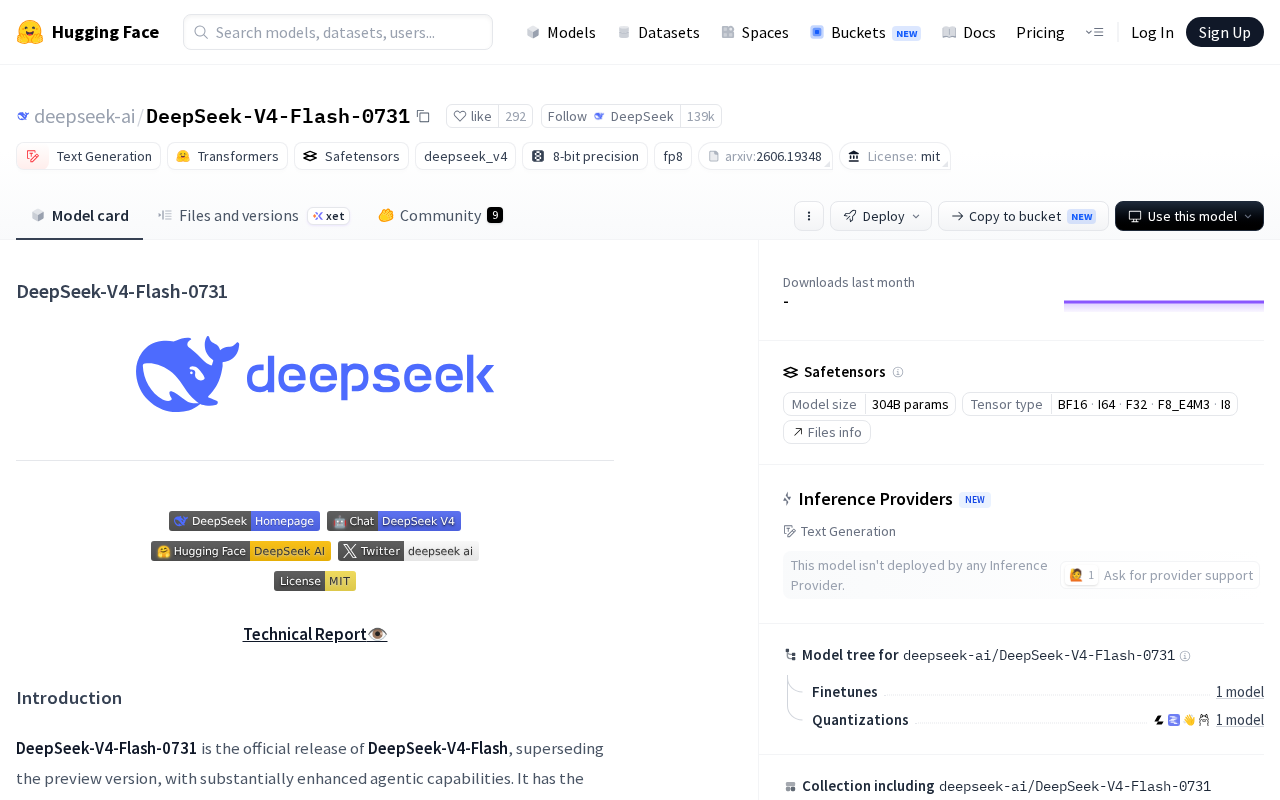
Recently, DeepSeek-AI released a new model called DeepSeek-V4-Flash-0731 on the open-source community. Although publicly available information remains limited (the news received only 8 points on Hacker News with no comments yet), the naming convention alone reveals several noteworthy signals. As one of the most technically influential teams in the Chinese large model ecosystem, every move by DeepSeek deserves careful scrutiny from the industry.
Breaking down the model name: V4 indicates this is the fourth-generation architecture in the DeepSeek series, the Flash suffix typically signifies a lightweight version optimized for speed and efficiency, and 0731 likely marks the release or training completion date (July 31). This naming convention continues DeepSeek's characteristically clear version management style and suggests the team is accelerating its model iteration cadence.
The Product Positioning Behind the Flash Name
The Industry Trend Toward Lightweight Models
In the current large model naming ecosystem, "Flash" has become a well-established label. Google's Gemini Flash, along with Flash/Mini/Turbo versions released by numerous vendors, all point in the same direction: dramatically improving inference speed, reducing latency, and lowering usage costs while maintaining usable capabilities.
Such models typically achieve this through smaller parameter scales, model distillation, quantization techniques, or architectural optimizations. Knowledge Distillation is a technique that transfers knowledge from a large model (teacher model) to a smaller model (student model). Its core principle is having the small model learn not only hard labels (correct answers) but also the soft labels (probability distributions) output by the large model, thereby capturing the large model's understanding of relative relationships between different options. Quantization is another key compression method that converts model weights from high-precision floating-point numbers (such as FP32 or FP16) to low-precision representations (such as INT8, INT4, or even lower), thereby reducing storage space and computational overhead. Modern quantization techniques like GPTQ, AWQ, and GGUF can compress model size to 1/4 or even 1/8 of the original while producing only minimal performance loss. The combined use of these techniques enables Flash-class models to run on consumer-grade GPUs or even CPUs, greatly expanding the applicable scenarios for large models.
Their target users are typically developers who need high-concurrency, low-latency scenarios—such as real-time conversation, code completion, and batch text processing. Compared to flagship models that pursue the ultimate capability ceiling, Flash versions emphasize a pragmatic philosophy of "good enough and fast."
DeepSeek's Accumulated Efficiency Expertise
The DeepSeek team has long been known for "cost-effectiveness" and "engineering efficiency." Previous models including DeepSeek-V2, V3, and the R1 series all achieved highly competitive performance at training costs far below comparable competitors. Among these, the MLA (Multi-head Latent Attention) mechanism and DeepSeekMoE (Mixture of Experts) architecture are the team's core weapons for efficiency optimization.
Specifically, MLA is an innovative attention mechanism proposed by DeepSeek in V2. Traditional Multi-Head Attention (MHA) requires caching large amounts of Key-Value pairs during inference, causing memory usage to grow linearly with sequence length—a bottleneck for long-context inference. MLA's core idea is to compress the KV cache into a low-rank latent space, recovering full attention information through learned projection matrices when needed. This dramatically reduces KV cache memory usage (by over 90% compared to MHA) while maintaining expressive power comparable to multi-head attention. DeepSeekMoE is another key efficiency technology that distributes model parameters across multiple expert networks, activating only a small subset of experts during each inference pass. For example, a model with total parameters in the tens of billions might only activate a few billion parameters during actual inference, thus dramatically reducing computational overhead while maintaining the knowledge capacity of a large model. DeepSeek's MoE implementation also employs fine-grained expert segmentation and shared expert mechanisms, further improving expert utilization and training stability.
Therefore, a Flash version at the V4 generation level is very likely a product of further evolution of these efficiency technologies. It's reasonable to speculate that DeepSeek-V4-Flash will offer targeted optimizations in inference throughput, memory usage, and response latency, becoming a "sweet spot" choice for production environment deployment.
Why DeepSeek-V4-Flash Deserves Attention
Continued Contributions to the Open-Source Ecosystem
DeepSeek has long maintained an open-source strategy, with its model weights and technical reports among the most openly available in the Chinese large model landscape. If V4-Flash continues this tradition, it will provide global developers with yet another high-quality self-deployable option. This is highly significant for enterprises and individual users who prioritize data privacy, require private deployment, or wish to control costs.
The license choice for open-source large models directly determines their commercial value and community adoption. Current mainstream open-source model licenses form a spectrum: from the most permissive like Apache 2.0 (allowing arbitrary commercial use and modification), to Meta's Llama license (requiring additional authorization above 700 million monthly active users), to various community licenses with usage restrictions. DeepSeek's previous models have mostly adopted relatively permissive licensing strategies, which is an important factor in their widespread adoption in the open-source community. Private deployment capability is particularly crucial for enterprise users—industries such as finance, healthcare, and government are constrained by data compliance requirements where data cannot leave the country or be uploaded to third-party servers, making open-source self-deployable models a necessity.
The value of open-source lightweight models lies not just in being "free," but in lowering the barrier to entry for AI applications. Developers can run, fine-tune, and further develop on their own hardware, freeing themselves from dependence on closed-source APIs. Open-source models have also spawned a vast fine-tuning and adaptation ecosystem: developers can perform LoRA fine-tuning or full fine-tuning on general-purpose base models for specific tasks, obtaining domain-specific models at costs far lower than training from scratch. This is exactly why DeepSeek's series of models has been able to build reputation within the community.
Competitive Signals from Rapid Iteration
Interestingly, the emergence of the V4 generation itself is a strong signal. Advancing to the fourth-generation architecture shortly after V3's release indicates that DeepSeek's R&D iteration pace is clearly accelerating. In the current white-hot competition among large models, rapid iteration capability often determines long-term success more than any single technical breakthrough.
However, it should be noted that specific details about this model's parameter scale, performance benchmarks, context length, and actual capability performance have not yet been disclosed by the official team. Discussion momentum is also still in its early stages. Therefore, the above analysis is largely based on naming patterns and extrapolation from DeepSeek's historical technical trajectory—ultimate performance still awaits official technical reports and community testing verification.
A Balanced View: Anticipation Tempered with Caution
For practitioners following open-source large models, DeepSeek-V4-Flash is undoubtedly a project worth adding to the watchlist. It may represent another important exploration by Chinese models on the "efficiency-first" path.
However, in the absence of official benchmark data, maintaining rational expectations is advisable. True value judgments should wait until the following key information becomes clear:
- Model scale and architecture details: Parameter count, whether MoE is used, proportion of activated parameters, etc.
- Performance: Scores on mainstream evaluation benchmarks, especially comparisons with similar Flash-class models
- Inference efficiency: Actual deployment latency, throughput, and hardware requirements
- Open-source license: Degree of commercial friendliness and usage restrictions
Regarding inference efficiency evaluation, multiple key dimensions need attention. First is Time to First Token (TTFT)—the time from when a user sends a request to receiving the first output token, which directly affects the user's perceived response speed. Second is generation throughput (Tokens per Second), measuring the model's continuous output speed. Third is concurrent processing capability—how many requests a single GPU can serve simultaneously. Fourth is memory usage, which determines what level of hardware the model can run on. These metrics often involve tradeoffs: larger batch sizes can improve total throughput but may increase per-request latency; more aggressive quantization can reduce memory usage but may affect output quality. The core design goal of Flash-class models is to find the optimal balance point among these dimensions, maximizing output per unit of compute cost. In actual production environments, this directly translates to differences in API call costs per million tokens.
Regardless, DeepSeek's continued investment in open source and rapid advancement of model generations is injecting vitality into the entire AI ecosystem. Developers are encouraged to closely follow updates on their official repository to obtain technical reports and model weight download information at the earliest opportunity.
Key Takeaways
Related articles

cMCP: Adding Signed Receipts to AI Agent Tool Calls for Auditable Denial Mechanisms
cMCP introduces cryptographic signed receipts for AI agent tool call denials under the MCP protocol, enabling auditable refusal credentials for AI governance.

Oxide Computer Raises $445 Million to Rebuild Server Architecture from the Ground Up
Cloud hardware startup Oxide Computer raises $445M to redefine server architecture with open-source firmware and integrated rack-scale design for on-premises cloud experiences.

Media File Organizer: A Free, Open-Source Tool for Automatically Organizing Your Plex Media Library
Media File Organizer is a free, open-source desktop tool that auto-matches TMDB metadata to batch rename and organize movie and TV files into Plex-compatible formats with preview before changes.