DiffSynth-Studio: A Complete Guide to the Open-Source Diffusion Model Tool with 12,000+ Stars

DiffSynth-Studio is ModelScope's all-in-one open-source diffusion model tool with 12,000+ GitHub stars.
DiffSynth-Studio is an open-source diffusion model tool from Alibaba's ModelScope team, boasting 12,000+ GitHub stars and 1,191 forks. It integrates mainstream diffusion model technologies — including Stable Diffusion, SDXL, ControlNet, and LoRA — into a unified workbench, encapsulating complex pipeline construction while lowering hardware barriers through optimizations like chunked loading and half-precision inference, enabling both developers and creators to quickly get started with AI image and video generation.
DiffSynth-Studio: A Complete Guide to the Open-Source Diffusion Model Tool with 12,000+ Stars
When diffusion models meet the open-source spirit, twelve thousand stars tell you one thing: AI image generation is no longer exclusive magic reserved for tech giants. Today, let's talk about DiffSynth-Studio — an open-source diffusion model tool built by the ModelScope team. What makes it so popular on GitHub?
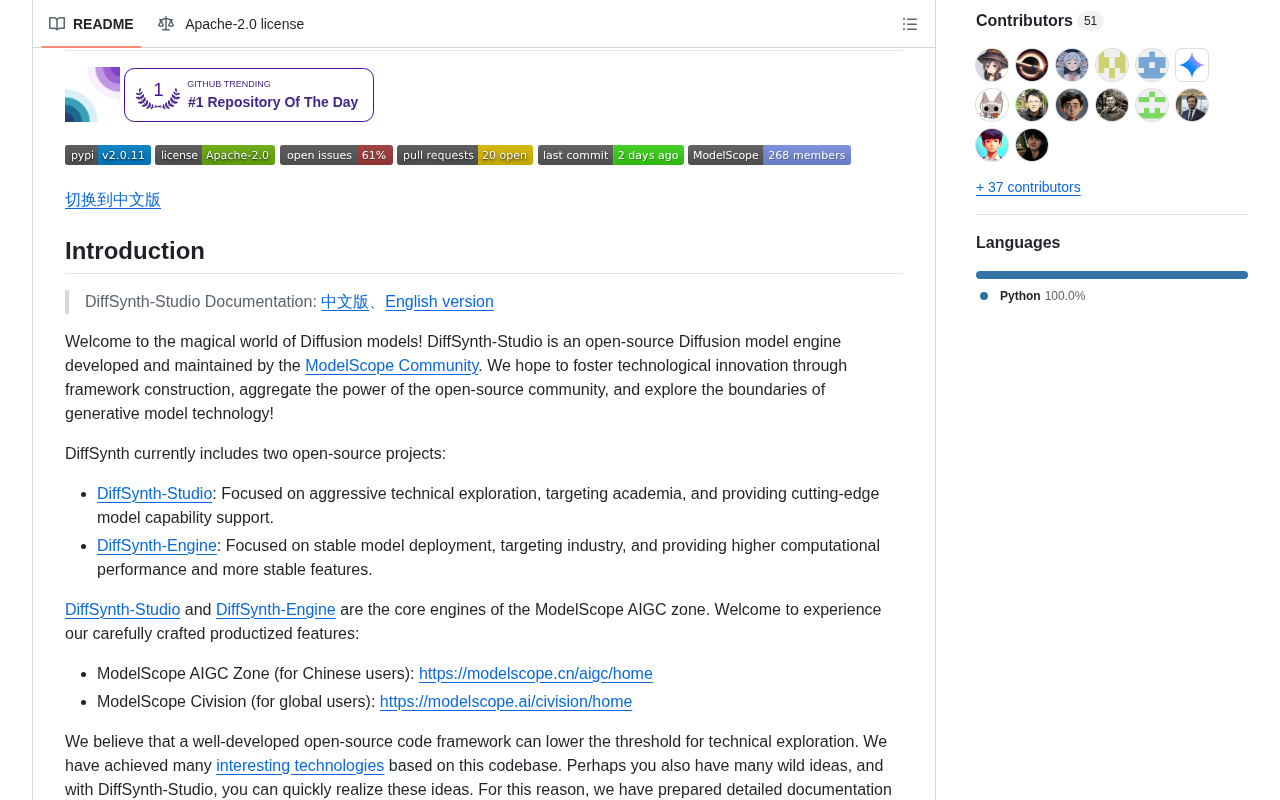
What Is DiffSynth-Studio: An All-in-One Diffusion Model Workbench
DiffSynth-Studio, launched by the ModelScope team, reveals its ambition right in its name — Diffusion + Synth, meaning "synthesize everything." The project's core philosophy is straightforward: let users harness the magic of diffusion models.
To understand this project's value, you first need to know what a Diffusion Model actually is. Diffusion models are a class of generative AI models based on probability theory, built around two key stages: forward diffusion and reverse denoising. During the forward process, the model progressively adds Gaussian noise to a real image until it becomes pure random noise; during the reverse process, the model learns how to "restore" a clear image from that noise step by step. This process of "creating order from noise" is the fundamental mechanism behind how diffusion models generate images. Since 2020, diffusion models have comprehensively surpassed GANs (Generative Adversarial Networks) — the previously dominant approach — in image generation quality, becoming the core technical paradigm in AI image generation, video generation, audio synthesis, and beyond.
Rather than letting people get lost among scattered research papers and fragmented code for various diffusion models, the project provides a pre-integrated "magic studio" where you can get started as soon as you walk in. No need to build a pipeline from scratch, no need to stare blankly at obscure low-level code — just grab it and run through a complete image generation workflow.
The pipeline (inference pipeline) mentioned here is a key concept in the AI field. A complete diffusion model pipeline isn't simply "one model" — it typically includes a text encoder (converting user prompts into vectors the model can understand), a noise scheduler (controlling the number and pace of denoising steps), a U-Net or Transformer backbone network (performing the actual denoising computation), a VAE decoder (converting latent space representations into final pixel images), and several other components. Version compatibility, parameter configuration, and data flow between these components all need precise alignment. For average users, building a functional pipeline from scratch often means hours or even days of debugging. What DiffSynth-Studio does is encapsulate all this complex component orchestration, letting users focus on creation itself.
Project URL: https://github.com/modelscope/DiffSynth-Studio
GitHub Community Data: The Buzz Behind 12,000+ Stars
Let's look at the hard metrics:
- 12,354 Stars
- 1,191 Forks
- Developed in Python
- Part of the modelscope organization
What do over ten thousand stars mean? It means it's not just developers paying attention — a large number of designers, content creators, and AI enthusiasts are all watching this project's progress.
And 1,191 Forks means over a thousand people have pulled the code to modify it, experiment with it, and add their own features. In GitHub's collaboration mechanism, a Fork means creating a complete copy of an open-source repository under your own account, forming an independent version. Users can freely modify code, add new features, and fix bugs in their own Fork, then submit improvements back to the original project via Pull Requests. Fork count is an important indicator of an open-source project's "depth of participation" — a Star might just be a "passing like," but a Fork means someone is actually using and modifying the code. 1,191 Forks indicate that DiffSynth-Studio has already formed an active secondary development ecosystem, with community contributors expanding the project's capabilities in different directions. This is the beauty of open-source communities — some people build the wheel, others improve it, and eventually everyone polishes the tool together until it becomes increasingly useful.
Speaking of the modelscope organization, it's worth elaborating here. ModelScope is an open-source model community platform launched by Alibaba's DAMO Academy in 2022, positioned similarly to Hugging Face internationally. The platform aggregates thousands of open-source models covering natural language processing, computer vision, speech recognition, multimodal AI, and more, while providing one-stop services including model hosting, online inference, and training fine-tuning. In China's AI open-source ecosystem, ModelScope plays an infrastructure-level role, and DiffSynth-Studio is one of its key projects in the diffusion model space. Backed by such platform resources, DiffSynth-Studio has natural advantages in model access, community operations, and continuous iteration.
Entry Barrier: Basic Python Knowledge Is All You Need
The project is written in Python, which means the barrier is low enough that anyone with basic Python experience can clone a copy and start tinkering. Of course, actually running it requires certain hardware configurations (GPU VRAM can't be too small), but at the code level, DiffSynth-Studio won't shut anyone out.
The GPU VRAM topic deserves a few more words. The inference process of diffusion models requires simultaneously loading model weights, intermediate feature maps, and noise tensors in VRAM, and the volume of this data is often substantial. Taking Stable Diffusion XL as an example, model weights alone occupy approximately 6.5GB of VRAM, and with intermediate computation data during inference, generating a single 1024×1024 image typically requires over 10GB of GPU VRAM. For video generation tasks, VRAM requirements multiply further. DiffSynth-Studio has done considerable optimization work in this area, including support for chunked model loading (loading different components into VRAM on demand), half-precision (FP16) or even lower-precision inference, and intelligent scheduling between VRAM and system memory. These techniques enable consumer-grade GPUs (such as an RTX 4060 with 8GB VRAM) to run certain models, significantly lowering the hardware barrier.
For those looking to get started with AI image generation and video synthesis, DiffSynth-Studio offers a remarkably friendly starting point:
- No need to piece together scattered model code on your own
- Pre-integrated calling interfaces for mainstream diffusion models
- Reference examples and documentation provided
Why DiffSynth-Studio Deserves Your Attention
ModelScope's approach here is clever. Diffusion models have evolved too rapidly in recent years — Stable Diffusion, SDXL, various ControlNets, LoRA... ordinary users simply can't keep up. What DiffSynth-Studio does is package all these capabilities into a unified workbench, dramatically lowering the barrier to entry.
It's worth untangling the relationships between these technical terms here, as they form the core puzzle pieces of the current diffusion model ecosystem:
Stable Diffusion is a text-to-image diffusion model open-sourced by Stability AI in 2022. It was the first to freely open high-quality AI image generation capabilities to the world, igniting the entire AIGC field. SDXL (Stable Diffusion XL) is its upgraded version, which significantly improves image quality, composition ability, and understanding of complex prompts through larger model parameters and a dual text encoder architecture.
ControlNet is a conditional control technique that adds extra control signal inputs on top of diffusion models — such as body skeleton pose maps, edge line drawings, depth maps, and more — allowing users to precisely control the composition and structure of generated images rather than relying solely on text descriptions. This technology was proposed by Lvmin Zhang and others at Stanford University and greatly expanded the practical utility of diffusion models.
LoRA (Low-Rank Adaptation) is a lightweight model fine-tuning technique, originally proposed by Microsoft Research for efficient adaptation of large language models. In the diffusion model domain, LoRA allows users to train only a minimal number of parameters (typically just tens of MB) to teach a model a specific art style, character, or concept, without retraining the entire multi-GB base model. LoRA's emergence spawned a massive community ecosystem — on platforms like Civitai, users have shared tens of thousands of LoRA models covering everything from anime art styles to realistic photography.
DiffSynth-Studio unifies all these technologies into a single framework, allowing users to freely combine them without configuring separate environments for each — and this is precisely its core competitive advantage.
Specifically, its value manifests on two levels:
- For developers: A platform for rapidly experimenting with various diffusion model techniques, saving enormous amounts of time otherwise spent on repetitive environment setup
- For creators: A potential productivity tool that transforms complex AI model capabilities into directly usable creative features
Conclusion
In today's explosion of AI tools, DiffSynth-Studio has become an unmissable project in the diffusion model space, backed by the ModelScope team's technical expertise and the open-source community's ongoing contributions. Whether you want to quickly experience AI image generation capabilities or plan to do secondary development based on diffusion models, this 12,000+ star project deserves a spot in your bookmarks.
The most powerful magic isn't the model itself — it's laying the spellbook open on the table so that everyone passing by can flip through it. That's exactly what DiffSynth-Studio is doing.
Related articles
 Product Reviews
The Programmer's Desk Setup Guide: Building a Workspace That Feels Like Home
Discover how programmers build productive, comfortable workspaces. From multi-monitor setups to ergonomic design, explore the desk philosophy that drives focus and flow.
 Product Reviews
Qoder vs Cursor Real-World Comparison: Which $20/Month AI IDE Is Better?
Hands-on comparison of Qoder vs Cursor AI IDEs: Agent autonomy, human interaction count, and architecture decisions. Qoder needed only 2 interactions vs Cursor's 8.
 Product Reviews
Cursor Cloud Agent Demo: Eliminating Bottlenecks Across the Entire Software Development Lifecycle
Deep analysis of Cursor's Cloud Agent demo showing how cloud VMs, automated test artifacts, and a full-chain control plane systematically eliminate human bottlenecks across the software development lifecycle.