GitHub 8,200-Star LLM Resource Hub: Covering the Full Pipeline from Training to Inference to Agents

A deep dive into GitHub's 8,200-star awesome-LLM-resources: the most comprehensive Chinese LLM resource navigator.
This article provides an in-depth analysis of the awesome-LLM-resources project on GitHub with 8,200+ stars. The project covers the full LLM lifecycle including data processing, model training, inference optimization, Agents, multimodal, and MCP modules. It uses scenario-driven classification, organizes content primarily in Chinese, and closely tracks cutting-edge trends like o1, MCP, and SLM, making it an excellent resource navigator for LLM developers and researchers.
Introduction
The pace of Large Language Model (LLM) technology iteration is astonishing, and practitioners face a core pain point: high-quality resources are far too scattered. Large Language Models (LLMs) are deep learning models based on the Transformer architecture, trained on massive amounts of text data. Since the release of ChatGPT in 2022, the LLM field has experienced explosive growth—from closed-source models like GPT-4, Claude, and Gemini to open-source models like LLaMA, Qwen, and DeepSeek—with technology iteration cycles shrinking from yearly to monthly or even weekly. This rapid iteration has led to severe knowledge fragmentation—a developer might need to simultaneously track model updates on Hugging Face, the latest papers on arXiv, API changes from major vendors, and tool releases from open-source communities. Information overload has become a universal pain point.
Model training, inference optimization, Agent development, multimodal generation... each direction has a vast number of papers, tools, and tutorials, yet lacks a systematic index entry point. The awesome-LLM-resources project on GitHub was created precisely to solve this problem, having already garnered over 8,200 Stars and 840 Forks, making it one of the most comprehensive Chinese-language LLM resource navigators.
This article will provide an in-depth analysis of the project's content architecture, core value, and applicable scenarios, helping developers at different stages quickly locate the resources they need.
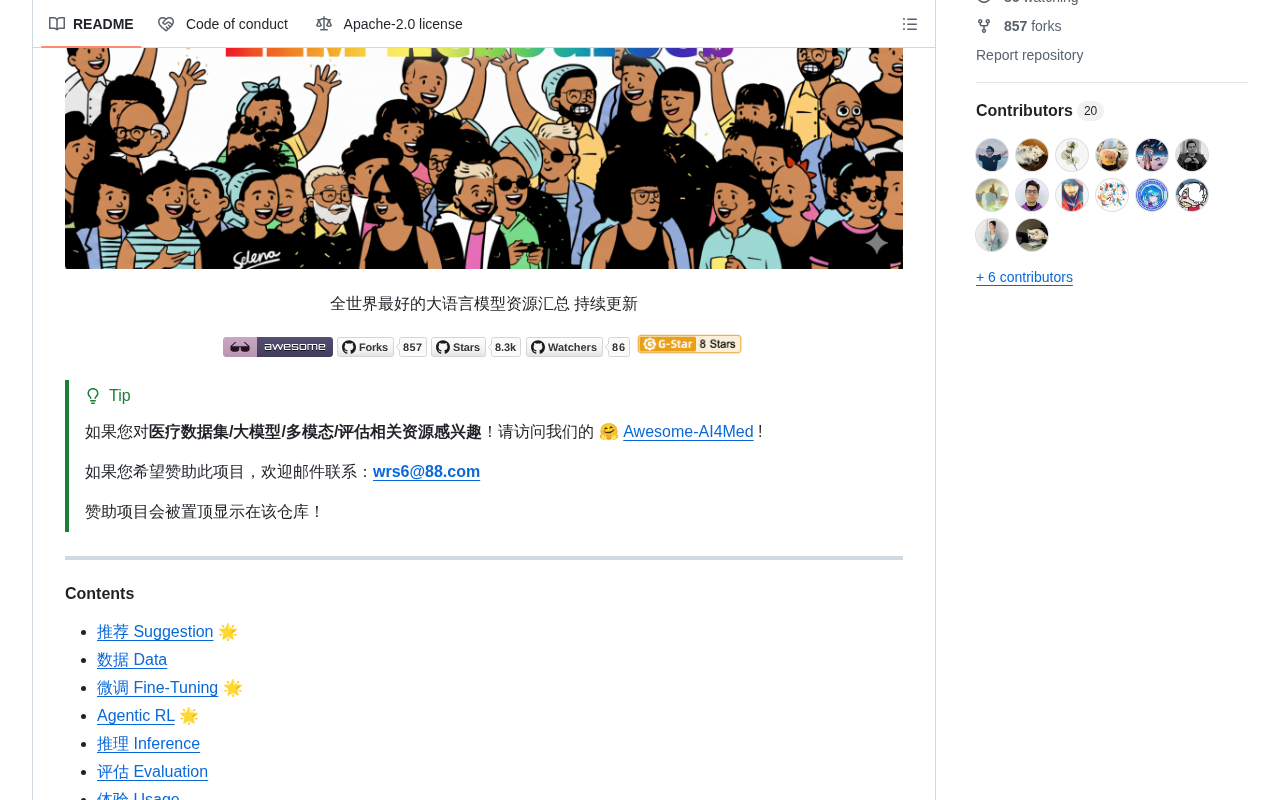
Project Overview: Covering the Full LLM Lifecycle
awesome-LLM-resources is maintained by developer WangRongsheng and is positioned as "the world's best LLM resource compilation." Unlike many awesome-series lists that merely compile links, this project features fine-grained categorization organized by LLM technology stack and application scenarios, covering the complete pipeline from data processing to model deployment.
Its core modules include:
- Data Processing: Tools and methodologies for training data cleaning, annotation, augmentation, and other stages
- Model Training: Technical solutions for pre-training, fine-tuning (SFT/RLHF/DPO), and more. Pre-training refers to training a base model on large-scale unlabeled corpora through self-supervised learning; SFT (Supervised Fine-Tuning) uses human-annotated instruction-response pairs for further training; RLHF (Reinforcement Learning from Human Feedback) captures human preferences through a reward model and optimizes output using reinforcement learning; DPO (Direct Preference Optimization) is a simplified alternative to RLHF that doesn't require training a separate reward model, directly optimizing the policy model through preference data pairs, significantly reducing the engineering complexity of alignment training.
- Model Inference: Inference optimization techniques including quantization, acceleration, and deployment. Since LLM parameter counts typically range from billions to hundreds of billions, inference costs are extremely high. Quantization techniques reduce model weights from FP16/FP32 to lower-precision formats like INT8/INT4, shrinking model size by 2-4x with minimal accuracy loss—representative approaches include GPTQ, AWQ, and GGUF. Inference acceleration frameworks like vLLM optimize KV Cache management through PagedAttention technology, while TensorRT-LLM leverages NVIDIA GPU hardware characteristics for deep optimization. Techniques like Speculative Decoding and Continuous Batching continue to push inference efficiency forward.
- Multimodal Generation: Cross-modal generation technologies for images, video, audio, and more
- Vision Language Models (VLM): Resources related to multimodal understanding and reasoning. VLMs are multimodal models capable of understanding both images and text simultaneously, typically composed of a vision encoder (e.g., ViT), a language model, and a projection layer connecting the two. Representative models include GPT-4V/4o, Claude 3.5's vision capabilities, and open-source models like the LLaVA series and InternVL. Current research hotspots include fine-grained visual understanding, ultra-high-resolution image support, video understanding, and GUI operation.
- Agent: Intelligent agent architectures, tool calling, and multi-Agent collaboration. AI Agents are AI systems capable of autonomously perceiving environments, formulating plans, and executing actions, with core capabilities including Tool Use, Memory management, Planning and reasoning, and Reflection. Typical architectures include the ReAct (Reasoning + Acting) paradigm and Plan-and-Execute patterns, with mainstream frameworks including LangChain, AutoGen, and CrewAI.
- AI-Assisted Programming: AI Coding related tools and practices
- AI Paper Review: Tools related to automated academic paper review
- o1 Model: Technical analysis of OpenAI's o1 series reasoning models. The o1 model introduces an internalized "chain of thought" mechanism, performing extended internal reasoning before generating final answers. This paradigm, known as "Test-time Compute Scaling," dramatically outperforms traditional models on complex tasks in mathematics, coding, and scientific reasoning, spawning open-source replication attempts like DeepSeek-R1 and QwQ.
- MCP (Model Context Protocol): Resources related to the Model Context Protocol. MCP is an open standard protocol proposed by Anthropic in late 2024, adopting a client-server architecture to provide LLM applications with a unified way to connect to external data sources and tools—similar to how the USB protocol unified hardware device connections—and is becoming critical infrastructure for the AI application ecosystem.
- Small Language Models (SLM): Training and deployment of lightweight models. SLMs typically refer to models with parameter counts ranging from hundreds of millions to several billion, such as Microsoft's Phi series and Google's Gemma series. Their rise stems from edge deployment needs and cost-efficiency considerations, with key techniques including high-quality data filtering, knowledge distillation, and architecture optimization for specific hardware.
Core Highlights Analysis
Closely Tracks Cutting-Edge Trends with High Update Frequency
One major advantage of this project is its rapid follow-up on frontier technologies. After OpenAI released the o1 reasoning model, the project quickly added a dedicated o1 section, collecting relevant technical analyses, replication attempts, and open-source alternatives. The o1 model represents an important turning point in LLM development—shifting from fast intuitive responses to deep reasoning, improving output quality by investing more computational resources during inference (i.e., "thinking tokens") to complement traditional training-time scaling. The success of this paradigm has driven the entire industry's emphasis on reasoning capabilities.
Anthropic's MCP (Model Context Protocol) was also incorporated into the resource system at the first opportunity. Before MCP, every AI application needed to write customized integration code for different data sources (databases, APIs, file systems, etc.), resulting in massive duplicate work. MCP defines a standardized communication protocol that enables any MCP-compatible AI application to plug-and-play connect to various data sources and tools, and is considered likely to profoundly change the development paradigm of AI applications.
This keen technological intuition makes the project not just a static resource list, but more like a dynamic technology radar, helping developers stay on the pulse of the industry.
Chinese-Friendly, Lowering the Entry Barrier
Although primary materials in the LLM field are mostly in English, this project is organized and annotated primarily in Chinese, making it extremely friendly for domestic developers. The project not only includes original English papers and tools but also extensively references technical blogs, tutorials, and practical experiences from the Chinese community, effectively reducing learning costs for non-native English speakers.
Scenario-Based Classification for Precise Need Matching
Unlike traditional awesome lists that categorize by technical type (papers/code/tutorials), this project adopts a scenario-driven classification approach. For example, the "AI-Assisted Programming" section integrates tools like Cursor, Copilot, and Cline together with related prompt engineering techniques and best practices; the "AI Paper Review" section focuses on academic scenarios, collecting a complete toolchain from paper polishing to automated review.
This organizational approach allows developers to quickly find a complete set of resources for their specific scenario based on actual needs, saving time that would otherwise be spent filtering through massive link collections.
Target Audience and Usage Recommendations
Beginner Developers
For those just entering the LLM field, it's recommended to start with the Data Processing and Model Training sections to understand the basic LLM development workflow. Data processing is the cornerstone of LLM training—high-quality training data directly determines model performance, involving multiple stages including data deduplication, toxicity filtering, quality scoring, and format standardization. The introductory tutorials and practical guides included in the project can help you quickly build a knowledge framework.
Mid-to-Senior Engineers
For engineers with some experience, the Model Inference, Agent, and MCP sections offer greater value. These modules contain extensive engineering practices and performance optimization techniques that can be directly applied to production environments. For example, the inference optimization section covers complete solutions from single-GPU deployment to distributed inference, while the Agent section includes implementation references ranging from simple ReAct patterns to complex multi-Agent orchestration systems.
Researchers
Academic researchers should focus on the o1 Model, Vision Language Model, and Small Language Model sections. These fields are in a period of rapid development, and the frontier papers and open-source implementations collected in the project help in grasping research directions. The small language model field in particular involves multiple open research questions about how to maximize model capability within limited parameter counts, including data ratio, architecture design, and training strategies.
Comparison with Similar LLM Resource Projects
LLM-related awesome lists are not uncommon on GitHub, but awesome-LLM-resources has several differentiated advantages:
- Broader Coverage: From data to deployment, from training to applications, it covers virtually every aspect of LLMs
- More Complete Chinese Ecosystem: The extensive inclusion of Chinese resources makes it the go-to navigator for domestic developers
- Faster Coverage of Emerging Directions: Rapid inclusion of emerging directions like MCP, o1, and SLM demonstrates the maintainer's technical sensitivity
- High Community Activity: The 8,200+ Stars and 840+ Forks demonstrate strong community recognition
Summary and Outlook
The value of the awesome-LLM-resources project lies not only in the quantity of resources but more in its systematic organizational approach and continuous update maintenance. In an era where LLM technology changes daily, a high-quality resource navigator can significantly improve developers' learning and work efficiency.
As LLM technology continues to evolve toward multimodality, long-form reasoning, and edge deployment, this project's content will continue to expand. The multimodal direction means models will not only process text but will unify understanding and generation across images, video, audio, 3D, and other modalities; the long-form reasoning direction, represented by o1, explores how to enable models to perform deeper logical reasoning; edge deployment focuses on how to bring powerful AI capabilities to phones, PCs, embedded devices, and other edge environments, enabling low-latency, high-privacy localized AI experiences.
For any developer or researcher working with large language models, adding this project to your bookmarks is a worthwhile choice.
Project URL: github.com/WangRongsheng/awesome-LLM-resources
Related articles
 Product Reviews
The Programmer's Desk Setup Guide: Building a Workspace That Feels Like Home
Discover how programmers build productive, comfortable workspaces. From multi-monitor setups to ergonomic design, explore the desk philosophy that drives focus and flow.
 Product Reviews
Qoder vs Cursor Real-World Comparison: Which $20/Month AI IDE Is Better?
Hands-on comparison of Qoder vs Cursor AI IDEs: Agent autonomy, human interaction count, and architecture decisions. Qoder needed only 2 interactions vs Cursor's 8.
 Product Reviews
Cursor Cloud Agent Demo: Eliminating Bottlenecks Across the Entire Software Development Lifecycle
Deep analysis of Cursor's Cloud Agent demo showing how cloud VMs, automated test artifacts, and a full-chain control plane systematically eliminate human bottlenecks across the software development lifecycle.