#LLM resource collection
273 related articles
 Tutorials
·2 min
awesome-llm-skills: Cross-Platform AI Agent Skill Library Guide & Resource Collection
Explore awesome-llm-skills, an open-source curated list of AI Agent skills compatible with Claude Code, Codex, and Gemini CLI, with resources and best practices for Agent workflows.
Read more →
 Product Reviews
·3 min
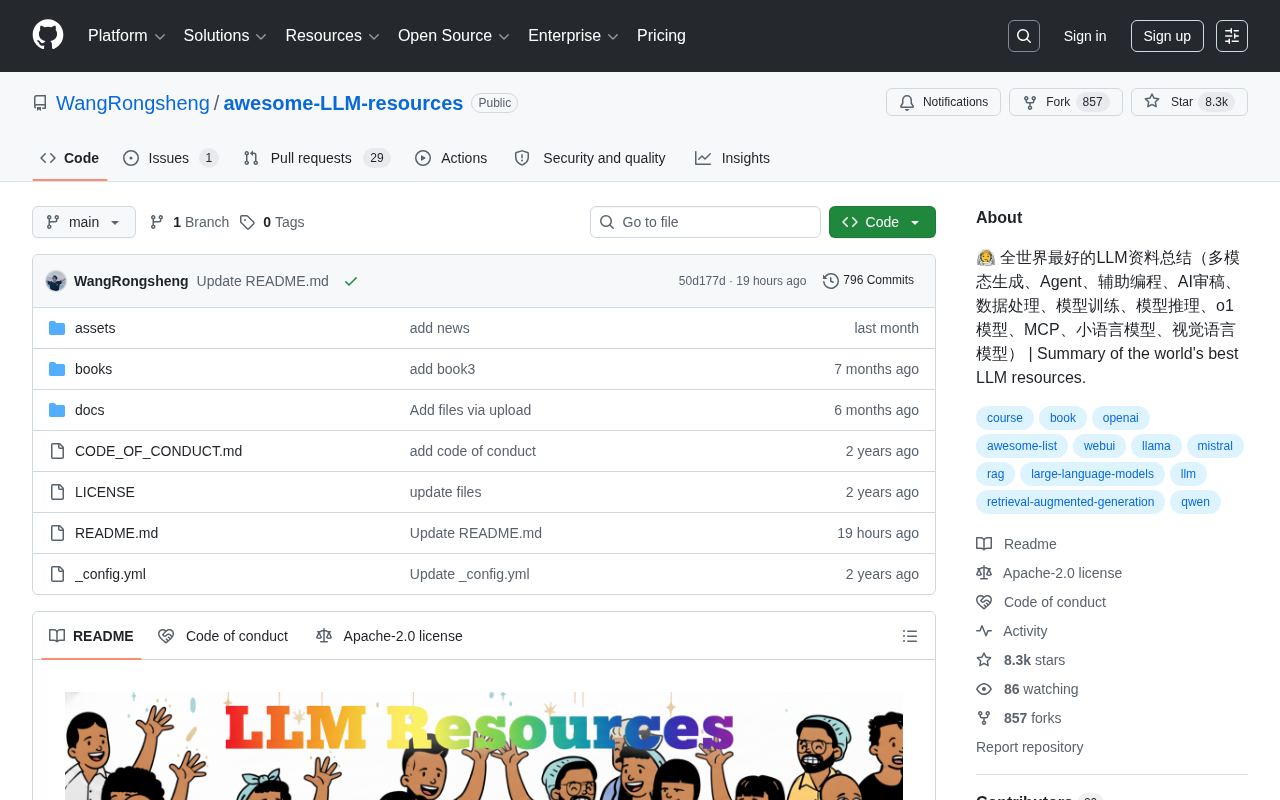
GitHub 8000+ Stars: A Deep Dive into awesome-LLM-resources — The Most Comprehensive Large Language Model Resource Collection
Deep dive into the GitHub 8000+ star project awesome-LLM-resources, covering LLM training, multimodal generation, AI Agents, MCP protocol, AI-assisted coding, and more for developers.
Read more →
 Product Reviews
·3 min
awesome-LLM-resources: Deep Dive into a GitHub 8000+ Star LLM Resource Collection
Deep dive into GitHub's 8000+ star project awesome-LLM-resources, covering AI Agents, model training, MCP protocol, multimodal generation and more across 10 core LLM directions.
Read more →
 Deep Dives
·2 min
awesome-LLM-resources: A Comprehensive LLM Collection with 8000+ Stars, Covering Multimodal, Agent, MCP, and 11 Major Domains
Deep dive into awesome-LLM-resources, a GitHub repo with 8200+ Stars covering multimodal generation, AI Agents, MCP, o1 models, small language models, and more.
Read more →

·3 min
Does Your School Matter for Breaking into Machine Learning? The Truth About Credentials vs. Capability
Does school background really matter for entering machine learning? This article analyzes the real impact of credentials and provides more effective strategies for building competitiveness.
Read more →

·3 min
Perplexity In-Depth Usage Guide: Advanced Techniques and Real-World Scenarios
A comprehensive guide to Perplexity AI's core strengths and advanced usage, covering Focus modes, Collections, Deep Research, and practical tips to become a Power User for efficient research and decision-making.
Read more →

·3 min
Reranking: The Underrated Secret Weapon for Boosting RAG Accuracy
Explore why reranking is the key to boosting RAG retrieval accuracy. Learn how cross-encoders overcome vector search limitations and how to implement two-stage retrieval architectures.
Read more →

·3 min
GrowthBook 5.0: Deep Dive into the AI-Native All-in-One A/B Experimentation & Growth Platform
GrowthBook 5.0 unifies feature flags, A/B experimentation, and product analytics into an AI-native, warehouse-native platform. Deep dive into its AI Visual Editor, Agent Skills ecosystem, and value for growth teams.
Read more →

·3 min
Xberg v1 Open-Source Document Extraction Engine: CPU-Only Local Processing Supporting 101 Formats
Xberg v1 is an MIT-licensed open-source local document extraction engine. CPU-only, supporting 101 formats with built-in SPLADE and ColBERT retrieval, Rust-powered for RAG and ML pipelines.
Read more →

·4 min
AI Engineer Growth Roadmap: From Programming Fundamentals to RAG and MCP Agent Development
A systematic AI engineer learning roadmap covering programming, math, ML, and data engineering foundations, plus frontier AI technologies like LLM, RAG, Agents, and MCP with free open-source resources.
Read more →

·3 min
MCP Session Analytics: Building Production-Grade Observability and Evaluation for AI Agents
How to build product analytics and evaluation capabilities for AI Agents at the MCP protocol layer, covering session-level tracing, tool call observability, and quality Evals.
Read more →

·2 min
MicroCodex: A C++ Programming Agent Under 1MB — A Fresh Take on Minimalist AI Tools
MicroCodex re-implements OpenAI's Codex programming agent in C++ with a binary under 1MB. This article analyzes its engineering design, minimalist philosophy, and use cases in CI/CD and embedded systems.
Read more →

·3 min
Which ML Projects Will Actually Help You Land a Job Offer?
Ditch overused tutorial projects. Learn what hiring managers actually look for in ML portfolios: LLM apps, Agent systems, MLOps practices, and real-world solutions.
Read more →

·4 min
SELENE Open-Source Project: An Interactive Notebook Library for Systematically Learning AI and Machine Learning from Scratch
SELENE is an open-source AI learning resource built on Jupyter Notebooks, systematically covering ML, deep learning, Transformers, and LLMs with interactive code and math derivations for beginners.
Read more →

·3 min
Symbio: Technical Analysis and Challenges of the AI Self Fine-Tuning Loop
In-depth analysis of Symbio's AI self fine-tuning loop mechanism, exploring the technical logic of self fine-tuning loops, personalization value, and challenges like catastrophic forgetting and model drift.
Read more →

·4 min
Multi-Purpose Home Server Build Guide: Streaming + AI Inference + App Hosting on One Machine
How to build a $500 multi-purpose home server for Jellyfin streaming, Ollama local AI inference, web app hosting, and Pi-hole ad blocking with dual RTX 3060 GPUs.
Read more →

·2 min
TRIP: Feature Deep Dive & Deployment Guide for the Open-Source Self-Hosted Travel Planning Tool
TRIP is a privacy-first open-source self-hosted travel planning tool supporting POI map management, multi-day itineraries, GPX tracks, and MCP Server AI integration. A detailed look at version 1.47.
Read more →

·6 min
Separate Domains vs. Subdomains for Self-Hosted Services? A Deep Dive into Security Isolation Strategies
Deep dive into domain security architecture for self-hosted services: Should services with different exposure levels use separate domains or subdomains? Analysis of subdomain enumeration risks, defense in depth, and practical isolation strategies.
Read more →

·4 min
HortusFox v5.9 Released: An Anti-AI Open-Source Plant Management Application
HortusFox v5.9 "Summer Plants Release" adds per-plant attachments, sorting preference memory, and 15 bug fixes. This anti-AI open-source self-hosted plant management app prioritizes data sovereignty for gardening enthusiasts.
Read more →

·5 min
The Complete Learning Path to Understanding the Kimi K3 Technical Report
A systematic learning path for understanding the Kimi K3 technical report, covering MoE, MLA, distributed training, and modern post-training techniques.
Read more →