LangGraph 1.0.5 Tutorial: Master AI Agent Orchestration & Multi-Agent Systems in Six Lessons

LangGraph is a low-level orchestration framework for building durable AI agents
This article introduces LangGraph as an independent sub-project within the LangChain ecosystem that uses a directed graph model to orchestrate AI Agent execution flows, addressing the flexibility limitations of LangChain's high-level abstractions. It focuses on two of LangGraph's five core features: Durable Execution (enabling fault recovery through checkpointing) and Comprehensive Memory Management (integrating short-term and long-term memory), while introducing a six-lesson tutorial series.
Why Learn LangGraph Now?
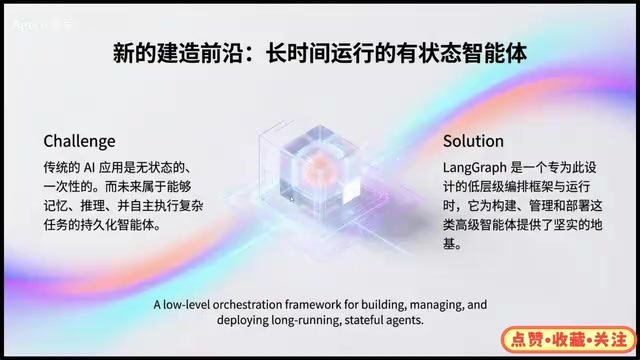
Traditional AI applications are stateless one-off interactions—users ask questions, models respond, and the conversation ends. But the next generation of AI applications needs the ability to remember, reason, and autonomously execute complex tasks—what we commonly call Durable Agents.
LangGraph is a low-level orchestration framework designed specifically for building such agents. To understand LangGraph's positioning, you first need to understand its relationship with LangChain. LangChain was born in late 2022 as one of the first development frameworks to standardize LLM calls, enabling developers to quickly build Q&A systems, document summarization tools, and other applications through high-level abstractions like Chains, Prompt Templates, and Memory. However, as AI application complexity increased, LangChain's high-encapsulation approach began to reveal its limitations: when you need precise control over execution order, handling conditional branches, or waiting for external events at a specific node, high-level abstractions become obstacles rather than enablers. LangGraph was released in early 2024 as an independent sub-project within the LangChain ecosystem, drawing on the directed graph computational model to represent an Agent's execution process as a network of nodes and edges. Each node is an independently executable computation unit, and edges define the transition logic between nodes. Unlike highly encapsulated frameworks like LangChain, LangGraph starts from the ground up, giving developers greater freedom to define every behavioral node of an Agent. LangChain makes calling LLMs and using tools simple, but the cost of "simple" is limited flexibility. LangGraph takes the opposite approach, providing a set of fine-grained orchestration capabilities that let you precisely control an Agent's execution flow.
This LangGraph 1.0.5 tutorial series on Bilibili consists of six lessons, each under 20 minutes, progressing from basic concepts to production-ready practices and covering all of LangGraph's core features. Let's walk through the knowledge structure of this course and LangGraph's key capabilities one by one.
The Five Core Features of LangGraph
Durable Execution
One of LangGraph's most important features. Durable Execution is a classic concept in distributed systems, with mature implementations in workflow engines like Temporal and Cadence. Its core idea is to serialize and persistently store a program's execution state, enabling recovery from the nearest checkpoint after any failure. LangGraph brings this mechanism into the AI Agent domain through its built-in Checkpointer component: every time an Agent completes a node's execution, the current state is serialized and stored in a storage backend (supporting in-memory, SQLite, PostgreSQL, and other backends). It not only preserves state but also maintains execution context. When an Agent encounters a failure during runtime, LangGraph enables seamless recovery, ensuring the process is never interrupted. This is critical for long-running tasks in production environments—for example, a complex Agent that needs to call multiple APIs and go through multiple rounds of reasoning shouldn't have to start over from scratch if any single step fails, and all the previous API calls and computational resources shouldn't be wasted.
Comprehensive Memory Management
LangGraph integrates both short-term memory and long-term memory mechanisms, giving agents true context-awareness capabilities. These two correspond to fundamentally different technical implementation paths: short-term memory is essentially context window management for the current session—LangGraph maintains message history, intermediate variables, and tool call results through the State object during a single graph execution, and this information disappears when the session ends. Long-term memory requires external storage system support, abstracting read/write operations through the Store interface, with the underlying layer connecting to vector databases (such as Pinecone, Chroma) for storing semantic memories, or relational databases for storing structured user preferences and historical behaviors. Short-term memory keeps the Agent coherent within a single conversation, while long-term memory enables the Agent to accumulate knowledge and experience across sessions. It's worth noting that introducing long-term memory brings new engineering challenges: how to decide which information is worth preserving long-term, and how to find the most relevant memory fragments during retrieval. These questions have spawned a series of engineering practices including memory compression and memory summarization, and represent one of the core challenges in AI Agent engineering today. This is the key evolution from "chatbot" to "intelligent assistant."
Related articles
 Tutorials
ChatGPT Plus Subscription Guide: Are GPT-5.5, image-2, and Codex Worth the Upgrade?
A detailed look at ChatGPT Plus features — GPT-5.5, image-2, and Codex — with a Plus vs Pro comparison and a complete step-by-step subscription guide for users outside the US.
 Tutorials
Harness AI Engineering in Practice: Using Claude Code to Master Enterprise-Level E-Commerce Development
Deep dive into Harness AI Engineering: master enterprise e-commerce development with Claude Code using the Rules, Skills, Wiki, and Changes framework.
 Tutorials
Cursor + Codex Dual-IDE Collaboration: A Practical Methodology for Open-Source Project Customization
A complete methodology for open-source project customization based on real-world experience, detailing the Cursor+Codex dual-IDE workflow, seven-stage process, MVP validation, and AI source code reading techniques.