Memmy Agent: Cross-Platform AI Memory Sharing Tool, A Local-First Personal Memory Hub

Local-first AI memory hub that lets all your AI tools share one unified memory of you.
Memmy Agent is an open-source, local-first personal memory hub that solves AI's cross-platform amnesia problem. It enables tools like Claude Code, Codex, OpenClaw, and Hermes to share a unified memory store of your preferences, decisions, and context. With a privacy-first architecture and 2M free tokens, it aims to make every AI remember the same you.
When AI Amnesia Becomes the Norm
Today, our interactions with AI are no longer limited to a single tool. Developers might simultaneously use Claude Code, Codex, OpenClaw, and Hermes, while everyday users switch between multiple platforms like ChatGPT and Claude. But here's the awkward reality: these AI tools share absolutely no memory with each other — preferences, decisions, and context you've repeatedly explained in one tool must be re-explained from scratch when you switch to another.
The technical root cause of these "memory silos" lies in the context window mechanism of large language models (LLMs). Each conversation session has a token limit, and once that window is exceeded or a new session begins, previous information is lost. While some platforms (like ChatGPT's Memory feature) have attempted cross-session memory, these memories are locked within their respective ecosystems and cannot flow across platforms — due to both technical reasons (different data formats across platforms) and business considerations (user lock-in effects).
These "memory silos" don't just waste time — they undermine AI's value as a personal assistant. Every conversation that starts fresh is a loss of context. Memmy Agent, which recently topped the Product Hunt charts, targets precisely this pain point.
What Is Memmy Agent
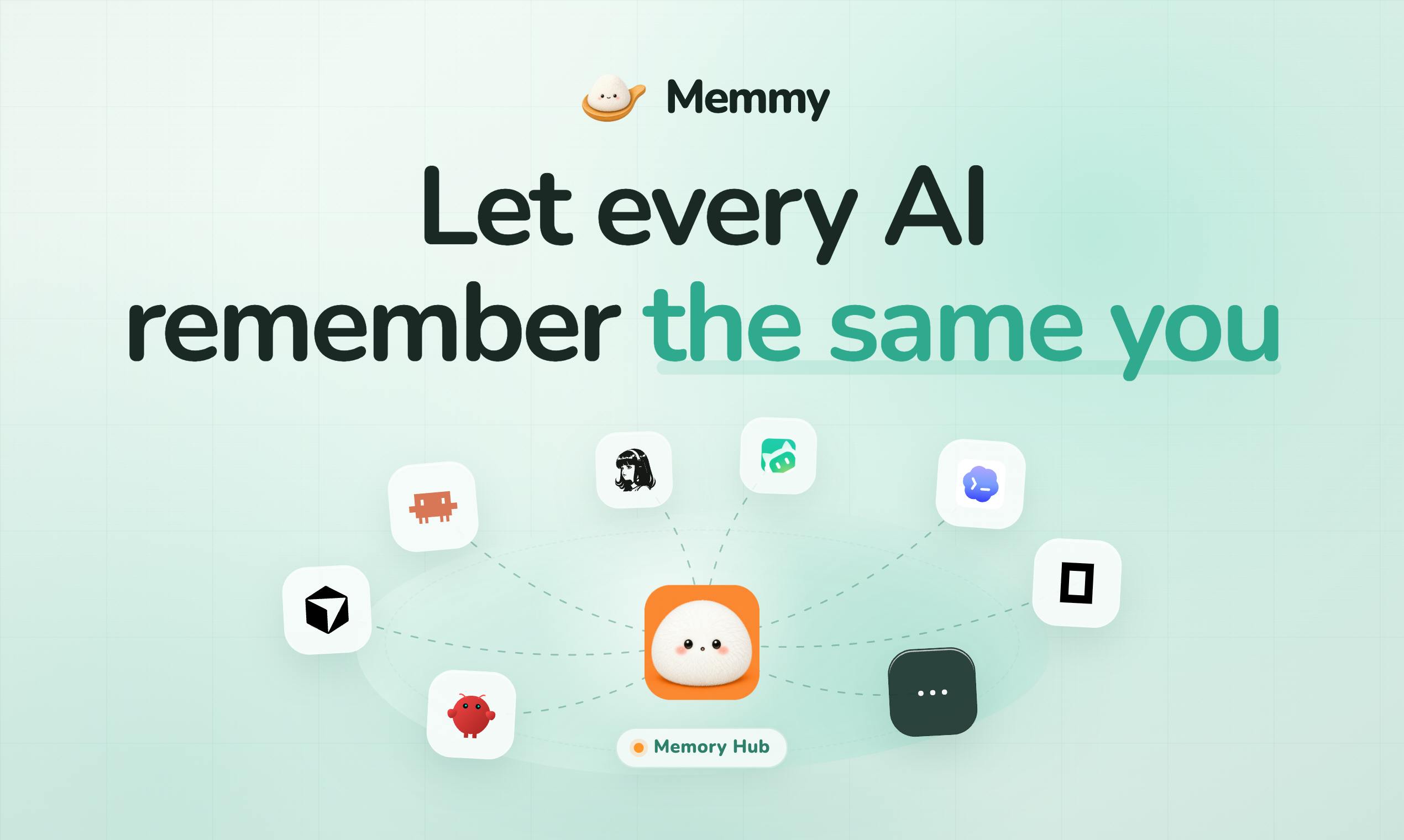
Memmy Agent positions itself as a personal memory hub and local AI agent. Its core philosophy can be summed up in one sentence: "Let every AI remember the same you."
Specifically, Memmy provides a shared, fully controlled memory for all your connected AI tools. Whether you're using Claude Code, Codex, OpenClaw, or Hermes, they can all access the same memory store, enabling cross-platform AI memory sharing.
The urgency of this need stems from the explosive growth of the AI Agent ecosystem between 2024 and 2025. Anthropic launched Claude Code for autonomous programming, OpenAI's Codex is positioned as an asynchronous software engineering agent, and numerous vertical-domain Agent tools have emerged. Users often need to choose the most suitable tool for different tasks, but the lack of a unified memory layer means user profiles are fragmented across multiple systems, requiring context to be rebuilt with every switch.
Where Does Memory Come From
According to official documentation, Memmy transforms the following into long-term memory:
- Chats: Daily conversation records with AI
- Decisions: Key choices you've made
- Prefs: Personal habits and preferences
- Progresses: Project or task advancement status
- Experiences: Accumulated lessons learned
More importantly, Memmy doesn't just passively store information — it can bring the right context into matching tasks and even take on work directly. This means it's not merely a memory repository but an intelligent agent with action capabilities. Under the hood, it likely employs a RAG (Retrieval-Augmented Generation) architecture — converting user history into vector embeddings stored in a vector database, then using semantic similarity search to find the most relevant memory fragments when new tasks arrive and injecting them into the AI's context.
Local-First and Data Sovereignty
One noteworthy design choice of Memmy Agent is its Local-first approach. In an era where AI applications overwhelmingly depend on the cloud, this direction directly addresses user privacy concerns.
Local-first is a software design paradigm whose core principle is that data is primarily stored on the user's local device, with network synchronization being optional rather than mandatory. Compared to traditional cloud-first architectures, Local-first applications work normally offline, and data sovereignty belongs entirely to the user. This philosophy originates from an influential research paper published by Ink & Switch labs in 2019 and has recently regained popularity in privacy-conscious applications, with representative products including Obsidian and Logseq. In the AI memory storage context, Local-first means sensitive information like user preferences and decision histories never gets uploaded to third-party servers, fundamentally eliminating data breach risks.
The official team explicitly emphasizes: your memory always remains under your control and can be managed at any time. For users who don't want to hand over personal conversations, decisions, and preferences to third-party cloud services, the local-first architecture provides stronger data security guarantees.
Additionally, Memmy is listed under Product Hunt's Open Source category, offering transparency in its technical implementation so users and developers can deeply understand how memory is stored and retrieved.
Pricing and Getting Started
Memmy adopts a free-to-start strategy: new users receive 2 million (2M) ChatGPT tokens of free quota.
To put this number in perspective: Tokens are the basic units that large language models use to process text. In English, each word corresponds to roughly 1-1.5 tokens, while in Chinese, each character corresponds to approximately 1.5-2 tokens. Two million tokens roughly equates to 1.5 million English words or about 3,000 pages of document processing. In terms of daily conversations, a typical AI interaction (including input and output) usually consumes 500-2,000 tokens, so 2 million tokens can support approximately 1,000-4,000 complete conversation interactions — quite generous for personal daily use and sufficient to fully experience its AI memory sharing capabilities without paying.
From a product categorization standpoint, Memmy spans three tags: Productivity, Open Source, and Artificial Intelligence — it's essentially a productivity tool that enhances AI usage efficiency.
Value and Reflections
Solving a Real Pain Point in Cross-Tool Memory Sharing
Memmy Agent addresses a need that is both genuine and increasingly pressing. As the AI tool ecosystem becomes more fragmented, the cost of migrating between multiple Agents grows ever higher. A unified memory layer can significantly reduce switching friction, allowing AI to truly become an assistant that knows you.
Ecosystem Compatibility Is Key
The success or failure of memory hub products like this largely depends on maintaining deep integration with mainstream AI tools. Memmy currently supports Claude Code, Codex, OpenClaw, and Hermes, covering developers' commonly used toolchains. However, AI tools iterate extremely fast, and continuously maintaining interfaces while expanding platform support will be a long-term challenge.
Memory Retrieval Accuracy Determines the Experience
What truly determines product experience is memory retrieval accuracy — the ability to bring the right context into matching tasks. If memory retrieval isn't intelligent enough, it could actually introduce noise that interferes with AI judgment.
This challenge technically corresponds to the core difficulty of RAG systems: relevance ranking. The system needs to precisely locate the most relevant fragments among massive historical memories while filtering out information that seems related but would actually mislead the model. This involves multi-dimensional algorithm design including vector similarity computation, semantic understanding, and temporal decay weighting. For example, a user's technical preferences from three months ago may have already changed, and the system needs to determine which memories remain valid. The underlying retrieval and relevance ranking algorithms represent Memmy's true technical moat.
Conclusion
Memmy Agent represents a natural evolutionary direction in AI tool development: moving from point-solution intelligence to unified cross-platform memory management. It enters the scene with a local-first, open-source, free-to-start posture, directly addressing users' dual demands for privacy and coherent experience.
As a new product, Memmy is still in its early stages, and its actual performance — especially memory retrieval accuracy and multi-tool integration stability — still awaits validation from more users. But the proposition of "letting all AI remember the same you" itself points toward the future direction of personalized AI experiences.
Related articles

X Money Fully Explained: Musk's Super App Financial Ambitions Come to Life
X Money officially launches, integrating high-yield savings, X Card cashback spending, and instant transfers. A deep dive into Musk's super app financial strategy and its regulatory, trust, and competitive challenges.

Does Your School Matter for Breaking into Machine Learning? The Truth About Credentials vs. Capability
Does school background really matter for entering machine learning? This article analyzes the real impact of credentials and provides more effective strategies for building competitiveness.

How to Choose Machine Learning Starter Tools? A Beginner's Development Environment Setup Guide
Confused about choosing between VS Code, Jupyter, Google Colab, and Anaconda for ML? This guide clarifies each tool's role and recommends a zero-cost beginner setup to help you start learning fast.