Mu: A Standardized Toolset Platform Designed for AI Agents

Mu is an early-stage platform providing standardized tools for AI Agents to bridge the gap between reasoning and action.
Mu is a new project featured on Hacker News that aims to provide AI Agents with standardized, modular tool capabilities. As Agents evolve from conversational demos to production-grade applications, the need for reliable tool calling—search, code execution, API integration—becomes critical. Mu targets this pain point with a decoupled, developer-friendly design, though it faces stiff competition from MCP, LangChain, and other established solutions.
Introduction: The Tool Dilemma in the Age of Agents
As large language models continue to grow more capable, AI Agents are transitioning from concept to practical reality. The core idea behind AI Agents is enabling language models to not only converse but also autonomously perceive their environment, formulate plans, and take action — a concept that traces back to the classic BDI (Belief-Desire-Intention) architecture in AI research. However, it wasn't until large language models demonstrated powerful reasoning and instruction-following capabilities that engineering implementation became truly feasible. Yet a truly valuable Agent needs more than strong reasoning abilities — it must be able to invoke external tools to accomplish real tasks: querying data, calling APIs, manipulating files, accessing the web, and more. It's against this backdrop that a project called Mu appeared on Hacker News under the title "Show HN: Mu – Tools for Agents," catching the developer community's attention.
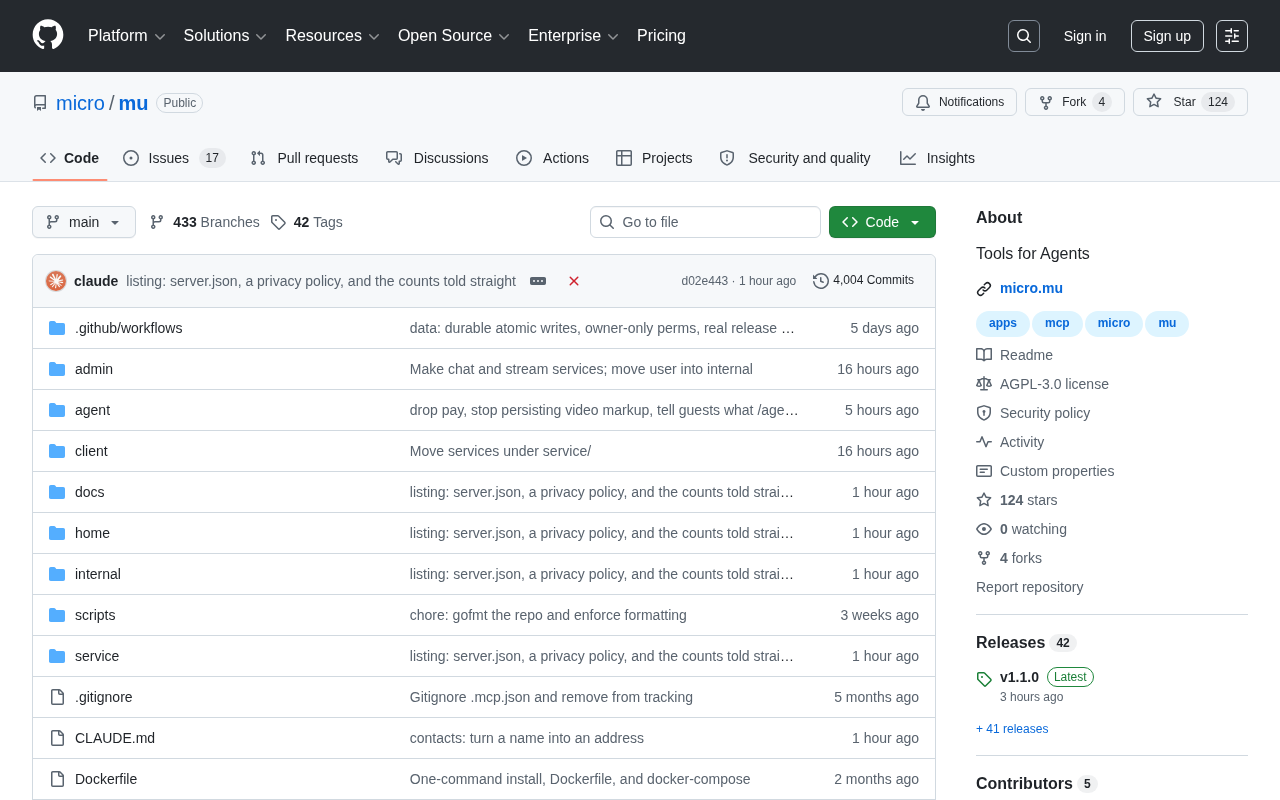
Mu's positioning is crystal clear: providing AI Agents with a standardized, easy-to-use set of tool capabilities. While the project is still in its early stages on Hacker News (9 upvotes, 1 comment), the track it targets — Agent tooling — happens to be one of the most critical and challenging aspects of bringing AI applications to production.
Why Agent Tooling Matters So Much
The Critical Leap from "Thinking" to "Doing"
At their core, large language models are text predictors. They excel at understanding, reasoning, and generation, but inherently lack the ability to interact with the real world. From a technical standpoint, language models are probabilistic models trained on massive text corpora — their "knowledge" is essentially a compressed representation of statistical patterns in training data, with inherent limitations such as knowledge cutoff dates, inability to access real-time information, and inability to directly execute computations. If an Agent can only "talk eloquently" within a chat window, its practical value remains severely limited. An Agent that truly creates productivity must possess the following capabilities:
- Calling search engines to retrieve real-time information
- Executing code or running scripts
- Reading and writing files, operating databases
- Integrating with third-party APIs
This is what's known as "Tool Use" or "Function Calling" capability. Function calling works as follows: developers pre-define a set of functions with names, parameters, and descriptions; the model determines during inference when to call a particular function and generates a structured call request (typically in JSON format); the application layer executes the actual call and returns results to the model. The key insight is the separation of "decision" from "execution" — the model decides what to call and what parameters to pass, while actual execution is handled by external code, ensuring safety and controllability. OpenAI pioneered this capability in GPT models in June 2023, followed by Anthropic's Claude, Google's Gemini, and other models. But how to efficiently organize, manage, and reuse these tools at the application layer remains an open question. Mu targets precisely this pain point.
The Ecosystem Value of Standardization
In the current Agent development ecosystem, tool definition and integration often lack unified standards. Different frameworks (such as LangChain, AutoGPT, CrewAI) each have their own tool wrapping methods, making tools non-reusable across systems and forcing developers to reinvent the wheel. Specifically, LangChain is one of the earliest LLM application development frameworks, offering rich tool chain abstractions and integrations but widely criticized for over-abstraction; AutoGPT is an early representative of autonomous Agents, demonstrating the possibility of Agents autonomously planning and executing tasks; CrewAI focuses on multi-Agent collaboration scenarios. The common problem these frameworks face is fragmented tool definitions — each framework has its own tool wrapping specification, tools cannot be reused across frameworks, increasing migration costs and redundant effort for developers. A project like Mu that focuses specifically on "Tools for Agents" could potentially lower developer onboarding costs and foster a reusable tool ecosystem, provided it can offer a concise, universal tool interface specification.
Analyzing Mu's Core Design Philosophy
Judging from the project name and positioning, Mu's core philosophy should be "making it easier for Agents to acquire capabilities." While publicly available information is limited, based on common practices among similar projects, we can make reasonable inferences about its design direction:
Tools as Plugins: Modular Composition
An ideal Agent tool platform should encapsulate each capability as an independent, composable "tool unit." Developers can mix and match tools for their Agent like building blocks, without worrying about underlying implementation details. This modular design philosophy has deep roots in software engineering — from the Unix philosophy of "do one thing well," to microservices architecture, to the ecosystem prosperity of package managers like npm/pip — all demonstrating that modularity and composability are effective paradigms for building complex system ecosystems. Applied to the Agent tools domain, each tool module should have clear input/output contracts, robust error handling mechanisms, and clear capability descriptions (so the model understands when to invoke which tool).
Decoupled from Specific Models: Universal Design
An excellent tool layer should be decoupled from specific large models — whether the backend uses GPT, Claude, or open-source models, it should be able to invoke the same set of tools in a unified manner. This decoupled design greatly enhances tool universality and project longevity. Architecturally, this means the tool layer needs to provide an intermediate representation — converting different models' function calling formats (OpenAI uses the tools parameter, Anthropic uses tool_use blocks, open-source models each have their own template formats) into a unified tool calling interface, achieving a "write once, use anywhere" effect.
Developer-Friendly: Low-Barrier Integration
As a Show HN project, Mu's target users are clearly developers. Therefore, clean APIs, clear documentation, and low-barrier integration will be the key factors determining whether the community adopts it. In the open-source tools space, "getting the first example running within 10 minutes" is often the make-or-break threshold for whether a project captures developers' initial attention — if the integration process is overly complex or documentation is unclear, developers will likely pivot to other solutions before even trying.
Competitive Landscape and Challenges
The Agent tools track is far from a blue ocean. Beyond the built-in tool systems of frameworks like LangChain mentioned earlier, Anthropic's MCP (Model Context Protocol) is becoming one of the de facto standards for tool connectivity. MCP is an open protocol released by Anthropic in late 2024 — similar to how USB-C provides a unified interface for hardware devices, MCP provides AI applications with a universal "plug-and-play" method for connecting various tools and data sources. It adopts a client-server architecture: MCP Servers expose tools and resources, MCP Clients (typically embedded in AI applications) communicate with them via standard protocols, supporting multiple primitives including tool calling, resource access, and prompt templates. Since its release, AI coding tools like Cursor and Windsurf, as well as multiple cloud service providers, have adopted MCP, and its ecosystem is rapidly expanding. OpenAI is also continuously improving its function calling ecosystem. In this environment, a new project must answer several key questions to stand out:
- What's the differentiation? What unique value does Mu offer compared to existing solutions?
- How to build an ecosystem? A tool platform's value largely depends on the quantity and quality of available tools — how to attract developers to contribute tools?
- How to handle standard compatibility? Should it establish its own standard or embrace existing protocols like MCP?
For early-stage projects, these are unavoidable challenges. The relatively low interaction on Hacker News also reflects that the project is still in its validation and refinement phase.
From Demo to Production: Deeper Challenges in Agent Tooling
There's a massive gap between Agent applications in prototype demos and production deployment — this is also the deeper reason why tool layer standardization matters. In demo environments, occasional Agent errors are tolerable, but production environments demand high reliability, low latency, and observability. Specific challenges include: error handling and retry mechanisms for tool calls (graceful handling of network timeouts, API rate limiting, abnormal response formats, etc.), Agent behavior predictability and consistency (the same input should produce predictable tool call sequences), state management across multi-step tasks (maintaining context between consecutive tool calls), cost control (each tool call may incur additional API fees and latency), strict definition of security boundaries (preventing Agents from executing dangerous operations like deleting databases or sending unauthorized emails), and human-in-the-loop workflow design (which operations require human confirmation before execution). An excellent tool platform should provide built-in support for these production-grade requirements at the framework level, rather than pushing all complexity onto application developers.
Conclusion: A Big Direction Behind a Small Project
Mu is still a very early-stage project, with both its popularity and maturity yet to be proven. But the direction it has chosen — providing tool capabilities for Agents — undoubtedly positions it on the right track for AI application development. As Agents transition from demos to production, tool layer standardization, usability, and ecosystem building will become increasingly important.
Regardless of whether Mu ultimately grows into a mainstream solution, explorations focused on "making Agents actually get things done" deserve ongoing attention from developers. For teams currently building Agent applications, closely tracking such tool projects and validating technical solutions suited to their scenarios early on will be an important step in maintaining competitive advantage.
Key Takeaways
Related articles

Deep Dive into Guava: Core Features and Practical Usage Guide
Deep dive into Google Guava's core features including immutable collections, Multimap, CacheBuilder local caching, ListenableFuture concurrency tools, and more to boost Java development efficiency.

How Open-Source Models Achieve Superior Retrieval Performance at 1% of GPT's Cost
Deep analysis of how open-source models match GPT-level retrieval performance at 1/100th the cost. Covers RAG cost optimization, embedding model fine-tuning, and deployment strategies.

Distilling Linus's Code Review Philosophy from 32,000 Emails
The linus-torvalds-skill project distills Linus Torvalds's code review style from 32,000 kernel mailing list emails into an AI Agent-callable skill, with open pipeline and multi-model experiments.