Distilling Linus's Code Review Philosophy from 32,000 Emails

An open-source project distills Linus Torvalds's code review expertise from 32K emails into an AI Agent skill.
The linus-torvalds-skill project extracts Linus Torvalds's code review philosophy from 32,000 Linux kernel mailing list emails, packaging it as an AI Agent-callable skill. It features a fully open data pipeline, multi-model comparison experiments, and CC0 licensing. While the approach offers a compelling paradigm for expert behavior mining, questions remain about capturing deep technical judgment versus surface-level style.
A Bold Idea: Putting Linus Inside an AI Agent
In the open-source world, Linux creator Linus Torvalds's code review style has become almost legendary—blunt, sharp, unforgiving, yet driven by an almost obsessive commitment to code quality. Every comment he leaves on the mailing list tends to pinpoint the core of an issue with precision. Now, a developer (GitHub user Mte90) has attempted to distill this unique "craft" from a massive archive of historical emails and package it as a skill that AI Agents can directly invoke.
The open-source project linus-torvalds-skill is built on a core idea: extract Torvalds's thinking patterns and judgment criteria as a code reviewer from approximately 32,000 emails on the kernel newsletter, ultimately generating a "code review skill" usable by AI Agents.
The Linux Kernel Mailing List (LKML) is the central collaboration platform for Linux kernel development. Running since the early 1990s, it has accumulated millions of archived emails. All kernel patch submissions, reviews, discussions, and final merge decisions take place here publicly. As the ultimate maintainer, every one of Torvalds's replies represents a final judgment on code quality—these emails constitute an extraordinarily rare, multi-decade record of expert decision-making, and serve as the core data source for this project.
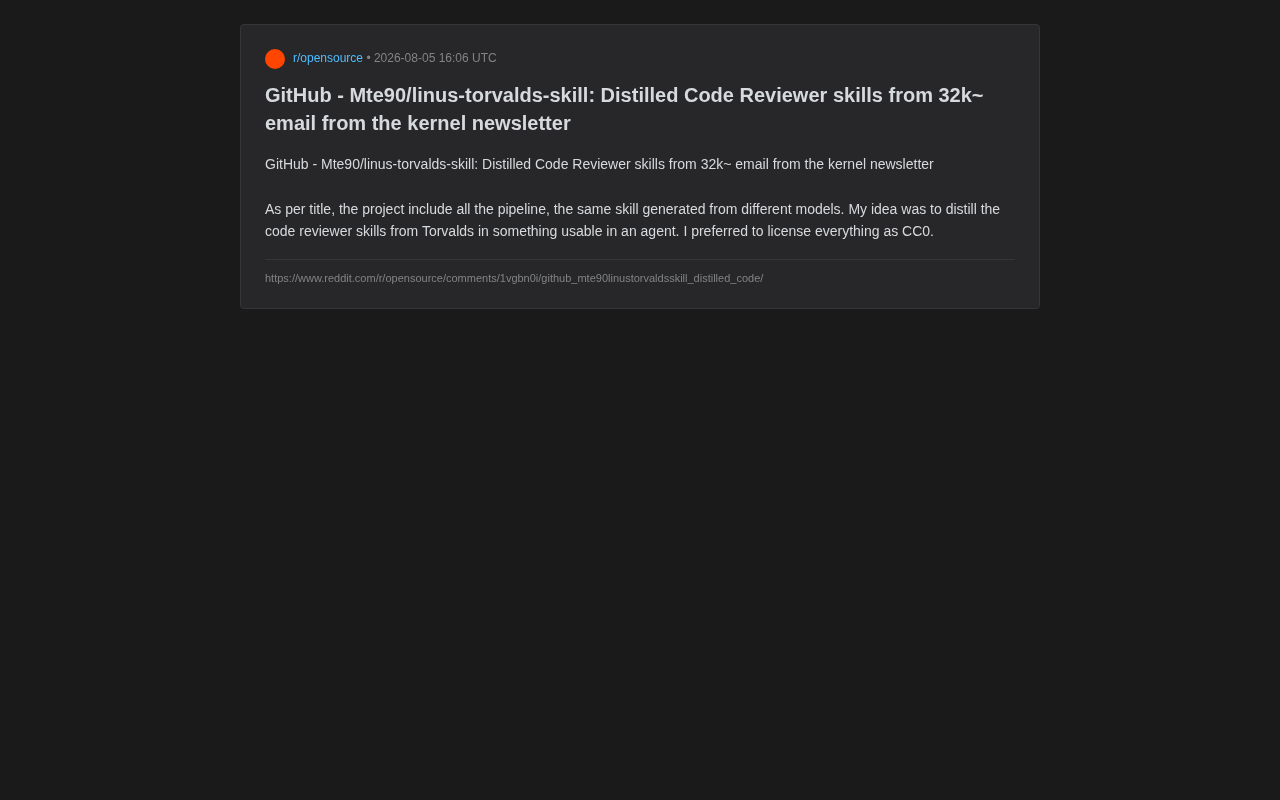
The author specifically notes that the project not only includes the final output but also fully opens the entire data processing pipeline, and uses different models to generate the same skill for comparison purposes. In data engineering and machine learning, a Pipeline refers to an automated sequence of data processing steps executed in order, typically including data collection, cleaning, tokenization, feature extraction, model inference, and post-processing. The core significance of opening the complete Pipeline lies in ensuring Reproducibility—other researchers can run the same workflow on the same inputs to get the same outputs, thereby verifying the reliability of conclusions or building improvements on top of them.
Even more commendable, the entire project uses the CC0 license (a complete waiver of copyright, releasing the work into the public domain), meaning anyone can freely use, modify, and distribute it. CC0 is a public domain dedication tool published by Creative Commons. Unlike common open-source licenses such as MIT or Apache, it is not a "license" but a "waiver"—the author voluntarily relinquishes all legally granted copyright and related rights. Users need not provide attribution, need not open-source derivative works, and can use it directly for commercial purposes. It represents the most permissive form of knowledge sharing currently available.
Why "Distill" an Expert's Code Review Ability?
Recovering Judgment Criteria from Data
Code review is one of the most experience-dependent aspects of software engineering. A seasoned reviewer can spot architectural risks, naming confusion, abstraction leaks, or potential concurrency issues at a glance—abilities that are difficult to fully convey through documentation or specifications. Torvalds's decades of accumulated email comments constitute a natural, high-quality "review decision dataset."
The project's approach is essentially a form of knowledge distillation: transforming unstructured natural language feedback (emails) into reusable judgment rules and style characteristics. Knowledge Distillation was originally proposed by Geoffrey Hinton and others in 2015, originally meaning the transfer of knowledge from a large, complex model (teacher model) to a smaller model (student model), using the teacher model's soft labels to guide the student model's training. The "distillation" in this project is a creative analogy—it treats human expert unstructured experience as the "teacher" and uses LLM comprehension and abstraction capabilities to convert tacit knowledge into explicit, executable rules and judgment criteria. Unlike traditional model distillation (large model teaching small model), it distills domain expert tacit experience, with the goal of enabling AI Agents to carry Torvalds-style rigorous standards and focal points when performing code reviews.
Skill Packaging for the Agent Era
Over the past two years, the concepts of AI Agents and "skills/tools" have rapidly gained traction. An AI Agent refers to an AI system with autonomous planning, decision-making, and execution capabilities that can automatically decompose tasks based on objectives and invoke various Tools or Skills to complete complex workflows. In current Agent frameworks (such as LangChain, AutoGPT, CrewAI, etc.), a Skill is typically defined as an encapsulated capability module that an Agent can decide when to invoke based on context. This modular design allows Agent capabilities to be continuously expanded by adding new Skills without retraining the underlying model.
Developers are no longer satisfied with having models generically "write code"—they want to endow them with role-specific professional capabilities. Packaging "Linus's code review" as a callable skill means that in scenarios like automated code review and PR review assistance, an Agent can evaluate code quality from a more "tasteful" and rigorous perspective, rather than merely checking for syntax errors.
Multi-Model Comparison: A Valuable Experimental Design
One highlight of this project is that the author used different models to generate the same type of skill from the same batch of emails. This design itself has research value:
- Consistency Verification: Do the "review principles" extracted by different models converge? If multiple models all emphasize certain common points (such as opposing over-abstraction and emphasizing simplicity), those points are more likely to be genuine cores of Torvalds's style. This is similar to the "triangulation" method in social science research—verifying the same conclusion through multiple independent means to enhance credibility.
- Capability Difference Comparison: The performance differences between models in understanding tone and extracting technical viewpoints can provide reference for choosing the underlying model. For example, some models may be better at capturing the logical structure of technical arguments, while others may be better at recovering emotional coloring and priority judgments in communications.
- Reproducibility: Opening the complete pipeline means any researcher can re-run the workflow, swap models or data, and verify results. This also allows the community to continuously refresh experimental results as new models are released, forming an evolving benchmark.
This approach of "open-sourcing the full workflow + multi-model cross-validation" elevates the project beyond mere novelty, giving it genuine methodological reference value.
CC0 License: Giving Knowledge Completely Back to the Community
The licensing choice deserves special emphasis. The author explicitly states a preference for "licensing all content under CC0." CC0 means waiving all copyright claims, placing the work directly in the public domain—users need not provide attribution or comply with any additional conditions.
This choice aligns deeply with the spirit of the Linux kernel and the open-source community. Since the source material comes from the public kernel mailing list, the author also chose to give back to the community in the most open way possible. Anyone can build upon, improve, or even commercialize it without legal burden. This is enormously convenient for teams looking to integrate such review skills into internal enterprise tools or commercial products. It's worth noting that CC0 differs fundamentally from GPL (the license used by the Linux kernel): GPL requires derivative works to also be open-sourced, while CC0 imposes no conditions whatsoever, representing a more thoroughgoing notion of "freedom."
A Sober Assessment: Can It Really "Replicate" Linus?
Style Is Easy to Learn, Judgment Is Hard to Acquire
Despite its creativity, we must rationally assess the boundaries of such projects. What models most easily capture from Torvalds's emails tends to be surface-level style—the blunt, sharp, sometimes emotional phrasing. What's truly scarce is the deep technical judgment behind it regarding operating system architecture, performance, and maintainability.
This touches on the classic distinction in cognitive science between "explicit knowledge" and "tacit knowledge." Explicit knowledge can be clearly articulated and transferred (e.g., "functions shouldn't exceed 100 lines"), while tacit knowledge is deeply embedded in a practitioner's intuition and experience (e.g., "this abstraction layer will become a bottleneck under high concurrency"). Torvalds's email text is explicit, but the architectural intuition driving that text is tacit. To what extent LLMs can infer the latter from the former remains an open question.
If the distilled skill merely learns to "nitpick in a harsh tone" without deep understanding of specific code context, it could actually produce misleading review comments. The real value lies in whether the Agent can point out the right problems in the right places, rather than merely mimicking tone.
Data Bias and Contextual Limitations
Kernel development is an extremely specialized domain—low-level C, performance-sensitive, with complex concurrency. Review criteria extracted from this context may not directly transfer to web development, business applications, or other scenarios. The Linux kernel's extreme requirements for deterministic behavior, memory safety, and microsecond-level performance have shaped a unique code aesthetic—for example, cautious use of macros, fine-grained lock considerations, and strict control of user-space/kernel-space boundaries. These concerns may have entirely different priorities in application-layer development. Users need to clearly recognize that this skill set carries strong "kernel DNA" and may require adaptation and adjustment for general-purpose code review.
Takeaways for Developers
Regardless of the final effectiveness, this project offers a forward-looking idea: systematically transforming a domain expert's historical behavioral data into AI-usable capabilities. This path can be generalized to countless scenarios—from outstanding architects' design reviews, to senior security experts' vulnerability assessments, to experienced product managers' requirement prioritization.
From a methodological perspective, this represents a new paradigm of "Expert Behavior Mining": rather than having experts manually write rules (time-consuming and incomplete), or having models learn from scratch (lacking domain depth), it automatically extracts patterns and principles from experts' historical behavioral traces. The prerequisite for this method is that experts need sufficiently large, accessible historical records with decision-making context—and the open-source community's public mailing lists, code review records, and Issue discussions provide exactly such a rich mine.
As the Agent ecosystem matures, "expert skill packaging" may become an emerging direction. With its open pipeline, multi-model experiments, and thorough CC0 licensing, linus-torvalds-skill provides a sample that can be studied and reproduced for this exploration. For developers interested in AI programming and automated code review, it's worth trying and worth deeply studying the data processing methods behind it.
Related articles

Safety Architecture for Medical AI: A Hybrid Design Combining Rule Engines and Machine Learning
Exploring hybrid architecture design combining rule engines and machine learning in medical AI, analyzing how deterministic rules, CSP, and scoring mechanisms ensure safety in exercise prescription systems.

Higgsfield's Million-Dollar AI Film Contest and Open-Source Workflow: A Deep Dive
Higgsfield launches a $1M AI film contest, partners with Pixar co-founder, open-sources studio workflows, and offers unlimited Seedance 2.5 access—a deep analysis of its creator ecosystem strategy.

Auto-Generating Paper Slides with Local LLMs: Balancing Efficiency and Privacy
Explore how local LLMs automatically convert academic papers into presentation slides, protecting unpublished research privacy while dramatically boosting efficiency for researchers.