Spring AI Alibaba Agent in Practice: Building Enterprise-Grade AI Agents Natively in Java

Build enterprise-grade AI agents natively in Java using Spring AI Alibaba Agent framework.
This article explores the Spring AI Alibaba Agent framework, which enables Java developers to build enterprise-grade AI agents within the familiar Spring Boot ecosystem without switching to Python. It covers the core architecture including Planners, Function Calling, RAG knowledge base integration, multi-agent collaboration, and critical production deployment considerations like rate limiting, session isolation, and security.
Why Should Java Developers Pay Attention to Spring AI Alibaba Agent?
In the AI agent development space, Python ecosystem frameworks like LangChain have long dominated. However, for the massive Java backend developer community, the cost of switching tech stacks has always been the primary barrier to implementing AI applications. The emergence of the Spring AI Alibaba Agent framework addresses exactly this pain point — enabling Java developers to natively build enterprise-grade AI agent applications within the familiar Spring Boot ecosystem.
An AI Agent is an AI system capable of autonomously perceiving its environment, formulating plans, executing actions, and adjusting strategies based on feedback. Unlike traditional single-turn Q&A-style LLM calls, Agents possess a closed-loop capability of "perceive-plan-act-reflect," enabling them to autonomously decompose complex tasks, invoke external tools, and manage multi-step execution workflows. Since 2023, as the reasoning capabilities of large models like GPT-4 have improved, Agent architecture has become the core paradigm for AI application deployment. The viral success of projects like AutoGPT and BabyAGI marks the acceleration of this trend.
Recently, a comprehensive hands-on tutorial series about Spring AI Alibaba Agent on Bilibili has attracted widespread attention. The tutorial covers the complete pipeline from zero to one, including framework principles, local setup, enterprise-grade development, and production deployment. This article will provide an in-depth analysis of the framework's technical value and practical key points based on the core content of that tutorial.
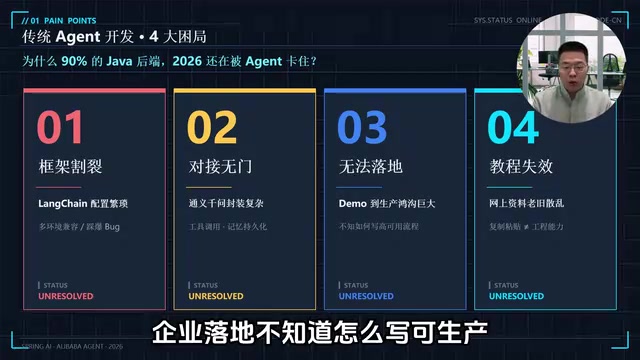
Common Pain Points for Java Tech Stacks in Agent Development
In practice, Java backend engineers typically encounter the following categories of problems when attempting Agent development:
Difficulty in Framework Selection
LangChain is currently the most popular LLM application development framework, released by Harrison Chase in late 2022. It provides core abstractions including Chains, Agents, Memory, and Retrieval-Augmented Generation (RAG). Its ecosystem includes LangSmith (monitoring and debugging), LangServe (deployment), LangGraph (multi-agent orchestration), and other toolchains. Python dominates the AI field due to its deep roots in data science and machine learning, as well as native support from core libraries like PyTorch and Transformers.
For Java developers, the choices are either being forced to learn the Python ecosystem or using community-ported versions that suffer from poor cross-environment compatibility, missing documentation, and frequent bugs. Integrating with domestic Chinese LLMs (such as Qwen) is particularly challenging when it comes to wrapping tool calls, memory persistence, and other components.
The Gap from Demo to Production
A vast number of online tutorials stop at the demo stage. When it comes to production-grade requirements like rate limiting, log monitoring, session isolation, and API security validation, there are virtually no complete reference solutions available. This leaves many teams stuck in the predicament of "the demo works, but production is full of pitfalls."
Insufficient Adaptation for Domestic Chinese LLMs
Foreign frameworks offer excellent support for OpenAI models, but adapting to domestic models like Qwen often requires extensive custom development. Details such as tool calling protocols, streaming output, and multi-turn conversation management all need additional handling. Qwen is Alibaba Cloud's large language model series, including Qwen-Turbo (high-speed, low-cost), Qwen-Plus (balanced performance), Qwen-Max (strongest reasoning capability), as well as specialized models like Qwen-VL (multimodal) and Qwen-Audio (speech understanding). For domestic Chinese enterprises, the core advantages of choosing Qwen include: data compliance (data stays within China), Chinese language optimization, lower API costs, and deep integration with the Alibaba Cloud ecosystem.
Core Architecture Analysis of Spring AI Alibaba Agent

Framework Positioning and Design Philosophy
Spring AI Alibaba Agent is not simply a thin wrapper on top of Spring AI — it features purpose-built architectural design at the foundational level. It deeply integrates with the entire Qwen model series and provides out-of-the-box core capabilities including Function Calling, Planner, Memory management, and multi-turn conversations.
Function Calling is the core mechanism for LLM interaction with external systems. Here's how it works: developers pre-define a set of functions with their names, parameter descriptions, and functional explanations, passing this metadata as part of the system prompt to the LLM. After understanding user intent, the model doesn't directly generate a text response — instead, it outputs a structured function call request (containing the function name and parameter values). The application layer receives this request, executes the actual function, and returns the result to the model for final response generation. OpenAI first introduced this capability in June 2023, and domestic models like Qwen subsequently followed suit. This mechanism evolved LLMs from "pure text generators" to "agents capable of operating on the external world."
The key differences from plain Spring AI include:
- Planner Mechanism: Supports task decomposition and multi-step execution, where the Agent can automatically break down sub-tasks based on user intent and complete them sequentially. The Planner is the core component in Agent architecture responsible for task decomposition and execution orchestration. When a user submits a complex request, the Planner decomposes it into multiple executable sub-tasks, determines execution order and dependencies, and evaluates results after each step to decide the next action. Common planning strategies include: ReAct (Reasoning + Acting, alternating between reasoning and action), Plan-and-Execute (formulate a complete plan first, then execute step by step), and Tree of Thoughts (tree-structured thought search). The Spring AI Alibaba Agent Planner supports dynamic path adjustment — re-planning subsequent steps based on intermediate results during execution — which is particularly important for handling business scenarios with high uncertainty.
- Tool Calling System: Natively supports custom tool function registration with seamless Spring Bean integration
- Memory Persistence: Supports persistent context storage to meet enterprise-grade multi-turn conversation scenarios
- Multi-Agent Collaboration: Supports task distribution and cooperation between multiple Agents
Unique Advantages of the Java Tech Stack
For Java teams, the biggest appeal of this solution is zero switching cost:
- Native Spring Boot Integration: Dependency management, configuration patterns, and Bean injection fully follow Spring conventions
- Natural Fit for Microservice Architecture: Lightweight design that seamlessly integrates into Spring Cloud and other microservice systems. In a microservice architecture, an Agent can exist as an independent service node, discoverable by other business services through service registration and discovery (e.g., Nacos). The tool functions called by the Agent can be remote interfaces distributed across different microservices, communicating via Feign or gRPC. The advantages of this architecture include: Agent services can scale independently (LLM calls are typically IO-intensive), tool function updates don't affect Agent core logic, and multiple business systems can share the same Agent service. Additionally, Spring Cloud infrastructure such as circuit breakers (Sentinel/Resilience4j), distributed tracing (SkyWalking), and configuration centers can be directly reused for Agent service governance.
- One-Step Qwen Integration: Simply configure the API key and start calling — no additional SDK wrapping needed
Key Points for Enterprise-Grade Agent Development
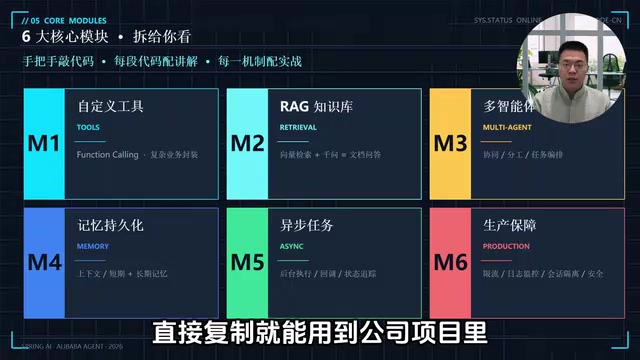
From Setup to Running Your First Agent Demo
The basic setup process is relatively straightforward: create a Spring Boot project, import Spring AI Alibaba dependencies, configure the Qwen API key, and you can quickly implement a basic conversational agent. For developers with Spring Boot experience, there's virtually no learning curve.
Deep Integration of Core Capabilities
The key to enterprise-grade Agent development lies in the coordinated interplay of the following modules:
Custom Tool Function Calling: Encapsulate business logic as tool functions that the Agent can automatically select and invoke based on user intent during conversations. Examples include querying order status, calling internal APIs, and executing database operations. In Spring AI Alibaba, tool function registration is deeply bound to Spring Bean lifecycle management — developers simply declare methods via annotations to expose them as Agent-callable tools, and the framework automatically extracts method signatures to generate function descriptions that meet LLM requirements.
RAG Knowledge Base Combined with Agent: Integrate Retrieval-Augmented Generation (RAG) with the Agent framework to enable intelligent Q&A based on enterprise private knowledge bases. The core RAG workflow includes: splitting enterprise documents into semantic chunks, converting them to vectors via Embedding models, and storing them in vector databases (such as Milvus or Elasticsearch). When a user asks a question, the question is first vectorized and the most relevant document fragments are retrieved from the vector store. The retrieved context is then sent to the LLM along with the user's question to generate an answer. In an Agent architecture, RAG is no longer a simple "retrieve-generate" pipeline — the Agent can proactively decide when to retrieve, what to retrieve, and how to leverage retrieved results for multi-step reasoning. Compared to fine-tuning, RAG's advantages include: no need to retrain the model, real-time knowledge updates, and traceable answer sources.
Multi-Agent Collaborative Architecture: In complex business scenarios, multiple specialized Agents each handle their own responsibilities — one for intent recognition, one for data querying, one for result synthesis — completing complex task chains through collaborative mechanisms. This architecture is similar to service orchestration in microservices, where each Agent focuses on its own capability domain and achieves cooperation through message passing and state sharing.
Context Persistence and Session Management: Essential problems to solve in production environments, including persistent storage of user sessions, multi-user session isolation, and context window management. Due to LLM context length limitations (Token window), as conversation turns increase, historical conversations need to be intelligently compressed or summarized to retain key information while controlling Token consumption.
Critical Considerations for Production Deployment
From demo to production, the following aspects often determine project success or failure:
- Rate Limiting and Degradation Strategies: LLM API calls have rate limits (Qwen's different versions have varying QPS limits), requiring proper rate limiting and circuit-breaking at the application layer. When model services are unavailable, the system should gracefully degrade to preset responses or human handoff rather than throwing errors directly.
- End-to-End Logging and Monitoring: Every decision step, tool call, and model response of the Agent needs a complete log chain for troubleshooting. This includes recording the input Prompt, output content, Token consumption, and response latency for each model call, as well as tool function call parameters and return results.
- Multi-User Session Isolation: In concurrent scenarios, ensure that different users' conversation contexts are completely isolated to prevent data cross-contamination
- API Security Protection: Agent interfaces exposed externally need proper authentication and input validation to prevent security risks like Prompt Injection. Prompt Injection is one of the primary security threats facing AI applications — attackers craft input text to attempt to override or bypass system-preset prompt instructions, causing the model to perform unintended operations. In Agent scenarios, Prompt Injection is even more dangerous because Agents have the ability to call external tools — attackers could potentially use injection to make Agents execute unauthorized database operations or API calls. Protective measures include: input filtering and sanitization, output validation, principle of least privilege, and using dedicated security detection models to pre-screen inputs.

Application Scenarios and Career Value for Java Developers
After mastering Spring AI Alibaba Agent, developers can independently build various enterprise-grade AI applications:
- Enterprise Customer Service Agent: Combining knowledge bases and tool calling to achieve automated customer service. The Agent can autonomously determine the type of user question and decide whether to retrieve answers from the knowledge base, query business system data, or transfer to human support.
- Document Retrieval Q&A Agent: RAG-based intelligent document assistant that precisely answers business questions
- Automated Data Processing Agent: Automatically executes data cleaning, analysis, report generation, and other tasks
- Multi-Tool Coordinated Complex Task Agent: Orchestrates multiple system interfaces to complete end-to-end business workflows
From a career development perspective, AI Agent development is becoming a rigid demand for enterprises. For Java backend developers, Spring AI Alibaba Agent provides a low-barrier transition path — no need to learn the Python ecosystem from scratch; you can enter the AI engineer track based on your existing tech stack.
Summary and Learning Recommendations
The core value of the Spring AI Alibaba Agent framework lies in lowering the integration barrier between the Java ecosystem and AI capabilities. It's not a silver bullet — it still depends on Qwen's performance at the model capability level, and complex Agent architecture design still requires developers to have a certain level of AI engineering understanding. However, for the large number of Java technology teams in China, this is indeed one of the most pragmatic enterprise-grade AI agent development solutions currently available.
Developers are advised to focus on understanding the underlying principles (how Planners, tool calling, and memory mechanisms work) rather than merely copying code. Only by truly understanding the Agent's decision logic — how the model determines whether to call a tool, how it selects the appropriate tool, and how it decides the next action based on tool return results — can you flexibly apply and optimize in real business scenarios. Additionally, it's recommended to pay attention to Agent Evaluation methodologies, establish quantitative metrics to measure Agent performance in specific business scenarios, and continuously iterate and optimize.
Key Takeaways
Related articles

EU AI Act Article 50 Takes Effect: Failing to Disclose AI Content Is Now Illegal
EU AI Act Article 50 takes effect August 2, 2025, mandating disclosure of AI-generated content. Analysis of core requirements, exemptions, and compliance risks facing PwC and other consulting giants over AI hallucinations.

Lost Gemini on Android Auto After Upgrading to Workspace? Causes and Fix Guide
Lost Gemini on Android Auto after upgrading to Google Workspace? Learn why the account type change disables in-car AI and follow this 3-step fix guide.

The AI Parenting Controversy: When Technology Begins to Replace Parent-Child Bonding
From a viral Reddit debate to AI parenting ethics: Is AI becoming the new electronic babysitter? Exploring the boundaries of generative AI in childcare and why parent-child bonding can't be outsourced.