EU AI Act Article 50 Takes Effect: Failing to Disclose AI Content Is Now Illegal

EU AI Act Article 50 now legally requires disclosure of AI-generated content targeting the public.
As of August 2, 2025, EU AI Act Article 50 mandates that AI-generated text on public interest matters must be disclosed. The provision targets undisclosed AI content while exempting law enforcement use and content with human editorial oversight. Major consulting firms like PwC and Deloitte face significant compliance risk after being exposed for publishing AI-hallucinated content, with penalties up to €15 million or 3% of global revenue.
EU AI Act Article 50 Officially Takes Effect
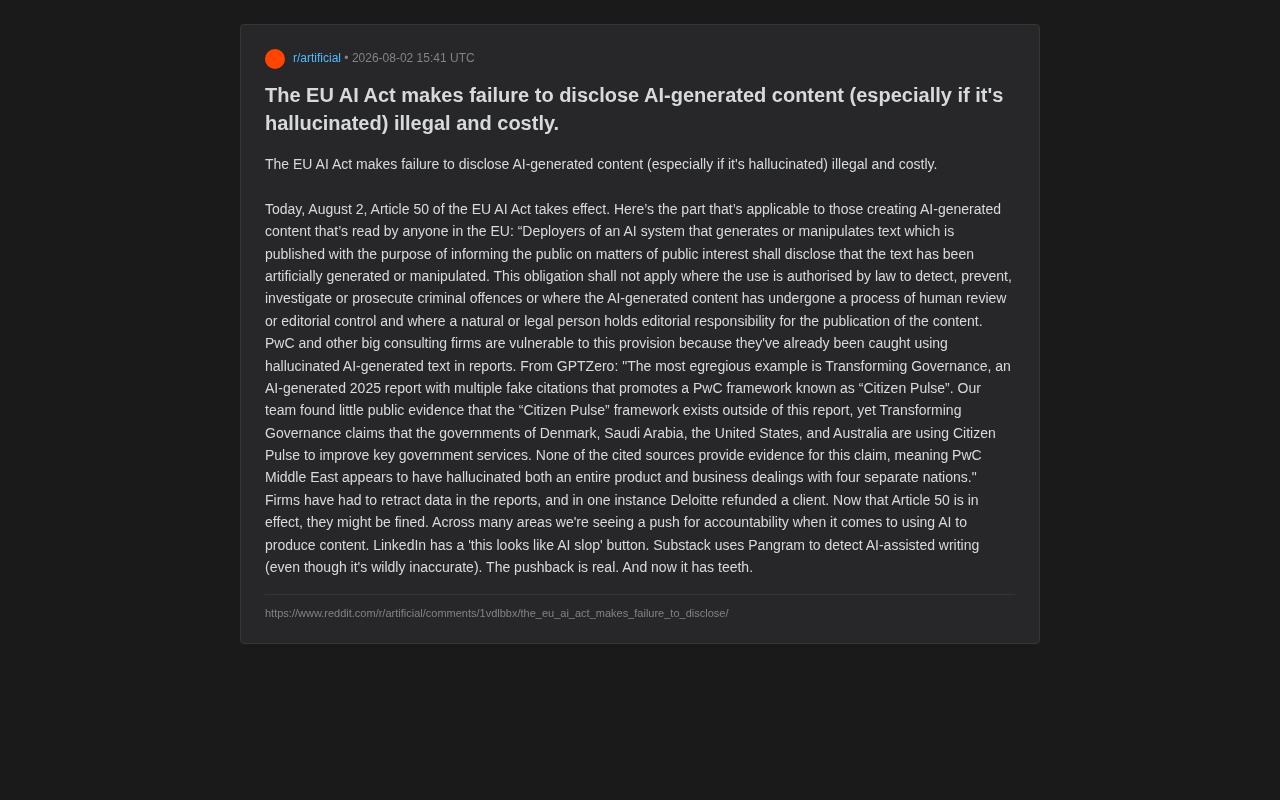
On August 2, 2025, Article 50 of the EU AI Act officially took effect, establishing a clear legal red line for transparency in AI-generated content. For anyone creating AI-generated content that is read by the public within the EU, this is no longer moral guidance—it is a legally binding obligation.
The EU AI Act is the world's first comprehensive legal framework regulating AI technology. It officially entered into force on August 1, 2024, but its various provisions are being implemented in phases. The Act adopts a risk-based tiered regulatory model, classifying AI systems into four levels—unacceptable risk, high risk, limited risk, and minimal risk—each corresponding to different compliance obligations. Article 50 falls under the transparency obligation for the "limited risk" category. Notably, the Act has extraterritorial reach: even if a company is not headquartered in the EU, it must comply with the relevant provisions as long as its AI system outputs target the EU market or affect EU citizens—a design philosophy consistent with the regulatory logic of the General Data Protection Regulation (GDPR).
The core provision explicitly states: Entities deploying AI systems used to generate or manipulate text that is published with the purpose of informing the public on matters of public interest must disclose that the text was artificially generated or manipulated. In other words, any AI-generated text aimed at the EU public and involving matters of public interest must be clearly labeled with its AI origin.
Two Important Exemptions
On a more granular note, the provision also establishes two categories of exemptions that make the regulation more practical:
- Law enforcement exemption: No disclosure is required when use is authorized by law for detecting, preventing, investigating, or prosecuting criminal offenses.
- Human review exemption: Disclosure is also exempted when AI-generated content has undergone human review or editorial control, and a natural or legal person assumes editorial responsibility for publication.
The second exemption is particularly critical—it essentially encourages organizations to establish robust human review chains. As long as there is a clear responsible party accountable for the content, AI-assisted creation remains viable. The "Human-in-the-Loop" (HITL) concept involved here is an important governance paradigm in AI system design, referring to retaining human review and intervention capabilities at critical decision or output stages of AI systems. In content production scenarios, HITL specifically manifests as human editors performing fact-checking, logic verification, and quality control on AI-generated drafts. This exemption elevates HITL from a technical best practice to a legal compliance requirement, constructing a clear chain of responsibility attribution that elegantly balances AI efficiency with accountability needs.
This also means the Act's real target is AI-generated content published directly to the public with no one accountable, especially content containing hallucinated information.
Consulting Giants First in Line Due to AI Hallucination Content
This new regulation sounds the alarm for a number of major consulting firms that have already been caught out by AI hallucination content. International consulting giants like PwC (PricewaterhouseCoopers) and Deloitte are squarely within this provision's risk exposure, as they have previously been exposed for using fabricated AI content in their reports.
To understand why the consulting industry has become a disaster zone, one must understand the deeper motivations behind their AI adoption. The global Big Four accounting firms—PwC, Deloitte, EY, and KPMG—have invested billions of dollars in AI in recent years. PwC announced a $1 billion investment in generative AI over three years, while Deloitte has deeply integrated AI into its audit, tax, and advisory services. The business logic is clear: the consulting industry's core products are knowledge reports and analytical documents, and large language models happen to excel at large-scale text generation. But this also brings systemic risk—the commercial value of consulting reports is built on professional authority, and once a report contains fabricated frameworks or false data from AI, the consequences of misleading client decisions can far exceed ordinary content errors.
"Citizen Pulse": A Framework Entirely Fabricated by AI
According to AI detection organization GPTZero, the most typical case involves an AI-generated report titled Transforming Governance. The report not only contained multiple false citations but also heavily promoted a PwC governance framework called "Citizen Pulse."
Here it's worth explaining the technical mechanism behind AI hallucinations: large language models are fundamentally next-token prediction systems based on probability, not knowledge retrieval systems. During training, models learn statistical patterns of language rather than accurate encodings of real-world facts. When models face domains insufficiently covered in their training data, or are asked to generate specific citations, data, and proper nouns, hallucination risk is particularly high—they will output content that factually doesn't exist with extremely high confidence, including fabricating academic papers, inventing product names, or concocting partnerships. Current mitigation approaches in the industry include Retrieval-Augmented Generation (RAG), fact-checking chains, and confidence calibration, but no solution can fundamentally eliminate the hallucination problem.
The GPTZero team's investigation found that, beyond the report itself, there was virtually no public evidence that the "Citizen Pulse" framework existed. Yet the report claimed that the governments of Denmark, Saudi Arabia, the United States, and Australia were using this framework to improve public services. None of the cited sources provided any corroboration for this claim.
In other words, PwC Middle East appears to have not only fabricated an entire product out of thin air but also invented business relationships with four sovereign nations. This is no simple typo—it's a systemic distortion produced by the combination of AI hallucinations and commercial promotion.
The Price Already Paid
In fact, even before Article 50 officially took effect, these consulting firms had already paid a price for AI hallucinations. Multiple firms were forced to retract erroneous data from reports, and Deloitte even refunded a client in one case. Now, with the provision officially in force, such behavior will no longer merely result in reputational damage and refunds—they may face substantial fines. Under the AI Act's penalty framework, companies violating transparency obligations may face fines of up to €15 million or 3% of global annual revenue (whichever is higher)—a penalty level that even the Big Four, with annual revenues in the tens of billions of dollars, cannot ignore.
An Industry-Wide Wave of AI Content Accountability
The EU's legislation is just one facet of this global accountability wave. Across multiple domains, society's growing vigilance and constraints on "producing content with AI" are becoming increasingly apparent.
Content Platforms' Self-Defense Mechanisms
Taking social and content platforms as examples:
- LinkedIn launched a "This looks like AI slop" report button, allowing users to proactively flag suspected low-quality AI-generated content.
- Substack adopted the Pangram tool to detect AI-assisted writing—though industry insiders have frankly noted that the accuracy of such detection tools is "extremely unstable."
Regarding the current state of AI detection technology, it's important to understand how it works and its limitations. Detection tools represented by GPTZero base their core detection principles on two linguistic metrics: perplexity and burstiness. Perplexity measures how predictable text is to a language model—AI-generated text typically has lower perplexity because it is itself the product of probability optimization; burstiness measures the variation in sentence length and complexity—human writing tends to exhibit greater fluctuation. However, these detection technologies face fundamental limitations: as model capabilities improve and prompt engineering becomes widespread, the statistical differences between AI-generated text and human writing continue to narrow, and detection accuracy drops significantly after humans edit AI text.
Hidden here is a paradox worth reflecting on: Society craves identification and accountability for AI content, but existing detection technology is far from mature. The false positive rate of AI detectors has been a focal point of debate in both academia and industry—cases of mistakenly flagging original human content as AI-generated are not uncommon. How to strike a balance between "transparent accountability" and "avoiding false accusations" will be a key challenge in regulatory implementation going forward.
The Technical Frontier of AI Content Labeling
Beyond text annotation as a form of explicit disclosure, the tech community is exploring deeper AI content identification solutions. Digital watermarking technology can embed statistical signals in AI-generated text that are invisible to the human eye but detectable by machines—for example, Google DeepMind's SynthID technology plants watermarks by fine-tuning token selection probabilities. C2PA (Coalition for Content Provenance and Authenticity) is promoting a content provenance standard based on cryptographic signatures, attaching tamper-proof origin metadata to digital content. These technical solutions complement legal requirements—the law stipulates the obligation to "must disclose," while technology provides implementation paths for "how to disclose" and "how to verify." In the future, the maturity of watermarking technology and metadata standards will largely determine whether Article 50 can be efficiently enforced.
From Moral Guidance to Legal Mandate: A New Era of AI Content Regulation
Over the past few years, discussions about AI-generated content transparency have largely remained at the level of industry self-regulation and ethical advocacy. The enactment of Article 50 of the EU AI Act marks the first time these discussions have truly "grown teeth."
For content creators, businesses, and organizations, this brings several direct implications:
- Rising compliance costs: AI-generated content targeting EU audiences must establish disclosure mechanisms or a traceable human review responsibility chain. Companies need to invest resources in building internal review processes, training editorial teams, and deploying content provenance tools—all of which represent real operational costs.
- AI hallucination risk becomes legally actionable: AI hallucinations are no longer merely technical defects but may evolve into legal liabilities, especially in reports involving matters of public interest. This means that when companies use AI to generate public-facing content, they must incorporate fact-checking into their standard workflows rather than merely relying on model outputs that "look reasonable."
- Human review value highlighted: The Act's exemption provisions effectively reinforce the importance of "human-in-the-loop," making human editorial responsibility the core of compliance. As AI tools increasingly replace repetitive writing tasks, the role of human editors is transforming from "content producers" to "quality gatekeepers" and "responsibility bearers"—a functional upgrade rather than obsolescence.
Conclusion
The enactment of EU AI Act Article 50 is an important milestone in global AI governance's transition from "advocacy" to "enforcement." It sends a clear signal: in an era of AI content proliferation, transparency and accountability are no longer optional.
For consulting firms, media organizations, and even individual creators who heavily rely on content production, how to embrace AI efficiency while maintaining the baseline of accuracy and transparency will be the key to thriving in the new regulatory environment. The PwC "Citizen Pulse" incident also serves as a warning to everyone: AI can accelerate content production, but the "facts" it fabricates must ultimately still be borne by humans.
Related articles

Workbuddy for Absolute Beginners: How a Desktop AI Agent Fits Into Real Workflows
A beginner's guide to the Workbuddy desktop AI agent: installation, claiming credits, file management, and building automated workflows—compared with CodeX for fit and cost, helping professionals shift from AI question-askers to AI managers.

OpenAI's New Agent Stack: Computer Use, Decisions API, and Ultra-Fast Workflows
OpenAI Dev Day unveiled a new agent stack: Computer Use outperforms humans, Decisions API delivers ultra-low-latency classification via Luna, Agents API opens the same Computer Use capabilities, and GPT-6.1 Sol costs only one-seventh of Astra. Core updates, benchmark data, and developer insights.

Liang Wenfeng Open-Sources DeepInfo Inference Framework, Takes On U.S. Ban
DeepSeek open-sources its DeepInfo inference framework after its models, featuring GPU/CPU cross-pipelining, small-model prediction with large-model verification, and full Huawei Ascend and NVIDIA chip support—facing the U.S. federal ban head-on. This article analyzes its significance for AI deployment and open-source strategy.