sqzd: An Open-Source Tool for Extracting Video Highlights Using Gemini Video Understanding

sqzd uses Gemini's video understanding to auto-extract highlight clips from long videos.
sqzd is an open-source tool by developer icnahom that leverages Google Gemini's multimodal video understanding capabilities to automatically extract high-value playable clips from long videos. Unlike traditional text-based summaries, it preserves video's native format while dramatically reducing consumption time. The project reflects a growing trend of developers building vertical AI applications on top of mature LLM APIs.
An Open-Source Attempt to Solve Information Overload
In an era of exploding video content, quickly finding truly valuable segments within a long video has always been a pain point. Traditional approaches either involve reading text summaries or manually scrubbing through the timeline repeatedly—the former loses the visual immediacy of video, while the latter consumes enormous amounts of time.
Recently, a developer (GitHub user icnahom) shared their open-source project sqzd on Reddit. It leverages Google's Gemini Video Understanding capabilities to automatically extract "high impact playable reels" from long videos. Users no longer need to read dry text summaries or manually scan timelines—the tool directly presents the most essential short video clips.
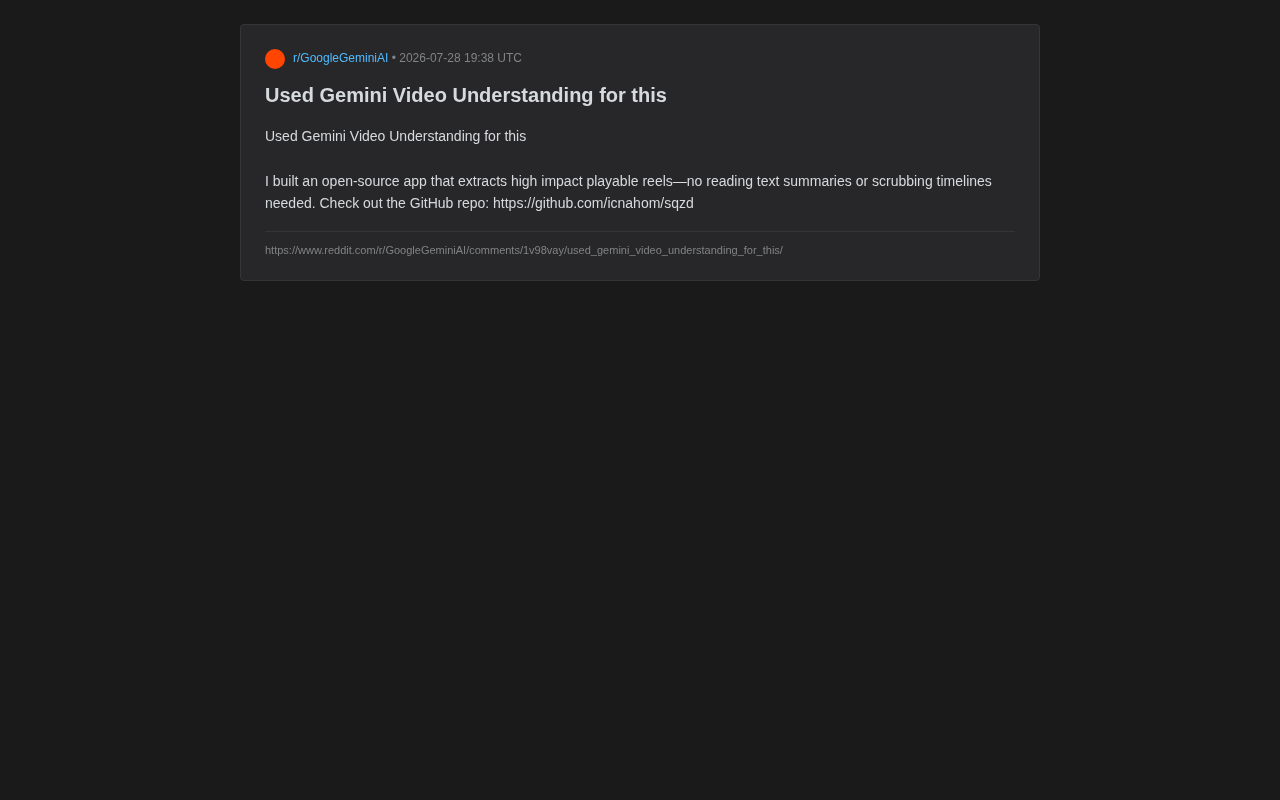
The core innovation of this approach is that it preserves video as the native medium for information delivery, rather than reducing video to text. For tutorials, talks, and livestream replays, visual and auditory information is often equally important—something pure text summaries simply cannot convey.
How Gemini Video Understanding Drives Content Filtering
From Multimodal Understanding to Intelligent Clip Extraction
The key reason sqzd can automatically extract high-value segments lies in Gemini's native multimodal video understanding capabilities. Unlike traditional pipelines that first convert video to audio, then to text, and finally perform NLP analysis, Gemini can directly "see" and understand video content—including on-screen actions, scene changes, speech content, and even emotional dynamics.
Traditional video content analysis typically follows a sequential pipeline: first, ASR (Automatic Speech Recognition) converts audio to text, then NLP processing is applied to the text (keyword extraction, topic segmentation, sentiment analysis), and finally the corresponding video time segments are reverse-mapped based on text analysis results. The fundamental problem with this approach is that information is lost at every conversion step—visual demonstrations on screen, the speaker's body language, charts on slides, audience reactions, and other non-verbal information are completely ignored. Additionally, errors in the sequential pipeline accumulate at each stage—ASR recognition errors directly impact the accuracy of all subsequent steps.
Gemini employs an end-to-end multimodal Transformer architecture that simultaneously processes video frame sequences, audio waveforms, and text information. This architecture enables the model to understand cross-modal semantic correlations—for example, when a speaker raises their voice while the screen switches to an important chart, the model can synthesize these two signals to identify a content climax. Gemini 1.5 Pro supports video input up to one hour long, and its long context window (supporting up to 1 million tokens) makes processing complete long videos possible without needing to split them into short segments for separate processing.
This means the model can holistically judge which segments are "high value": it might be the articulation of a key argument, a brilliant demonstration, or a climactic moment in content pacing. Such judgment relies on understanding the overall semantics of the video, rather than simple keyword matching.
Significantly Reducing the Time Cost of Consuming Long Videos
For everyday users, the practical significance of such tools is a dramatic reduction in the time cost of consuming long videos. A two-hour meeting recording or livestream replay might be compressed into a few key clips of several dozen seconds each after processing by sqzd. Users can grasp the core content in a very short time while retaining the option to decide whether they need to watch the full video.
Advantages and Limitations of the Open-Source Tool sqzd
Reusability and Customizability Through Open Source
sqzd is released as open source (project URL: github.com/icnahom/sqzd), which distinguishes it from many closed-source video summary SaaS products. Developers can freely examine implementation details, modify logic, and integrate it into their own workflows. For content creators, educators, or teams that need to process videos in bulk, a self-hostable, customizable tool is often more attractive than a black-box commercial service.
This also reflects a current trend in AI application development: more and more developers are choosing to rapidly build vertical-scenario applications on top of mature LLM APIs. Gemini provides the underlying video understanding capability, and developers only need to focus on product logic and interaction experience to create practically useful tools in a short time. sqzd's development model represents a typical paradigm in the current AI application ecosystem: developers no longer need to train large models themselves, but instead call mature LLM APIs to obtain underlying AI capabilities, concentrating their efforts on product design and user experience. This model dramatically lowers the barrier to AI application development—an independent developer doesn't need GPU clusters or massive training datasets to build products with advanced AI capabilities. However, this also introduces dependency risks on API providers, including price changes, terms of service modifications, API capability adjustments, and other uncontrollable factors.
Limitations to Consider Rationally
Of course, as a personal open-source project, sqzd is still in its early stages. It depends on the Gemini API, meaning users need to configure their own API keys and bear the associated calling costs. Additionally, the criteria for judging "high-value segments" is essentially the model's subjective understanding—for highly specialized or context-heavy videos, extraction results may deviate from user expectations.
Furthermore, privacy and copyright issues that universally affect video understanding applications deserve attention—when uploading video content to a third-party model for processing, users should be mindful of content sensitivity.
AI Is Reshaping How We Consume Video
Tools like sqzd may be small, but they reflect a change that's already underway: AI is transforming how we consume video information. From "passively playing along a timeline" to "actively obtaining essential clips," video is no longer linear content that must be watched from beginning to end.
As multimodal models like Gemini and GPT-4o continue to strengthen their video understanding capabilities, we can expect more similar vertical applications to emerge—whether for automated editing, content retrieval, or intelligent recommendations. The competitive landscape in video understanding is evolving rapidly: beyond Google Gemini, OpenAI's GPT-4o also possesses video understanding capabilities, able to directly analyze video frames combined with audio for reasoning; Meta's ImageBind explores a unified embedding space across six modalities; in the open-source domain, projects like Video-LLaMA and VideoChat are advancing the democratization of video understanding. The differences in core capabilities among these models manifest in maximum supported video length, temporal localization precision (whether it can be accurate to the second), fine-grained action recognition ability, and inference cost. For applications like sqzd, temporal localization precision is particularly critical, as it needs to accurately annotate the start and end timestamps of high-value segments.
For developers, this represents an opportunity window worth watching: the underlying capabilities are already in place—what remains is finding scenarios that truly solve user pain points.
Key Takeaways
Related articles

MiniMax H3 Open-Source Video Model AMA Deep Dive: Architecture, Capabilities, and Future Roadmap
MiniMax H3 team hosts Reddit AMA detailing their open-source video generation model's architecture, image-to-video capabilities, inference optimization, and future roadmap.

GPT-5.6 Sol Continues Optimization, Luna Opens to Free Users: Decoding the Model Tiering Strategy
OpenAI releases dual GPT-5.6 updates: Sol continues optimizing reasoning capabilities while Luna opens to free users. Analysis of the model tiering strategy and its industry implications.

ComfyUI Integration with MiniMax H3: Complete Video Generation Workflow Deployment and Optimization Guide
Complete guide to deploying MiniMax H3 video generation in ComfyUI, covering text-to-video, image-to-video, first/last frame animation, environment setup, VRAM optimization, and prompt techniques.