0.5B Small Model Rivals 2B Models with Only 60B Tokens: Data Efficiency Becomes the New Battleground
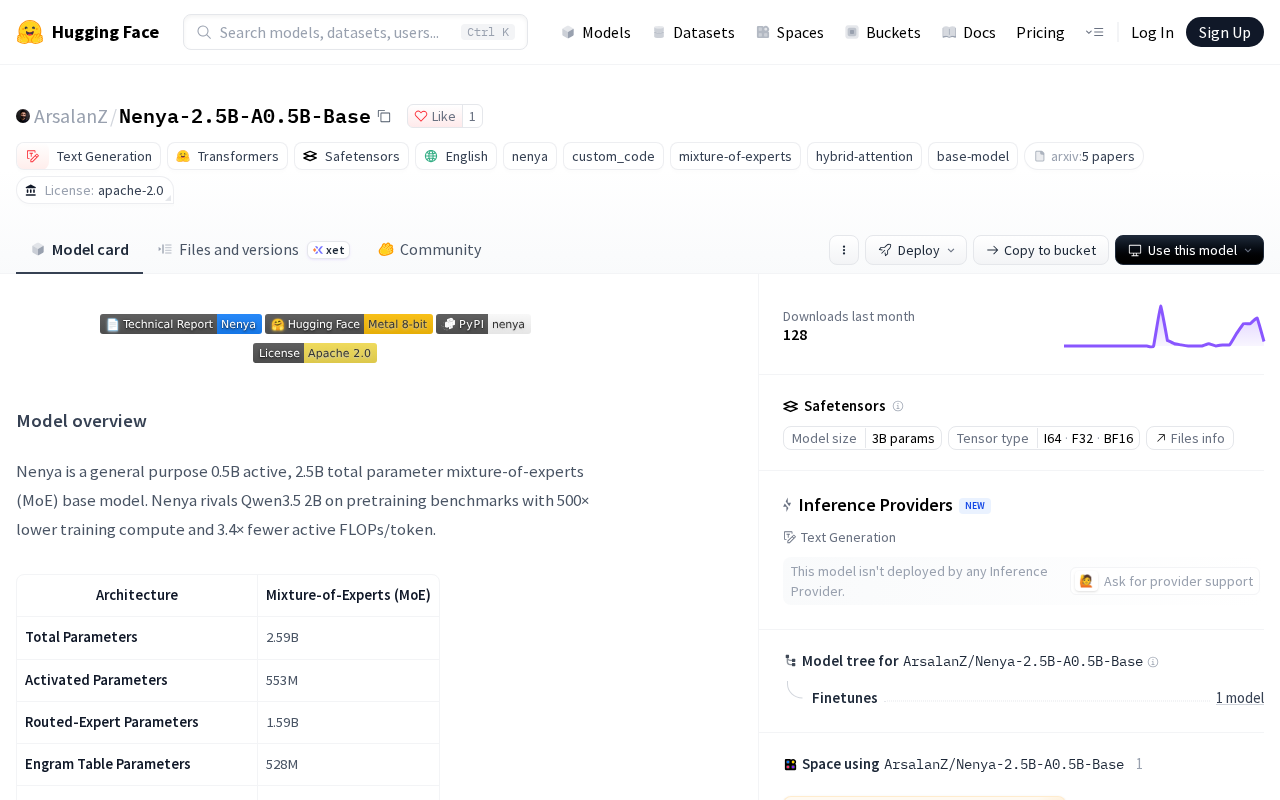
Community leak claims a 0.5B model rivals 2B-class models with only 60B tokens, making data efficiency a new battleground.
A Hacker News post claims a 0.5B-parameter model trained on just 60B tokens performs comparably to Qwen3.5-2B (30T+ tokens), spotlighting data efficiency. The article notes the claim lacks evaluation details and reproducibility, but reflects the industry's shift from stacking parameters and data toward reassessing ROI. Smaller models gain appeal for edge deployment and fine-tuning, though benchmark scope and generalizability need caution.
Small Models Strike Back: Parameter Count Is No Longer the Only Yardstick
A striking discussion has emerged on Hacker News: a foundation model with only 0.5B parameters, trained on just 60B tokens of data, is said to be comparable to Qwen3.5-2B—which reportedly used over 30T tokens of training data. The stark contrast between these two figures gives "data efficiency," a topic previously confined to academia, a sudden sense of engineering reality.
First, it's important to clarify: this information comes from a community post with only 4 points and 1 comment. It's an early leak with no accompanying evaluation report, benchmark table, or training recipe. The more reasonable attitude is to treat it as a directional signal worth watching rather than a rigorously validated conclusion. But even as a signal, the question it points to is important enough—with both compute and data becoming increasingly expensive, the input-output ratio of model scale versus data scale is being recalculated.
What the Contrast Behind the Numbers Means
Looking at the two configurations side by side, the most immediate shock is the difference in data magnitude. The 2B model corresponds to 30T+ tokens, meaning each parameter was "fed" tens of thousands of tokens; the 0.5B model used only 60B tokens, a much lower data-to-parameter ratio. If the former's performance can truly be approached by the latter, at least one of two things must be true: either improvements in model architecture and training strategy have unlocked additional efficiency, or the marginal returns of massive data have already entered a plateau.
This also explains why such posts easily spark discussion in technical communities. Over the past few years, the industry's main theme has been "bigger scale, more data," with Scaling Laws repeatedly cited. But when a model with only a quarter of the parameters and orders of magnitude less data is used as a benchmark, people naturally ask: are we trading massive amounts of redundant data for gains that could be achieved through smarter training methods?
Scaling Law is the key background for understanding this discussion. A 2020 paper from OpenAI proposed that model performance exhibits a power-law relationship with parameter count, data volume, and compute—the more you invest, the lower the loss, with the downward trend remaining smooth across multiple orders of magnitude. This directly spawned the industry habit of "stack parameters, stack data." But subsequent research (such as DeepMind's Chinchilla) revised this understanding: given a fixed compute budget, parameter count and training token count should grow roughly proportionally; too many parameters with insufficient data actually wastes compute. Chinchilla's empirical ratio of "about 20 tokens/parameter" contrasts sharply with the 2B model's 30T+ tokens (about 15,000 tokens/parameter) mentioned here, indicating that actual training data investment far exceeds the theoretical optimum—which is precisely the starting point for the "data efficiency" discussion.
Data/parameter ratio (tokens per parameter) is a commonly used metric for measuring training configurations. A ratio that's too low means parameters are "undernourished," prone to underfitting; a ratio that's too high may mean data is being reused or model capacity is insufficient, with diminishing marginal returns. The 0.5B model using 60B tokens gives a ratio of about 120, while the 2B model using 30T+ tokens gives a ratio as high as 15,000. The difference is not just one of magnitude but represents two entirely different training philosophies: the former pursues "less but better," the latter relies on "massive coverage." Understanding this ratio is essential to judging where exactly the so-called "data efficiency" improvement occurs.
Data Efficiency Is Becoming a New Competitive Dimension
From an engineering perspective, improving data efficiency has more practical value than increasing parameter scale. Training data isn't free: cleaning, deduplication, mixing ratios, and copyright compliance all cost money, and high-quality corpora are even scarcer. If a 0.5B model can achieve usable foundational capabilities within 60B tokens, its appeal for edge deployment, vertical domain fine-tuning, and rapid iteration experiments would rise significantly—precisely the scenarios most sensitive to cost and response speed.
But over-extrapolation should be avoided. Foundation model capabilities are multi-dimensional: common-sense Q&A, code, mathematical reasoning, and long-context understanding each have different difficulty curves. The word "rivals" in community contexts usually means closeness on one or a few benchmarks, not comprehensive parity. Without public evaluation details, understanding it as "narrowing the gap on some tasks" is safer than "smaller is better."
Edge deployment refers to running models directly on terminals such as phones, laptops, and embedded devices rather than relying on cloud APIs. Such scenarios are extremely sensitive to parameter count: a 0.5B-level model, after quantization (e.g., INT8, INT4), can be compressed to a few hundred MB, enabling local inference with advantages including low latency, privacy protection, and offline availability. In contrast, a 2B model even after quantization typically requires larger memory and compute budgets. Therefore, "whether small models can achieve usable capabilities" directly determines the feasibility boundary of edge AI—one of the reasons data efficiency discussions receive particular engineering attention.
Three Points of Caution to Maintain
First, the evaluation criteria are unclear. The specific benchmarks, prompt settings, and whether instruction fine-tuning was applied when comparing to Qwen3.5-2B are all unspecified in the material, directly affecting the reliability of the conclusion. Second, reproducibility is questionable. The training recipe, data sources, and architecture details for the 60B tokens are not publicly discussed, and a single community leak is difficult to independently verify. Third, small models' "comparability" often holds on specific tasks; when generalized to open-ended dialogue and complex reasoning, gaps may reopen.
Practical Implications for Developers
For small and medium-sized teams currently selecting models, the practical significance of such signals isn't to switch models immediately but to adjust evaluation habits: don't just look at parameter count and leaderboard rankings—include "the data and compute required to achieve target performance" as a comparison dimension. At equivalent capability, solutions with lower training and inference costs have lighter long-term maintenance burdens.
At the same time, this reminds teams working on data and training strategies that data quality and mixing-ratio optimization may yield better returns than simply piling on volume. Before community discussions settle into papers or technical reports, staying attentive and citing cautiously is the most appropriate position when facing such early-stage information.
One-line Summary
Community leak claims a 0.5B model rivals 2B-class models with just 60B tokens, with data efficiency potentially becoming a new competitive dimension.
Paragraph Summary
An early Hacker News discussion claims that a 0.5B-parameter foundation model trained on only 60B tokens can match Qwen3.5-2B, which used 30T+ tokens, sparking interest in "data efficiency." The article notes that while this signal lacks evaluation details and reproducible recipes, it reflects the industry's shift from simply stacking parameters and data toward reassessing input-output ratios. Rising costs of data cleaning and high-quality corpora make small models more attractive for edge deployment, vertical fine-tuning, and rapid experimentation. The author also cautions that foundation model capabilities are multi-dimensional, "rivalry" is usually limited to certain benchmarks, and evaluation criteria, reproducibility, and generalizability all warrant scrutiny. For developers, model selection should include the data and compute required to achieve target performance in comparisons.
Related articles

Snapchat Opens AI Assistant Lens Building: Supports Claude Code and Cursor
Snapchat lets Lens creators describe AR filters in natural language, with AI assistants like Claude Code and Cursor handling the full build process, greatly lowering the AR creation barrier.

Is the Planck Length the Smallest Distance? Why Physicists Are Skeptical
The Planck length is often called the smallest distance in the universe, but science videos point out this claim has never been experimentally confirmed. This article explains the origins of the Planck length, the obstacles of microscope thought experiments, and what it really tells us—the scale at which quantum gravity becomes unavoidable, not spacetime pixels.

AI Agents Drive Spend Management: Payhawk Raises $280M
Payhawk raises $280M at a $2B valuation. The 2018-founded enterprise finance platform uses AI agents to track and manage expenses and procurement. This article analyzes its product evolution, valuation signals, and impact on the spend management space.