Is the Planck Length the Smallest Distance? Why Physicists Are Skeptical
The Planck length is the characteristic scale of quantum gravity, not a proven minimum distance.
The article clarifies the common popular-science misreading that "the Planck length is the smallest possible distance in the universe." The Planck length, about 1.6×10⁻³⁵ meters, is assembled from the speed of light, the reduced Planck constant, and the gravitational constant, marking the characteristic scale at which quantum mechanics and gravity both operate. However, no experiment has found a hard lower limit on distance, and no one has ever observed "pixels" of spacetime. Attempting to probe this scale with higher resolution would require extremely high energy that could form a mini black hole, hiding itself behind a microscopic horizon—a fundamental obstacle, not an engineering difficulty. The author emphasizes that the Planck length only indicates that quantum gravity becomes unavoidable at this scale; it does not prove spacetime discreteness. Equating it with "the smallest distance" is an overextension lacking evidence.
The Planck length is often popularized as "the smallest possible distance in the universe," but this claim has never been confirmed by any experiment. A recent science video re-examines the concept, pointing out that it is more of a theoretical "warning sign" than a pixel grid of spacetime.
Where Does the Planck Length Come From?
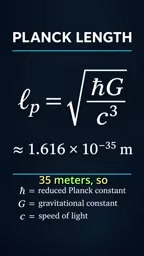
The Planck length is about 1.6×10⁻³⁵ meters. How small is that? The video offers an intuitive analogy: a Planck length relative to an atom is roughly equivalent to an atom relative to the entire solar system.
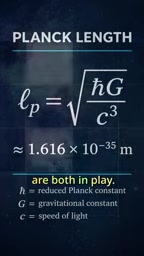
It isn't arbitrarily defined; it is assembled from the speed of light, the reduced Planck constant, and Newton's gravitational constant. Because these three constants appear together, the Planck length naturally becomes the characteristic scale at which quantum mechanics and gravity both come into play. In other words, as soon as you want to discuss quantum effects and gravity simultaneously, this length emerges on its own.
The reduced Planck constant is the Planck constant divided by 2π, denoted ħ, approximately 1.055×10⁻³⁴ joule-seconds. It is more commonly used in quantum mechanics than the Planck constant h, because angular frequency relates to energy as E=ħω, avoiding the repeated appearance of the 2π factor in formulas. The Planck length is precisely formed by combining ħ, the speed of light c, and the gravitational constant G through dimensional analysis, i.e., √(ħG/c³). These three constants respectively mark the core scales of quantum effects, relativistic effects, and gravitational effects, and their combination naturally yields the characteristic length at which all three become simultaneously non-negligible.
The "Smallest Distance" Claim Lacks Experimental Evidence
The problem is that no one has ever seen a "pixel" of spacetime. The video explicitly states: no experiment has found a hard lower limit on distance.
Space in our everyday experience is continuous, and energy in quantum mechanics is also continuous (at least no known lower limit exists), while the assumption of the Planck length as the "smallest distance" remains at the level of theoretical conjecture. Treating the Planck length as evidence of spacetime discreteness confuses two concepts: "theoretical characteristic scale" and "physical minimum unit."
Want to See Smaller? The Microscope Logic Hits a Wall
A natural idea is: couldn't we just build a better microscope to resolve smaller distances? The video points out that this path runs into trouble.
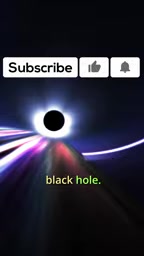
Resolving smaller distances requires shorter wavelengths, which means higher energies. Pushing this logic to the Planck scale, some thought experiments suggest that you might need to concentrate enough energy into a sufficiently small region that gravity would hide itself behind a microscopic horizon—that is, a mini black hole.
This does not mean nature actually works this way. The video carefully emphasizes: we don't know whether nature behaves like this. But this thought experiment at least shows that probing the Planck scale with the naive approach of "increasing resolution" may encounter fundamental physical obstacles, not merely engineering difficulties.
The microscopic horizon (the horizon of a mini black hole) is key to understanding this thought experiment. A black hole horizon is the boundary beyond which light cannot escape, and its radius is proportional to mass (the Schwarzschild radius). If extremely high energy is concentrated into a tiny region, the mass equivalent of that region becomes enormous, and its Schwarzschild radius may exceed the size of the region itself, thus forming a mini black hole. At that point, any signal (photon) attempting to probe smaller distances would fall inside the horizon and be unable to return to the detector, so resolution is physically blocked. This argument is not a rigorous proof but an illustrative thought experiment, used to show that the naive path of increasing resolution may encounter fundamental obstacles.
What Does the Planck Length Really Tell Us?
So what is the significance of the Planck length? The video's conclusion is: it tells us the scale at which quantum gravity becomes unavoidable, but it does not tell us that spacetime is discrete.
This is a subtle but important distinction. The Planck length is a "warning sign" indicating that existing theories need to be superseded by quantum gravity near that scale; it is not a measured lower limit of a physical constant. Misreading "the scale at which theory breaks down" as "a minimum distance exists" is a common overextension in science communication.
Quantum gravity refers to the theoretical framework that unifies quantum mechanics and general relativity; no complete version has yet been experimentally confirmed. Near the Planck scale, quantum effects of gravity are expected to become as important as other interactions, and existing theories (general relativity and the Standard Model) break down there. The Planck length is therefore often regarded as the energy scale at which quantum gravity effects "must inevitably appear," rather than direct evidence of spacetime discreteness. Candidate theories including loop quantum gravity and string theory make different predictions for Planck-scale physics, but all lack experimental testing—which is why physics at this scale remains an open problem to this day.
Reflections on the "Smallest Distance" Narrative
The value of this content lies in its dismantling of a widely circulated popular-science simplification. Many popular science materials equate the Planck length directly with "the smallest tick mark of space," but the original video explicitly states: no one has demonstrated this, and no experiment supports a hard lower limit on distance.
From a science communication perspective, such simplifications, while easy to understand, can easily lead the public to mistakenly believe that spacetime discreteness is an established fact. A more accurate statement is: the Planck length is the scale at which quantum gravity effects must appear; whether spacetime is actually discrete at that scale remains an open question.
The video does not offer any alternative theory or new experimental proposal; it merely performs a conceptual clarification. For readers concerned with the foundations of quantum gravity, this clarification is more valuable than a neat "smallest distance" conclusion—it reminds us that many seemingly certain "smallest/largest" propositions in physics are often just aliases for theoretical boundaries, not direct readings of nature.
Related articles

Snapchat Opens AI Assistant Lens Building: Supports Claude Code and Cursor
Snapchat lets Lens creators describe AR filters in natural language, with AI assistants like Claude Code and Cursor handling the full build process, greatly lowering the AR creation barrier.

AI Agents Drive Spend Management: Payhawk Raises $280M
Payhawk raises $280M at a $2B valuation. The 2018-founded enterprise finance platform uses AI agents to track and manage expenses and procurement. This article analyzes its product evolution, valuation signals, and impact on the spend management space.

Lenovo Legion Go Beam Leak: Could Be the Most Affordable Handheld
Lenovo Legion Go Beam handheld leaks, possibly positioned more affordably. This article analyzes Lenovo's current handheld pricing, the potential positioning of the Legion Go Beam, and why cheap handhelds are a key market gap.