1.2 Million People's Data Breached: Why Third-Party Vendors Have Become Security Black Holes

A third-party vendor breach at Heights Finance exposes 1.2M records, highlighting systemic supply chain data risks.
Heights Finance's breach of 1.2 million people's data through a third-party vendor illustrates a systemic security pattern: raw sensitive data flowing through vendor systems creates inevitable large-scale exposure. With AI Agents multiplying data handoff points, enterprises must shift from perimeter defense to data lifecycle governance—using tokenization, field-level minimization, and self-held encryption keys to render leaked data valueless.
A Breach That Occurred Beyond the "Trust Boundary"
Heights Finance recently disclosed a serious data breach affecting at least 1.2 million people. The stolen data includes names, home addresses, Social Security Numbers (SSNs), phone numbers, and financial records—nearly all the sensitive information needed to construct a complete identity profile.
Here's the critical detail: this breach didn't occur within Heights Finance's own systems. It originated from a third-party vendor platform. In other words, Heights Finance entrusted sensitive data to a trusted partner, and attackers pried open the gap from this downstream node.
This is far from an isolated case. Third-party vendor data breaches have become the most prominent type of security incident in recent years. According to Ponemon Institute research, approximately 60% of data breaches involve third-party vendors. The root cause of this pattern lies in the high degree of specialization in modern enterprises—financial institutions typically outsource loan processing, customer service, data analytics, and other functions to specialized service providers, who often serve dozens or even hundreds of clients simultaneously. The 2023 MOVEit file transfer platform zero-day vulnerability attack serves as a cautionary tale: a single software vulnerability impacted over 2,000 organizations and compromised the data of more than 60 million people.
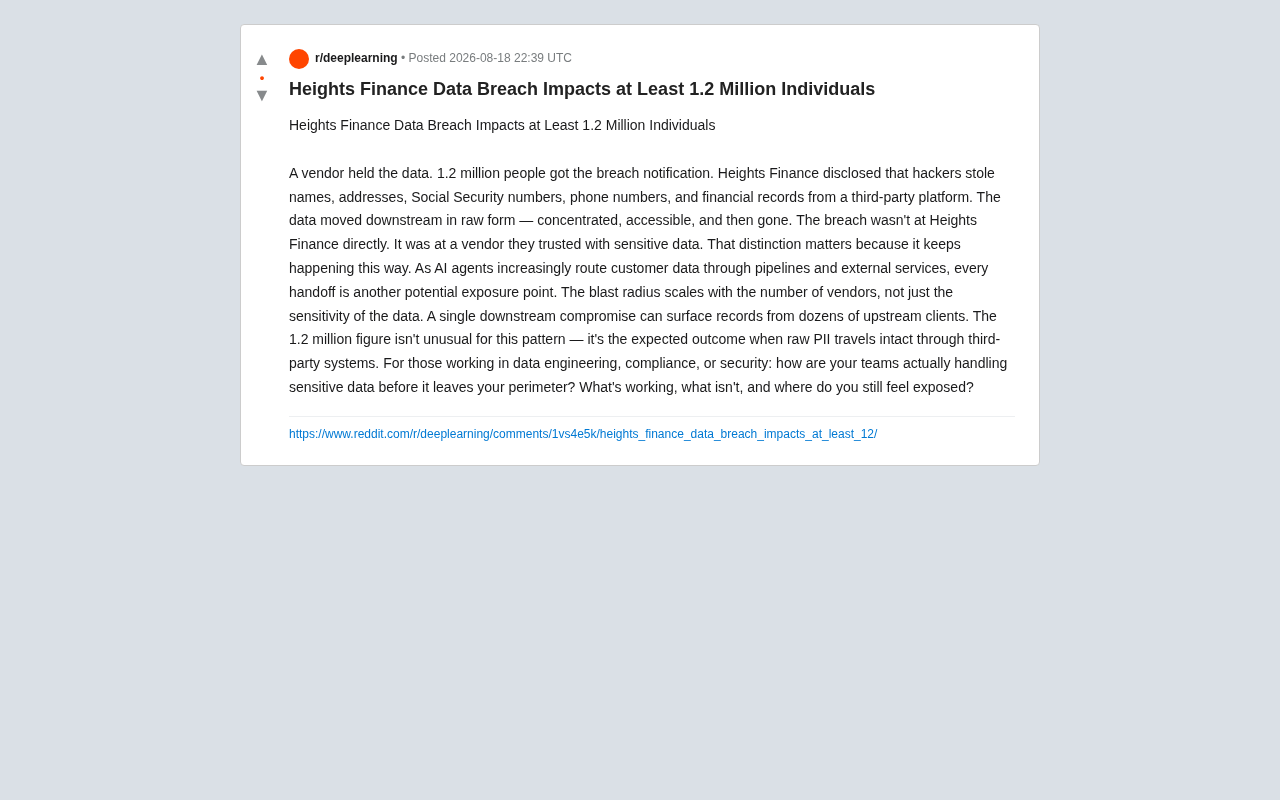
This distinction is crucial because this pattern keeps repeating. Data flows between enterprises in its "raw form"—centralized, accessible, and then compromised in one fell swoop at some point in the chain. When we discuss data security, we tend to focus on core system defenses while overlooking the fact that once data leaves our own "boundary," our control over it drops dramatically.
Blast Radius Scales with the Number of Vendors
This incident reveals a long-underestimated security principle: the blast radius of a data breach depends on the number of vendors, not merely the sensitivity of the data itself.
One Downstream Compromise Impacts Dozens of Upstream Clients
When a third-party platform simultaneously serves multiple clients and holds their data in insufficiently processed raw form, any successful attack on that platform can expose records from dozens of upstream enterprises at once. The figure of 1.2 million isn't abnormal under this model—it's precisely the expected outcome when "raw PII (Personally Identifiable Information) passes through third-party systems in its entirety."
PII (Personally Identifiable Information) refers to any data that can be used alone or in combination with other information to identify a specific individual. Under the U.S. legal framework, SSNs, driver's license numbers, and financial account numbers are classified as highly sensitive PII, and their exposure typically triggers mandatory disclosure requirements under state-level data breach notification laws. When complete highly sensitive PII is stored in plaintext on third-party systems, victims face long-term risks of identity theft and credit fraud once a breach occurs.
Look at it from another angle: enterprises often treat data security as a "point" problem, believing that guarding their own castle is sufficient. But in reality, modern data flows form a network. Every data handoff is a new potential exposure point. The more vendors you trust, the more weak links exist in the chain.
The Double-Edged Sword of Centralized Data
Third-party platforms become high-value targets for attackers precisely because they naturally "centralize" vast amounts of data. For enterprises, centralization means efficiency; for attackers, centralization means excellent ROI. Breach one vendor, and you harvest a treasure trove of data from dozens of clients. This asymmetry has made supply chain attacks one of the fastest-growing threat types in recent years.
The logic of supply chain attacks is particularly direct at the data layer: attackers identify third-party platforms that centrally store data from multiple clients, then concentrate their efforts on breaching that single point. Compared to individually breaching each enterprise's core systems, this "hit one, get ten" strategy is extremely attractive economically. The MITRE ATT&CK framework has listed Supply Chain Compromise as an independent initial access vector, and Gartner predicts that by 2025, 45% of organizations will have experienced supply chain attacks—triple the 2021 figure. Behind this trend is attackers' precise identification and strategic targeting of "data centralization nodes."
The AI Agent Era: Data Handoff Points Are Exploding
If supply chain risks were still relatively manageable in the past, the proliferation of AI technology is dramatically amplifying the problem.
A sharp reality: As AI Agents increasingly route customer data to various data pipelines and external services, every handoff becomes a new potential exposure point.
An AI Agent is an intelligent system capable of autonomously perceiving its environment, formulating plans, and executing actions. Unlike traditional single API calls, AI Agents typically employ frameworks like ReAct (Reasoning + Acting) or Plan-and-Execute, autonomously deciding which tools to call and which data sources to access to complete complex tasks. In a typical enterprise AI Agent architecture, a single task execution may involve data flow paths including: user input → semantic retrieval from vector databases (e.g., Pinecone, Weaviate) → LLM reasoning → external API calls (CRM systems, payment gateways, compliance checking services) → result aggregation and output. Frameworks like LangChain, AutoGen, and CrewAI make this multi-step orchestration extremely convenient, but also mean sensitive data may flow through multiple third-party service endpoints without developers being fully aware.
Automation Makes Data Flow Faster—and More Out of Control
The core value of AI Agents lies in automatically calling tools, accessing external APIs, and chaining multiple services together to complete complex tasks. This means a single piece of customer data might flow through several third-party services within seconds: vector databases, LLM inference endpoints, external knowledge bases, third-party analytics tools...
Every additional link adds another trust assumption and another potentially vulnerable node. Traditionally, manual approvals and process friction somewhat limited the casual flow of data; AI Agents' efficiency precisely eliminates this "friction," allowing data to cross enterprise boundaries at scale and speed without human intervention. The weakest point in security defenses is often not the most sensitive data, but the most easily forgotten automated handoff.
This risk is particularly pronounced in RAG (Retrieval-Augmented Generation) architectures. When enterprises index internal documents and customer records into vector databases to enhance LLM responses, fragments of this data may be sent via prompts to external LLM service providers' servers. Without strict data filtering mechanisms, a seemingly harmless customer service query could expose SSNs, financial records, and other sensitive information to third-party inference services. Even more challenging is that AI Agent decision paths are often opaque—they may dynamically choose to call an external service during execution, a decision that was never subject to human approval.
What Did You Do Before Data Left Your Boundary?
Facing this structural risk, the real question isn't "how to prevent vendors from being breached" (which is largely outside your control), but rather "what did I do before data left my boundary to render it harmless even if leaked?"
Shifting from "Trusting Vendors" to "Minimizing Exposure"
The following practices are becoming the consensus direction for data engineering, compliance, and security teams:
-
Data Masking and Tokenization: Before data leaves your systems, replace sensitive fields like SSNs and financial records with meaningless tokens. Even if a downstream breach occurs, attackers only obtain irreversible gibberish. The core principle of tokenization is replacing sensitive data with a meaningless substitute value while maintaining the mapping between original values and tokens in a secure Token Vault. Unlike encryption, there is no mathematical relationship between the token and the original data, so even if attackers obtain both the token and the encryption algorithm, they cannot reverse-engineer the original data. In the payment industry, the PCI DSS standard already recommends tokenization for protecting cardholder data. Format-Preserving Tokenization can even generate tokens in the same format as the original data, allowing downstream systems to operate normally without modifying their database schemas.
-
Field-Level Minimization: Only pass the minimum dataset required for business operations to vendors, rather than lazily pushing entire tables as-is. "Complete raw PII flowing through" is the core problem—most handoffs don't actually require complete data. For example, a credit assessment service may only need a credit score range rather than a full SSN, and an email marketing platform only needs email addresses rather than complete customer profiles.
-
End-to-End Encryption with Self-Held Keys: Even when using third-party platforms, ensure only you hold the decryption keys while vendors store only ciphertext. This model is commonly called BYOK (Bring Your Own Key) or HYOK (Hold Your Own Key), ensuring that even if the vendor's storage systems are completely compromised, attackers see only indecipherable ciphertext.
-
Continuous Vendor Risk Assessment: Incorporate third-party security posture into ongoing monitoring rather than conducting a one-time review at contract signing. This includes continuously monitoring vendors' security certification status, vulnerability disclosure records, SOC 2 audit reports, and using security rating platforms (such as BitSight, SecurityScorecard) to assess vendors' external attack surfaces in real time.
Three Questions Every Team Should Ask Themselves
Whether you work in data engineering, compliance, or security, these three questions deserve repeated examination:
- How does your team actually handle sensitive data before it leaves your boundary?
- Which measures are effective, and which are merely performative?
- Where do you still feel exposed?
Conclusion: From Perimeter Defense to Data Lifecycle Governance
The Heights Finance breach affecting 1.2 million people is not essentially an isolated technical failure, but yet another confirmation of a systemic pattern: when raw sensitive data flows through third-party systems in complete form, large-scale breaches are only a matter of time.
Data Lifecycle Governance requires enterprises to systematically manage data throughout its entire journey—from creation, storage, use, and sharing to destruction. Both the NIST Privacy Framework and ISO 27701 standards emphasize management requirements across the full data lifecycle. In practice, this means enterprises need to establish data classification and grading systems (determining which data belongs to highly sensitive levels), data flow maps (tracking the complete flow paths of data between internal systems and external vendors), and data minimization principles (collecting and sharing only the minimum data necessary for business operations). The recently emerging Data Security Posture Management (DSPM) tools are designed precisely to address this challenge—they can automatically discover and classify sensitive data across multi-cloud environments while continuously monitoring data flow directions and access patterns.
In an era where AI Agents are pushing data handoffs to unprecedented density and speed, enterprises must abandon the illusion that "security means guarding your own walls." Instead, they must build governance systems centered on the data lifecycle—assuming that every downstream node will eventually be compromised, and ensuring that even when it happens, the leaked data has already lost its value. If blast radius is determined by the number of vendors, then the only way to reduce exposure is to ensure every data handoff carries as little and as harmless information as possible.
Related articles
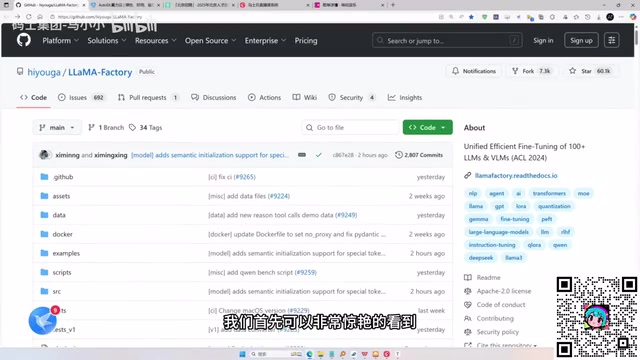
LLaMA-Factory in Practice: A Complete No-Code Guide to Fine-Tuning Large Models
An introduction to LLaMA-Factory, the open-source fine-tuning tool: its 60.1K-star background, supported models and algorithms, local vs. cloud deployment, and CUDA setup steps.

Zeng Ming's Deep Retrospective: Why OpenAI May Not Be the Ultimate Winner — and Why the Corporate System Will Disappear
Zeng Ming's deep retrospective on the AI endgame: model companies are just infrastructure, OpenAI and Anthropic won't be the final winners; the next battle is the Agent entry point standard; the corporate system will disappear as AI restructures collaboration, and only mission-driven companies can survive the cycle.
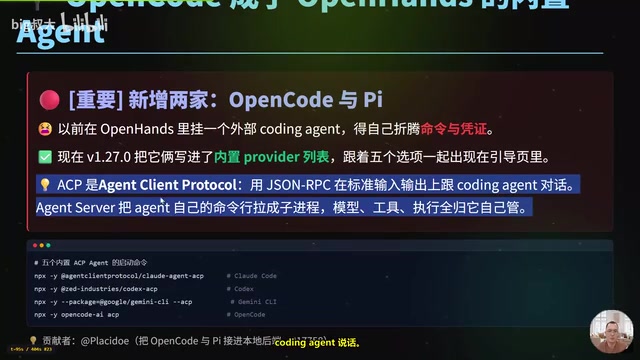
OpenHands v1.28.0: OpenCode and PI Added as Built-in Agents, API Keys Requestable In-Conversation
OpenHands ships 5 releases in 21 days: v1.27.0 adds OpenCode and PI as built-in agents, v1.28.0 enables in-chat key requests. ACP integration, credential reuse, model list changes, and upgrade advice.