Appearance Compensation in Volume Rendering: Why RGB Accuracy Cannot Guarantee Density Correctness

Research proves that volumetric data perfectly reproducing external RGB may still have incorrect internal density fields, since appearance can compensate for density deviations.
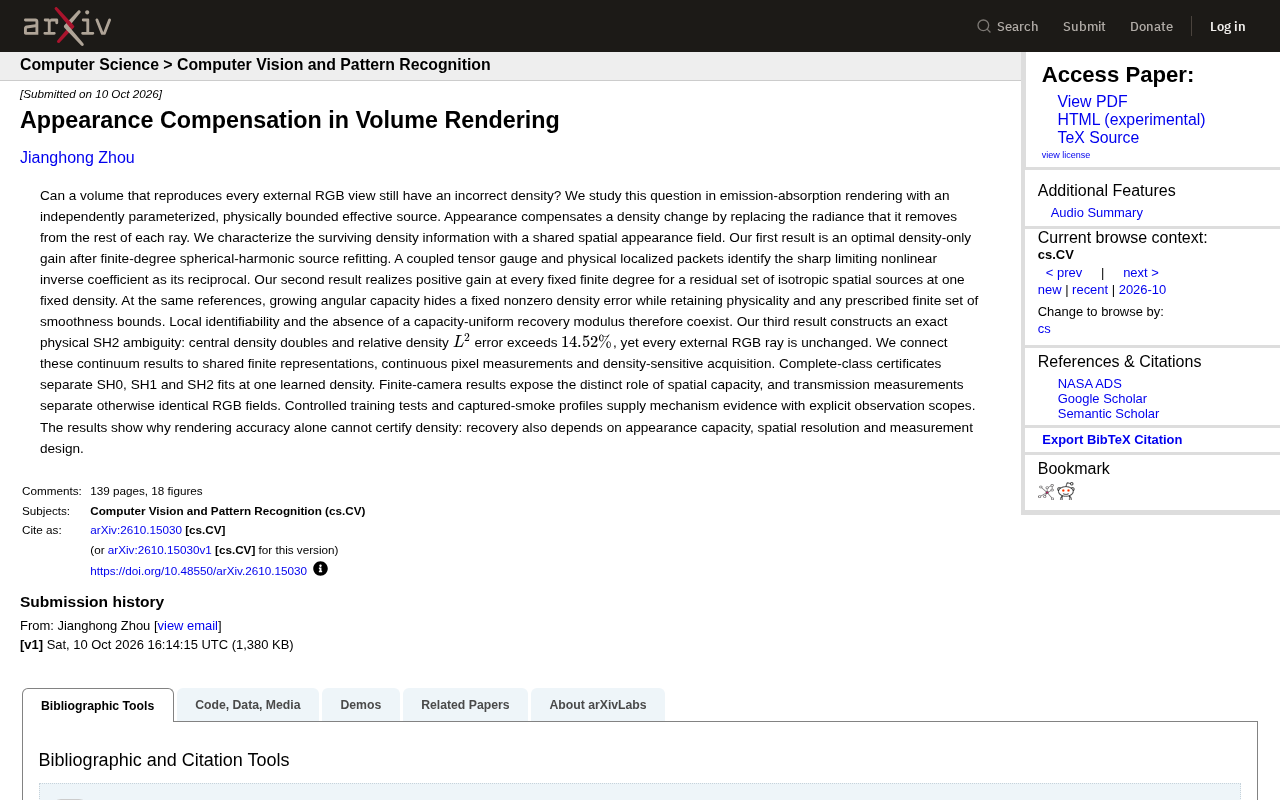
This research addresses identifiability in volume rendering: even if a volume perfectly reproduces RGB images from all external viewpoints, its internal density field may be incorrect. Under the emission-absorption model, the authors introduce a physically bounded effective radiance source, showing that appearance can maintain external observations unchanged when density changes. Three results follow: optimal density gain equals the reciprocal of a nonlinear inverse coefficient; increased angular capacity may hide fixed nonzero density errors; and an exact SH2 ambiguity doubles central density with L2 error above 14.52% while all external RGB rays remain unchanged. The work links continuous theory to finite representations and acquisition design, noting that transmission measurements can separate RGB-indistinguishable fields and that rendering accuracy alone cannot prove density correctness.
Title
Appearance Compensation in Volume Rendering: Why RGB Accuracy Cannot Guarantee Density Correctness
Meta Description
Volume rendering research reveals: volumetric data that perfectly reproduces external RGB views may still contain density errors. Appearance compensation mechanisms can double central density while keeping external rays unchanged even when L2 error exceeds 14.52%, and density recovery depends on appearance capacity, spatial resolution, and measurement design.
Article Content
There is a long-overlooked problem in volume rendering: if a volume can perfectly reproduce the RGB image from every external viewpoint, is its internal density field necessarily correct? A study titled Appearance Compensation in Volume Rendering gives a negative answer, and mathematically characterizes the boundaries of this ambiguity.
The Core Problem: Appearance Can "Compensate" for Density Deviations
In the emission-absorption rendering model, the researchers introduce an independently parameterized, physically bounded effective radiance source. The role of this source is that when density changes, it can maintain the final external observation unchanged by replacing the radiance removed from the rest of the ray. In other words, appearance can compensate for changes in density.
This means that the correctness of rendered images cannot directly prove the correctness of the internal density field. The researchers use a shared spatial appearance field to characterize the density information that still "survives" after density changes—that is, the part that can truly be recovered from external observations.
This perspective extends the identifiability problem of volume rendering beyond mere image-fitting accuracy to the joint constraints of appearance capacity, spatial resolution, and measurement design.
The emission-absorption model is the most fundamental physical model in volume rendering. It describes two processes as light travels through a medium along a viewing ray: the medium emits radiation outward (emission term), while also absorbing radiation from behind and from itself (absorption term). Under this model, the radiance that ultimately reaches the camera can be written as an integral along the ray, with the density field appearing in both the emission and absorption terms. Precisely because density controls both "how much light is emitted" and "how much light is blocked," there exists room for mutual compensation between these two roles: when density is overestimated or underestimated over some interval, its effect on the final pixel can be offset by adjusting the emission intensity in that interval. This coupling is the physical root of why appearance compensation can occur, and it is also why identifiability analysis in volume rendering must start from the emission-absorption equation.
Three Core Results
Result 1: Optimal Density Gain and Nonlinear Inverse Coefficient
Under the appearance compensation framework, the researchers derive the optimal "density-only" gain after finite-order spherical-harmonic source refitting. Through a coupled tensor gauge and physically localized packets, they determine the sharp limiting nonlinear inverse coefficient and prove that its optimal gain is exactly the reciprocal of this coefficient.
This provides a quantitative ruler for understanding density recoverability: how efficiently density information can be "decoded" from appearance depends on the structure of this nonlinear inverse coefficient.
Spherical Harmonics (SH) are an orthogonal family of functions defined on the sphere, commonly used to represent directional distributions. In graphics and neural rendering, environment lighting, anisotropic emission, or view-dependent radiance fields are typically expanded into spherical harmonic coefficients of different orders (SH0, SH1, SH2, ...). The higher the order, the richer the angular detail that can be expressed, and this "angular capacity" corresponds to the appearance expressiveness repeatedly mentioned in the article. Finite-order spherical harmonics mean that the directional distribution is truncated at some resolution, so source refitting must seek the optimal solution within a low-dimensional subspace. Understanding the trade-off between spherical harmonic order and spatial resolution is key to grasping the counterintuitive result that "increased angular capacity instead hides density errors": more directional degrees of freedom are not equivalent to more identifiable density information.
Result 2: Increased Angular Capacity Actually Hides Density Errors
The second result is even more counterintuitive. The researchers prove that for a set of residual isotropic spatial sources at fixed density, positive gain can be achieved at every fixed finite order. But as angular capacity (i.e., spherical harmonic order) continues to increase, a fixed nonzero density error is "hidden"—it is completely absorbed by appearance while the system remains physical and satisfies any prespecified finite set of smoothness constraints.
This means that local identifiability and a "capacity-free consistent recovery modulus" can coexist. Increasing appearance expressiveness does not automatically improve density recovery capability; under certain conditions, it instead masks density errors.
Result 3: Construction of an Exact SH2 Ambiguity
The third result provides an exact physical SH2 ambiguity construction: the central density doubles, the L2 error in relative density exceeds 14.52%, yet every external RGB ray remains unchanged.
This is a very strong counterexample. It shows that even if the central value of the density field changes by 100%, external observers cannot detect any anomaly from RGB images as long as the appearance parameters are adjusted appropriately. For applications that rely on RGB rendering accuracy to validate density reconstruction, this poses a fundamental challenge.
SH2 ambiguity refers to a set of solutions constructed when appearance is represented using only second-order spherical harmonics (SH2), where different density fields combined with different spherical harmonic coefficients produce exactly the same set of external RGB rays. Here "ambiguity" is mathematical non-identifiability: given observations, there exist at least two physically valid internal configurations that cannot be distinguished. In the construction, the central density doubles while the relative L2 error exceeds 14.52%, indicating that the ambiguity magnitude is not negligible but large enough to change structural-level density distribution. The value of this counterexample lies in its exactness (rather than numerical approximation), so it cannot be attributed to insufficient optimization or trapping in a local minimum, but rather to inherent degrees of freedom in the model itself. This constitutes a lower-bound-style difficulty for any volumetric reconstruction method that uses RGB loss as its primary supervision signal.
From Continuous Theory to Finite Representations and Acquisition Design
The researchers further connect these continuous-domain results to shared finite representations, continuous pixel measurements, and density-sensitive acquisition schemes.
Complete-class certificates can distinguish SH0, SH1, and SH2 fits on a learned density. Finite-camera results reveal the unique role of spatial capacity, while transmission measurements can separate RGB fields that would otherwise be completely identical. This means that relying solely on RGB images is insufficient; introducing transmission measurements or other modalities of observation can break the ambiguity.
Controlled training experiments and real-captured smoke profiles provide evidence for these mechanisms, along with explicit statements of the observation scope.
Transmission measurement is a type of imaging relative to reflective RGB observation: it records the attenuation intensity of light after passing through a medium, rather than the scattering or emission from the medium toward the camera. Under the emission-absorption model, transmission is mainly determined by the density integral along the ray and is insensitive to the emission term, so it naturally carries information directly related to density. When two density fields are completely consistent in RGB appearance, their transmission integrals are usually different, and transmission measurements can distinguish them. The article's mention of using transmission measurements to separate "RGB fields that are otherwise completely identical" precisely exploits this sensitivity to density rather than appearance. For neural radiance fields and volumetric reconstruction practice, this implies that jointly acquiring RGB and transmission (or other density-sensitive modalities) data is a viable path to break appearance compensation ambiguity and constrain the density solution space.
Implications for Rendering and Reconstruction Practice
The core message of this research is: rendering accuracy itself cannot prove density correctness. The quality of density recovery depends on three mutually coupled factors—appearance capacity (such as spherical harmonic order), spatial resolution, and measurement design.
For researchers and engineers working on neural radiance fields, volumetric reconstruction, smoke/fluid acquisition, and related areas, this means that when validating density field quality, PSNR or SSIM of RGB rendering cannot be used as the sole criterion. It is necessary to introduce additional density-sensitive measurement methods or impose appropriate regularization constraints on appearance capacity to more reliably constrain the solution space of the density field.
The research also indirectly explains why, in learning-based volumetric representations, the shared finite representation structure and the design of the acquisition scheme need to be considered together rather than optimized separately.
One-line Summary
Research proves that volumetric data perfectly reproducing external RGB may still have incorrect internal density fields, since appearance can compensate for density deviations.
Paragraph Summary
This research addresses the identifiability problem in volume rendering: even if a volume perfectly reproduces RGB images from all external viewpoints, its internal density field may not be correct. Under the emission-absorption model, the authors introduce an independently parameterized, physically bounded effective radiance source and prove that when density changes, appearance can maintain external observations unchanged by replacing the removed radiance, thereby forming "appearance compensation." Based on this framework, the study presents three results: the optimal density gain under finite-order spherical harmonic source refitting equals the reciprocal of the nonlinear inverse coefficient; increased angular capacity may instead hide fixed nonzero density errors; and an exact SH2 ambiguity construction in which central density doubles, L2 error exceeds 14.52%, yet all external RGB rays remain unchanged. The research further connects continuous theory to finite representations and acquisition design, points out that transmission measurements can separate fields indistinguishable by RGB, and emphasizes that rendering accuracy cannot serve as the sole criterion for density correctness.
Related articles

Free Unlimited Claude Code Solution: Agnes AI + CC Switch Setup Guide
No paid subscription needed — pair the free AI platform Agnes AI with the open-source tool CC Switch to provide a backend for Claude Code, enabling unlimited free calls to text, image, and video models. This guide covers the full setup, test results, and usage boundaries.

A Complete Zero-Cost Guide to Getting Started with Claude Code for Beginners in China
A beginner's guide to Claude Code for users in China: two installation methods (command line and IDE plugin), full configuration steps for replacing the official API with the free domestic LongCat model, and a hands-on demo of building a small tool with natural language, plus tips.

When the NSA Gets Involved: The AI Supply Chain Crisis Behind Open-Source CVEs and API Key Hijacking
Multiple open-source projects disclosed severe CVEs in one day, PHP flaws alarmed the FBI, and Railway and OpenCode were breached with API keys stolen. This article breaks down the vulnerability window, AI-accelerated exploitation, and the AI supply chain crisis behind the API key black market, with a developer defense checklist.