Gaussian Process Bandit Optimization: Exploration Strategies and Inference Regret Guarantees

Research introduces inference regret guarantees for GP bandit optimization and proposes a plug-and-play exploration query strategy to improve final recommendation quality.
This study addresses an overlooked evaluation gap in Bayesian optimization: classic cumulative regret measures whole-process performance, but real-world deployment often cares only about how good the final recommended point is—i.e., inference regret. The authors propose a simple, general approach: occasionally replace acquisition queries with exploration queries in any BO pipeline without altering the algorithm's main structure. Theoretically, they bound the GP posterior standard deviation via fill distance to derive inference regret guarantees. Experiments on synthetic benchmarks, hyperparameter optimization, and control tasks show improved final recommendation quality.
Bayesian optimization is widely used in machine learning, hyperparameter tuning, and controller design. Its classic evaluation metric—cumulative regret—measures the algorithm's performance across all evaluation points throughout the optimization process. However, in real-world deployment, we often only care about how good the single point the algorithm ultimately recommends is, not about the intermediate process. This gap in evaluating "final output quality" is especially pronounced in noisy environments.
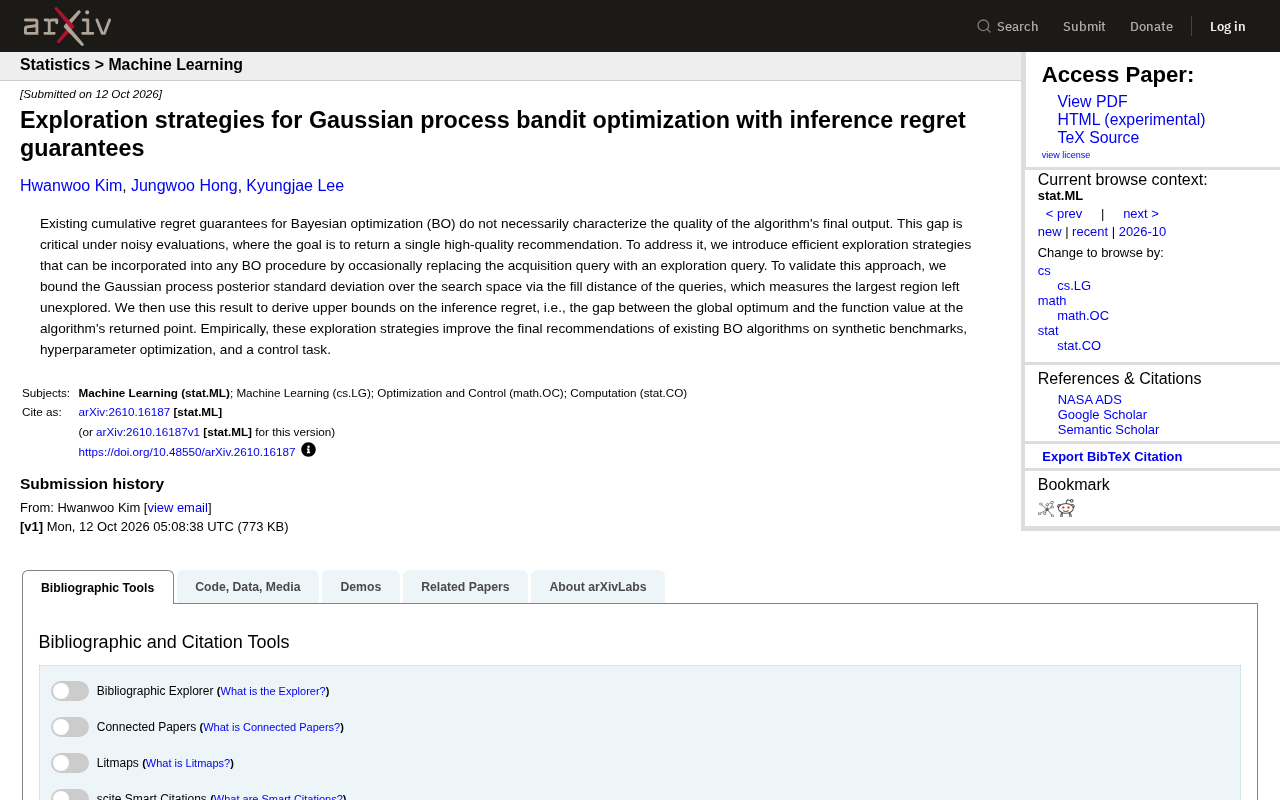
A recent study proposes a new exploration strategy to address this problem, introducing theoretical guarantees for "inference regret" in Gaussian process bandit optimization. According to the research, existing cumulative regret guarantees for Bayesian optimization do not necessarily characterize the quality of the algorithm's final output—which is precisely the core concern of inference regret.
Cumulative Regret vs. Inference Regret: An Overlooked Gap
The standard theoretical framework for Bayesian optimization typically takes cumulative regret as its optimization objective. Cumulative regret measures the accumulated loss from not selecting the optimal solution across all query steps. This metric suits scenarios where a good decision must be made at every step, such as online advertising or recommendation systems.
But when the goal is "finding the single best point within a limited budget," cumulative regret may not be the appropriate measure. One algorithm might perform mediocrely during earlier exploration yet deliver an excellent recommendation at the end; another might perform reasonably well at every step but ultimately recommend a disappointing point. Inference regret is designed for the latter scenario—it directly measures the gap between the global optimum and the function value at the point the algorithm ultimately returns.
The core contribution of this research is that it fills the theoretical gap between cumulative regret theory and final output quality.
The Fundamental Relationship Between Gaussian Processes and Bayesian Optimization: A Gaussian Process (GP) is a non-parametric Bayesian model that treats the objective function as a stochastic process, where the function values at any finite set of points follow a joint Gaussian distribution. A GP is fully characterized by a mean function and a kernel function (covariance function), with the kernel encoding prior knowledge such as the smoothness and scale of the function. In Bayesian optimization, the GP serves as a "surrogate model": each time a point is evaluated, the observed data is used to update beliefs about the objective function via the Bayesian posterior, yielding a posterior mean and posterior standard deviation. The posterior mean represents the current best estimate of the function value, while the posterior standard deviation represents the uncertainty at that point. Based on these two quantities, the algorithm constructs an acquisition function (such as GP-UCB, EI, or Thompson Sampling) to determine the next evaluation point. Understanding this "surrogate model—acquisition function—evaluation—update" loop is a prerequisite for understanding the difference between cumulative regret and inference regret: both regrets are built on this loop, but they evaluate different objects.
Exploration Queries: A Plug-and-Play Improvement
The proposed approach is elegant and general: in any Bayesian optimization pipeline, occasionally replace the acquisition query with an exploration query. This substitution does not alter the main structure of the original algorithm, so it can be seamlessly integrated into existing BO frameworks.
Intuitively, standard Bayesian optimization algorithms (such as GP-UCB or EI) tend to balance "exploitation" and "exploration," but this balance is optimized for cumulative regret. When the objective becomes inference regret, the algorithm needs to more actively cover underexplored regions of the search space to prevent the final recommendation from getting trapped in a local optimum.
The research validates this strategy experimentally: on synthetic benchmarks, hyperparameter optimization tasks, and a control task, introducing the exploration strategy improved the final recommendation quality of existing Bayesian optimization algorithms. This suggests the method has broad applicability, not limited to any particular class of problems.
Acquisition Functions and the Exploration-Exploitation Trade-off: An acquisition function is a scalar function in Bayesian optimization that converts the posterior distribution into a decision about "which point to evaluate next." Common choices include GP-UCB (posterior mean plus a confidence coefficient times the posterior standard deviation, where the coefficient controls exploration intensity), Expected Improvement (EI, which measures the expected magnitude by which a point exceeds the current best value), and Thompson Sampling (sampling a function path from the posterior and taking the optimum along it). The design goal of these acquisition functions is almost always to minimize cumulative regret, so they naturally lean toward "exploitation"—finely searching near regions known to perform well—while exploration only serves subsequent exploitation. When the final evaluation criterion becomes inference regret, this bias may cause the algorithm to converge prematurely to a local optimum. The so-called "exploration query" bypasses the exploitative tendency of the acquisition function and directly selects points that maximize spatial coverage or reduce global uncertainty (for example, the point maximizing the posterior standard deviation), thereby compensating for the shortcomings of acquisition functions optimized for cumulative regret in terms of final output quality.
Theoretical Guarantees: Bounding Posterior Standard Deviation via Fill Distance
The theoretical analysis in this work deserves attention. The researchers bound the upper limit of the Gaussian process posterior standard deviation over the entire search space using the fill distance of the queries. Fill distance measures the largest "unexplored" region in the search space—the smaller the fill distance, the denser the coverage of the search space by query points.
The key significance of this step is that it connects a geometric quantity (fill distance) with the uncertainty of the Gaussian process (posterior standard deviation). With this upper bound, the researchers can further derive an upper bound on inference regret—that is, the gap between the global optimum and the function value at the point the algorithm returns now has a theoretical guarantee.
The value of this analytical approach lies in the fact that it does not simply assume the algorithm can find the global optimum, but provides a quantifiable guarantee—under what conditions inference regret can be controlled within what range. For application scenarios requiring reliability guarantees (such as safety-critical control systems), this theoretical support is particularly important.
Reproducing Kernel Hilbert Space (RKHS) and the GP Assumption Space: In the theoretical analysis of GP bandits, the objective function is typically assumed to belong to the Reproducing Kernel Hilbert Space (RKHS) corresponding to the kernel function, with a bounded norm. This assumption enables researchers to characterize the smoothness of the function using the RKHS norm and derive regret upper bounds. The cumulative regret upper bound of standard GP-UCB is parameterized precisely by the RKHS norm bound and the maximum information gain. The analysis of inference regret requires additionally controlling the posterior standard deviation at "unqueried points," which is where fill distance comes into play: fill distance characterizes the coverage density of the query point set in the search space, while the properties of the kernel function (such as the smoothness parameter of the Matérn kernel) determine how the posterior standard deviation decays with distance. Combining the two allows the maximum posterior standard deviation over the entire search space to be bounded as a function of fill distance, and further allows the upper bound on inference regret to be expressed as an explicit function of the algorithm's runtime, kernel properties, and spatial dimension.
Practical Implications and Limitations
From a practical standpoint, the appeal of this research lies in its "lightweight" nature: it does not require redesigning the algorithm—only inserting exploration queries into the existing pipeline. For teams that have already deployed Bayesian optimization systems, this means that final recommendation quality can be improved with relatively minor modifications.
However, questions such as how frequently to substitute exploration queries and at what stage inserting exploration is most effective may still leave room for discussion in the paper. Additionally, the tightness of the theoretical guarantees and their applicability to non-stationary or high-dimensional problems require further follow-up research to verify.
Overall, this work provides a theoretical characterization and practical improvement scheme for the final output quality of Bayesian optimization, making it especially suitable for application scenarios that focus on "recommending a single point at the end" rather than "performance throughout the process."
One-line Summary
The research introduces inference regret guarantees for Gaussian process bandit optimization and proposes a plug-and-play exploration query strategy to improve final recommendation quality.
Paragraph Summary
This research addresses an overlooked evaluation gap in Bayesian optimization: classic cumulative regret measures whole-process performance, but real-world deployment often cares only about how good the single point the algorithm ultimately returns is—i.e., inference regret. The study points out that existing cumulative regret theoretical guarantees do not necessarily characterize final output quality. To address this, the authors propose an elegant and general approach: in any Bayesian optimization pipeline, occasionally replace the acquisition query with an exploration query, seamlessly integrating without altering the algorithm's main structure. Theoretically, the research uses the fill distance of queries to bound the Gaussian process posterior standard deviation over the search space, thereby deriving theoretical guarantees for inference regret. Experiments on synthetic benchmarks, hyperparameter optimization, and a control task show that introducing the exploration strategy generally improves the final recommendation quality of existing algorithms. This method is especially suitable for application scenarios that focus on "recommending a single point at the end" rather than "performance throughout the process."
Related articles

Bilibili's Hit Dify Tutorial: A Practical Guide to Building 20+ AI Apps from Scratch
A distilled guide to Bilibili's top-rated Dify tutorial: Windows + Docker deployment, MySQL connection, five app types, model integration strategy, and publishing.

Agent Skills Beginner's Guide: From Concepts to Multi-Agent Collaboration in Practice
A comprehensive guide to Agent Skills: core concepts, components, the importance of Description, standardization, beginner learning paths, and multi-agent collaboration.

One Neuron Detects Both Cats and Cars? We Reproduced It and Found a New Explanation
The cat-car neuron reinterpreted: researcher Cammarata argues it distinguishes pointy from round, not cats from cars. We reproduced the experiment and found the new explanation holds on most inputs—but cars are the exception. The interpretability debate continues on language models.